- “change is best experienced by staying in one place” – there is a difference between difference and change
- “A long resting stone is not an object in the landscape but a deeply ingrained witness to time and a focus of energy for its surroundings.” – interesting how a stone/other elements in a landscape can form a record of what has happened there, like coded/encrypted records – link to idea of “deep storage“?
- “Repeating this work makes me more aware of the differences…The day I make a perfect cone will possibly be the last time I make one.”
- “There is enormous freedom in going empty-handed to a place and discovering there the material and the means to work with it.”
- “A concentration of energy is achieved when materials are drawn tightly together.”
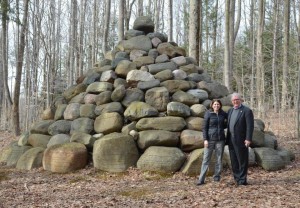
- “One cairn next to a river in Illinois marks the ‘100-year flood’ that happened in 1954, and is built to the height the water then reached. The twelve-foot-high cairn gives a feeling of the weight, power and volume of a river in flood in a way that a marked pole never could. From now on annual high-water levels will be carved into the cairn as horizontal lines. The rhythm and position of these lines will be dictated by the rhythm of the river, and their marking could stretch well beyond my lifetime.” – a joint effort in record keeping by both man and nature – also an interesting combination between an artwork and a scientific measure
- “I have cleaved quarry stones into layers, cut holes into each slab, then reconstructed the stone with the holes aligning, becoming smaller as they deepen…looking into the centre…back in time.” – link to Rachel Sussman’s work looking at the concept of “deep time” explored through ancient living beings (some people consider rocks to be living?)
- I really liked hearing more about Goldsworthy’s process in the “Sand Stone” chapter:
- he goes out every day if possible to make work – “I make a lot of bad work with many failures”
- making such a large quantity of work increases the chances of success, particularly when chance is so often involved in his nature-based work
- learn to embrace events that happen by chance, even if upon first impression it appears as though a work has been ruined (potentially more applicable to work that is more chance/nature-based such as Goldsworthy’s)
- “A good work in a moment of intense clarity, not mystery.”
- “Seeing clearly in a chaotic situation is the means by which an artist becomes a participant and gains control. It is the difference between a ship sinking or sailing in rough seas. I cannot change the force, but I can be witness to it. The intention is not to tame the chaos but to tap its energy.”
- “I strive for a beauty that cannot be explained in words. It is too hard-won to be described by conventional definitions. I am drawn to beauty as a tree is drawn to light or an animal to water. It is nourishment and a reality that does not ignore those qualities that are considered ugly but touches on truth in the nature of things.” – interesting/refreshing to see an artist of Goldsworthy’s stature talking about simply the beauty of art in this way as often this can be shunned over the conceptual merit of an artwork
- great variety in his work from the large flood stones to the more ephemeral red earth splashes
And as it happened to a Dutch Ambassador, who entertaining the King of Siam with the particularities of Holland, which he was inquisitive after, amongst other things told to him, that the water in his country, would sometimes, in cold weather, be so hard, that Men walked upon it, and it would bear an Elephant, if he were there. To which the King replied, “Hitherto I have believed the strange things you have told me, because I look upon you as a sober fair man, but I am now sure you lye”.
John Locke, An Essay Concerning Human Understanding 1689
- in the Arctic are you in a landscape? or is it more of a waterscape because everywhere is made from ice? but it is just as solid/stationary in that moment as rock is, and even land/rock flows at a very slow rate
- heating rock/stone causes it to flow faster, and fired stones will often slowly tear open
- “Looking into a deep hole unnerves me and I am made aware of the potent energies within the earth. The black is that energy made visible.”
- “The black hole is like the flame of a fire. The flame makes the energy of fire visible. The black is the earth’s flame – its energy.”
- “Drawing is not restricted to or defined by pencil and paper; it is related to life, like drawing breath or a tree taking nourishment through its roots to draw with its branches the space in which it grows. A river draws the valley and the salmon the river.”
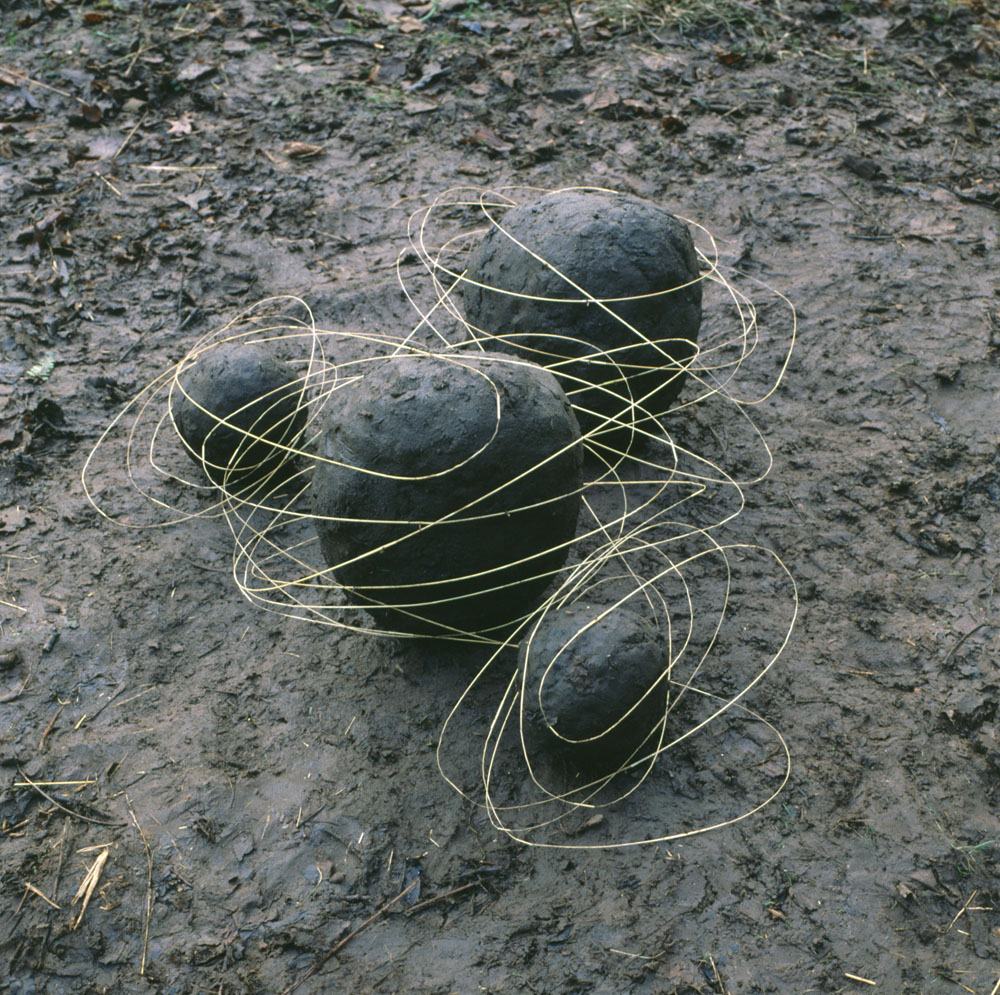
- “A stone charges a place with its presence, with time filling in and flowing around it, just as a sea or river rock affects the surrounding water by creating waves, pools and currents.” – I didn’t really understand what he meant by drawing with grasses/stalks around a rock, wanting to explore the space around it without looking like the lines were binding the rocks, but upon looking at the work I see exactly what he means and I feel it works really well. It’s interesting that the book is relatively old (published 1994) and perhaps now the same effect could well be achieved by simply photoshopping a photo, or even just drawing on a photo would have a similar effect. However, there is something very authentic about how the piece is entirely natural and entirely sculptural – like many of his pieces it doesn’t look as though it is real, yet it is all made from materials that were already in location.
- “There is a shock in seeing a river rock pool turned red by the rubbing of two stones together. If to shock were my sole purpose, then it would not have mattered how the colour had been made. It is important to me that beyond this initial shock is the truth that it is a colour of the river in a landscape stained with a red that becomes more intense as I approach its source.”
- “I can understand why the rock fell. What is more profoundly challenging and disturbing is that until it fell it was as if it never would” – definitely a thought that can be applied to many situations, perhaps the climate crisis being one of them
- “Nature contains so much pent-up energy waiting to be released. Most boulders are either on or resting from a journey. I enjoy visiting stones marked on maps as ‘Hanging’, which appear ready to fall but can remain like this for hundreds of years – balanced between an instant and timelessness.”

- use of photography: “The photograph does not replace but comes out of the working process and can be as much a part of an artist’s vocabulary as recorded sound is of a musician’s.”
- a photograph takes an often ephemeral work and makes it permanent and exhibitable, and can often capture the work from a specific angle or at a specific moment – it is not performance art
- “It is appropriate for me to use a medium that is connected to time. A photograph roots itself in the moment when it was taken and in this respect functions differently to painting or drawing. The photograph is time. (…) Images that show us growing older will be further dated by the patina of a changing technology that will make today’s colours look crude and grainy just as photographs of the past appear to us now.”

 Anna Harris