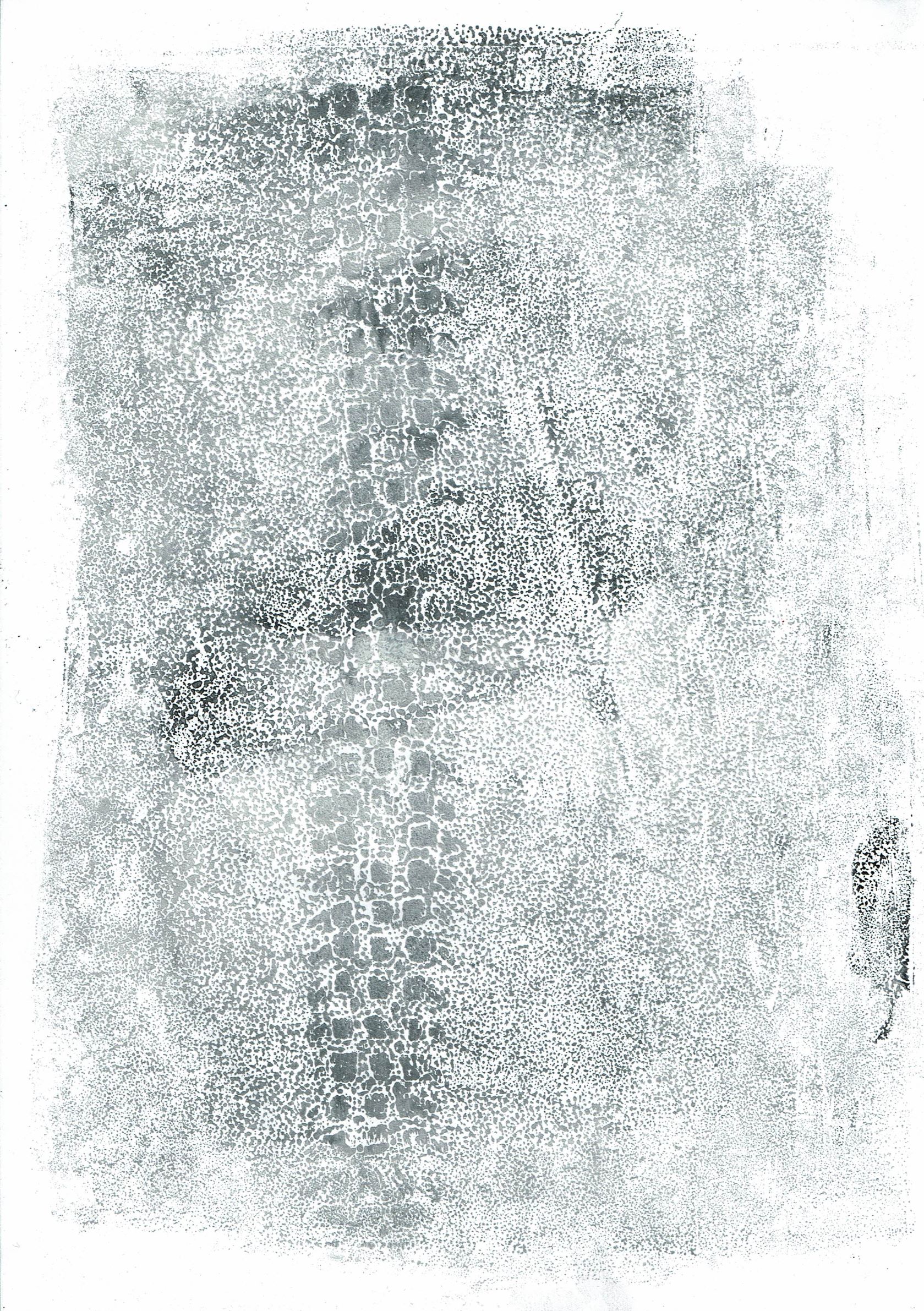
Following on from my aerial sketch of the punchbowl, I created some prints of the same area. By printing it, the image is simplified and perhaps the focus is shifted more towards the composition of the shapes as opposed to their textures and identities as fields. It also alludes slightly to the Great Stone civilisation (as I mentioned at the end of “The History of the Ridgeway”) in terms of the simple (stone-like?) shapes. Someone also mentioned to me that the central area appears almost animal-like, in particular reminiscent of the White Horse (a nearby ancient chalk carving into the side of the Ridgeway), thus creating another potential link to the Ridgeway’s history.


The second print is probably the most successful visually, simply because the first print is a little dark/heavy (too much ink), and the last too light (this was intentionally a ghost print). I feel there is an interesting contrast between the origin of these images – aerial/satellite photography, a very contemporary way of making images – and their two-dimensional nature, which is almost like very early forms of art (from cave paintings through to early Renaissance pieces where perspective wasn’t introduced). It could be interesting to introduce the third-dimension back in through the use of contour lines, which would then bring in a map-like element to the work. Perhaps this could be done by creating a new print that could be layered over these ones?
I also thought that this idea of layering prints could also be used to explore the idea of the layered history of a place. When walking there recently I noticed the layered tracks in the path:

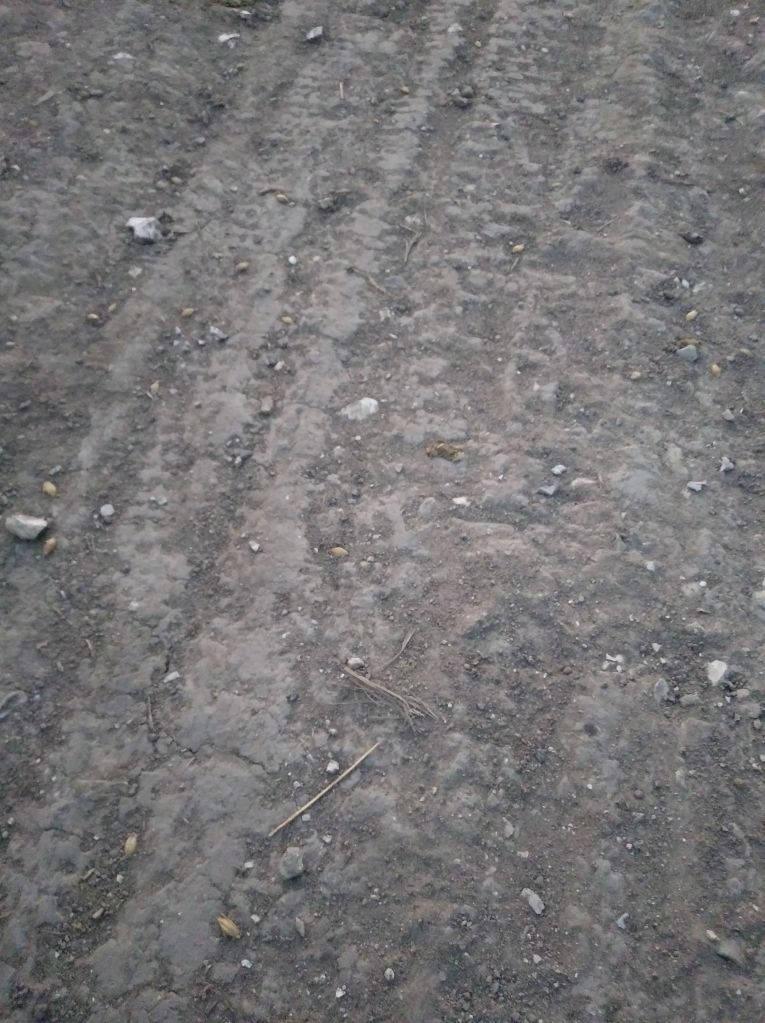
Obviously these prints are all very recent, but the idea could be extended to a wider timespan.
In this particular example, individual tracks can be picked out (e.g. bike tracks, horseshoe prints), so I made a couple of foam boards imprinted with these different images:


These were both just drawn by hand onto the boards, and I feel the bike track is a little more successful due to its continuous, ongoing nature – the horseshoe is a bit stationary. These prints are all pretty much to scale, so to get around this problem I would either have to scale everything down (in which case the bike track would have to be much smaller across the page), or get much larger paper (may be interesting to get a long roll of paper?).
Nonetheless I briefly experimented with layering the two prints:


I found the layering worked better when a darker layer was underneath and then a slightly lighter/more transparent layer placed over the top, so that the darker layer can still be seen. I also liked the ones with slightly more background texture/noise as it is reminiscent of the surface of the ground, and alludes to further potential tracks and patterns that could be hidden within it. Instead of manually trying to replicate this ground texture, instead I took a foam board out and pressed it into the ground so that it replicated the texture. I found the ground had to be fairly deeply rutted in order to leave an imprint; I had tried to get a footprint indented into a foam board previously but found that not enough pressure could be applied to create an identifiable outcome. Maybe if I had a softer, deeper material this would work better?
The print made from the ground texture alone:

And layered with the other tracks:


The ground texture works well with the natural noise of the monoprints to create a path-like surface, and I like how many smaller, indistinguishable patterns are created within the background (which looks like white noise?). All these prints only have a few layers, but it would be interesting to come up with a technique where layers can be continually added, like the path itself, with these individual layers still being in some way visible, rather than just smudging into a grey monotone as would happen with this technique. Perhaps if I were to wait for the ink to dry fully between layers, and if I were to control the difference (in tone) between layers more closely, then more layers could be achieved with this technique. The idea of the layers in some way denoting time links somewhat to the previous aerial prints; whereas I spoke about changing them from two dimensions to three by adding topographic lines, these are raised from three (?) dimensions to four with the addition of the time element.
As I mentioned previously, I had tried to incorporate a footprint by standing on one of the foam boards to create an imprint. This particular method didn’t work, but I did discover that simply standing on the print, while it is face down on the ink, does create a good footprint:
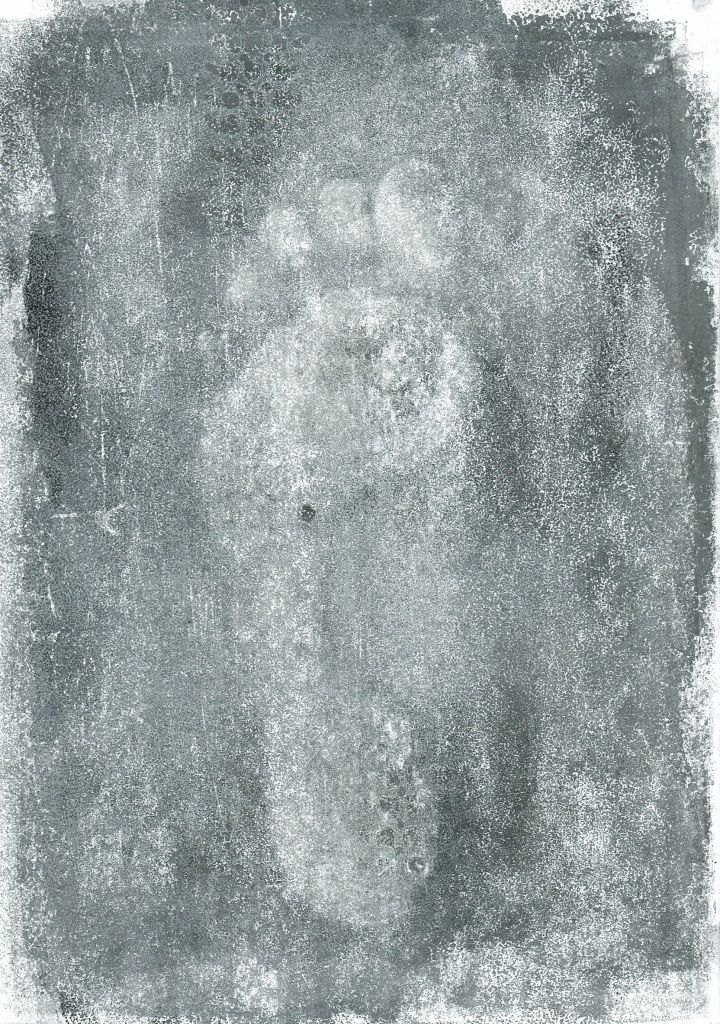


I experimented with both a bare footprint, and in a shoe, which perhaps gives a vague suggestion of old and new. The bare footprint is more closely associated with tracks than the horseshoe/bike print/shoe print, and for this reason has been used more by other artists. Richard Long, in particular, springs to mind when using the bare footprint, so may be a good artist to research were I to pursue this idea further.
As I went about all this printing experimentation, it also occurred to me that print-making itself leaves tracks and traces of the process throughout: the way the ink has been rolled out and mixed is apparent in the end result; bumps and ridges in the surface used to roll the ink out on can be seen; different amounts of ink reflect in different densities of colour; imperfections in the foam board show up in the end result etc. In this way printmaking is a perfect media for exploring this idea of traces left in time.

 Anna Harris