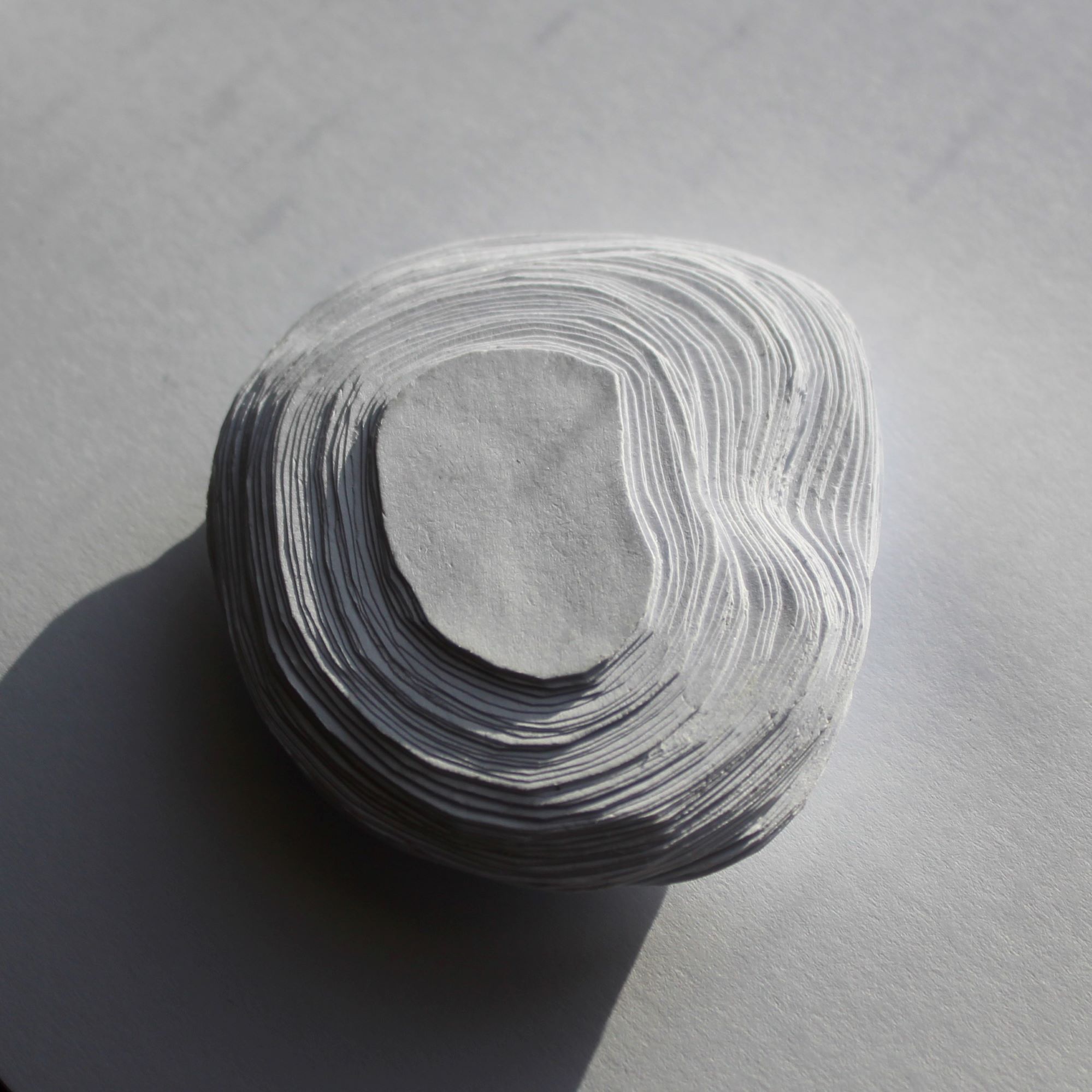
Since the start of term I have primarily been doing a lot of research; this seems to be my default way of working when I’m not sure what to make. I find that a wide range of information gathering – casting a metaphorical net out and seeing what it brings back – is an effective way of sparking/finding inspiration, although it can be a bit unreliable as you will never know ahead of time what you might find, and what you might therefore want to make.
I’ve so far continued with what I was working on over summer: themes of land/landscape, human impact/remains, ideas of time, the past bound up in the natural world, walking, archaeology, environment. I’ve been drawing on my new surroundings, in particular looking at the rock/stone on the beaches and exposed cliff faces. These rocks are an extension of this idea of information being bound up in an object, its past having visually shaped the way it is today. I like the way the visible layers are each representative of thousands of years, with the specific patterns being unique to each one and the processes it has undergone since formation.
As part of my research I visited CSM (Camborne School of Mines) and the Geology section of the library. Whenever I’m looking at a particular topic my instinct is to research it factually, learn about the science behind it, in order to feel like I’ve fully researched and explored my subject matter. I felt if I wanted to centre my work around rocks then I should learn about the different rock types in the local area, the processes they might have gone through to form, how long they have taken to form etc. However, while it was interesting to see some more unusual rock types in the CSM collection, generally speaking I found the content to all be fairly dry and uninspiring. This reminded me of a Tate article I recently read: https://www.tate.org.uk/research/publications/tate-papers/03/thomas-guest-and-paul-nash-in-wiltshire-two-episodes-in-the-artistic-approach-to-british-antiquity in which it considers Paul Nash’s paintings Landscape of the Megaliths and Equivalents for the Megaliths, both of which centre around the ancient stone ring at Avebury. In these paintings Nash has depicted the site, not literally, instead aiming to capture the idea of the place. He wanted to explore his own emotional response to the past rather than “being subservient to archaeological understanding”.
- “Rational enquiry might help explain a long-standing puzzle, but it ran the risk of emptying the monuments of all but the most literal meanings.”
- “Yet it is odd to consider that in my design I, too, have tried to restore the Avenue. The reconstruction is quite unreliable, it is wholly out of scale, the landscape is geographically and agriculturally unsound. The stones seem to be moving rather than to be deep-rooted in the earth. And yet archaeologists have confessed that the picture is a true reconstruction because in it Avebury seems to revive.”

Equivalents for the Megaliths, Paul Nash – Image from https://www.tate.org.uk/art/artworks/nash-equivalents-for-the-megaliths-t01251 
Landscape of the Megaliths, Paul Nash – Image from https://www.albrightknox.org/artworks/rca19486-landscape-megaliths
I find it particularly interesting what he says about “rational enquiry…emptying the monuments of all but the most literal meanings” as this goes against my own tendency of thoroughly researching a subject in order to fully understand it. This does actually make a lot of sense – it is very much the idea of the past bound up in the rocks that I’m looking to capture, it doesn’t matter how accurately I depict them, or how much I know about them. In fact, researching this information may even take away from the mystery of the subject matter; if I wanted to learn about their exact formation and chemical make-up then would that not be a job for some kind of scientist rather than artist? There’s always room for overlap between these two fields, and this overlap is something that I am interested in exploring through my work, but for now it is refreshing for me to entirely reject the idea of factual research that I so often fall back on when this time it is not necessary, perhaps even counter-productive.
I have gathered lots of visual research on the rocks in the surrounding area (see Rocks), both photographs and physical collections. I have created some sketches from these, mainly focussing on the layered, contour-like effect found in many of these, but I wouldn’t say the sketches particularly add anything that isn’t already present in the rocks themselves. I feel it is important to create work from these that carries something additional, otherwise I may as well just exhibit the rocks themselves (which is equally something I could explore – some kind of curatorial approach such as in Otobong Nkanga’s work).
I’ve therefore started experimenting with making my own versions of the rocks – to try and capture the idea of them. So far they have been made out of paper, mainly as it is quite a thin material so creates the delicate layers very well, and creates the idea of a time-consuming process to build up the layers necessary. It’s also easily accessible which makes a big difference when I’m starting a piece – I’m less likely to procrastinate making something if I already have all the materials I need. I perhaps took this almost too literally with the first one I made as I used lined paper as that was all I had to hand.
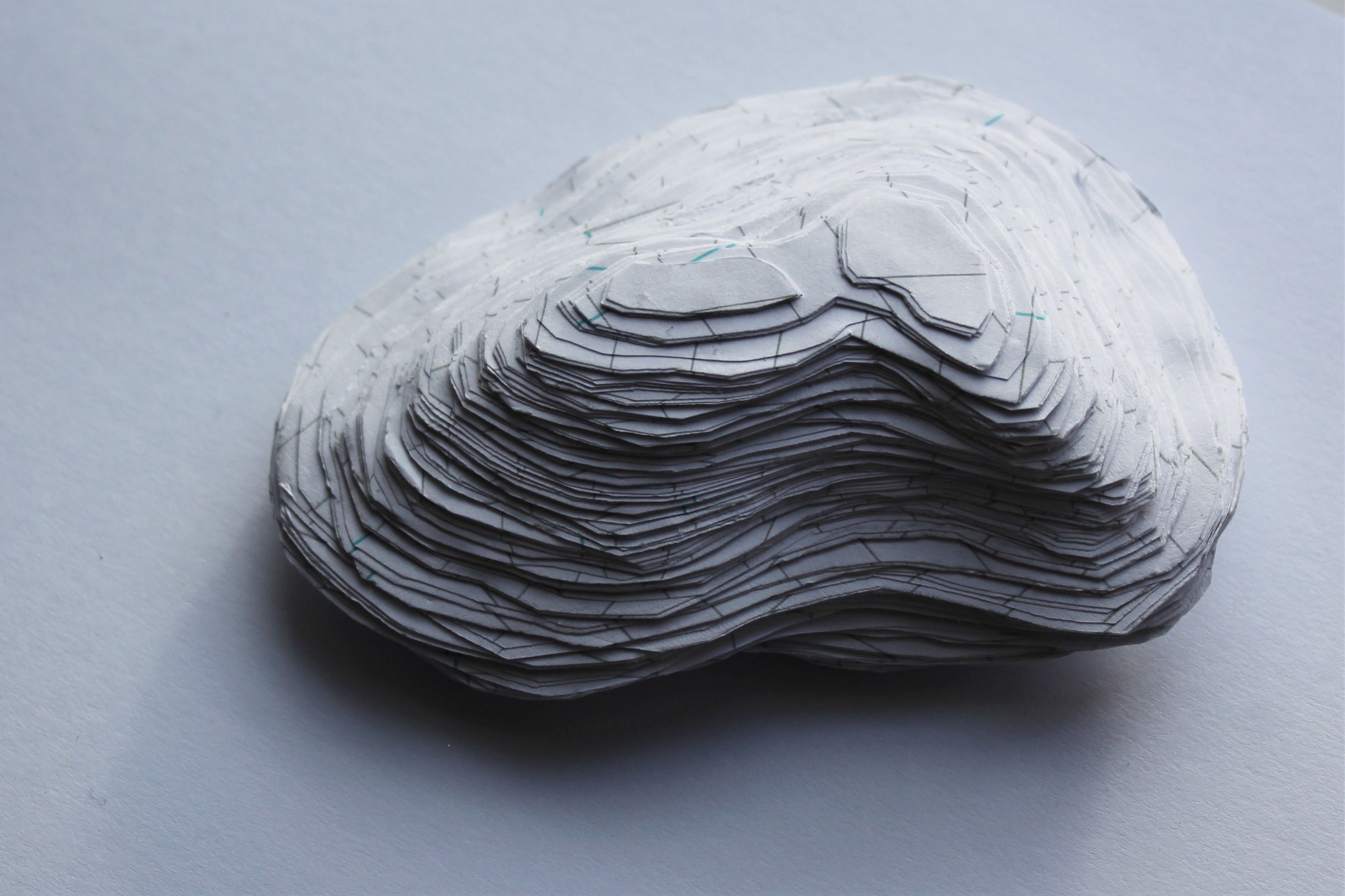
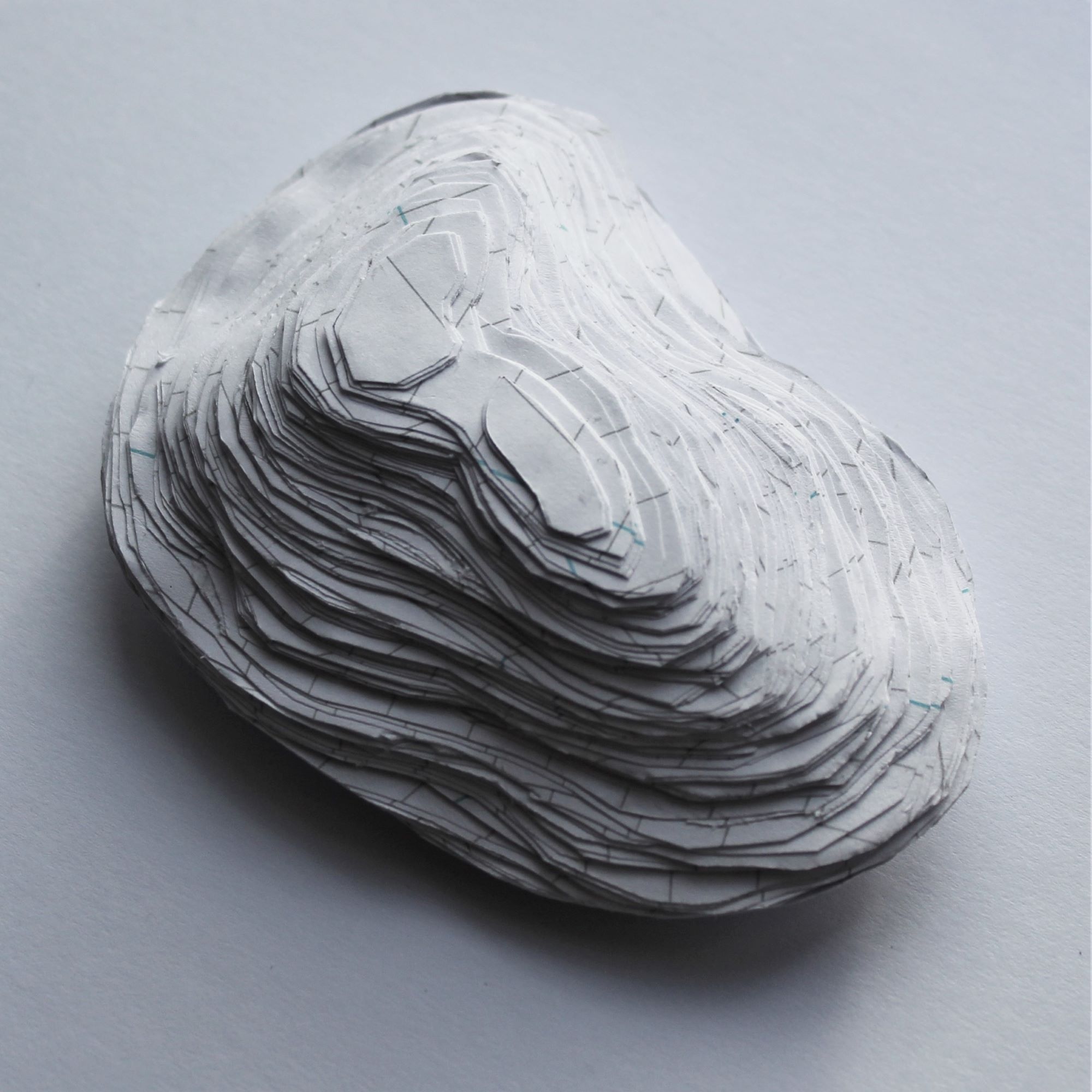
For a rough first attempt this one was fairly successful as it captured the idea of creating a layered object, reminiscent of a rock, with a smooth, contoured shape. As I mentioned, the lined paper probably wasn’t the best idea as it makes it look very informal, and the lines detract from the overall curved shape of the piece. I’m also not particularly happy with the shape; the sides don’t curve as smoothly as I would have liked, and I didn’t explore any difference in gradient of the edges. I did learn a lot from this first one, however, such as, although the building process is fairly refined and controlled, small discrepancies in one layer will be picked up and exaggerated over the large number of layers required. This reminded me of the Surrealists’ method of “outsourcing creative control to their materials”, which is an interesting idea that I’d like to explore further. This idea of the nature of a material changing when used en masse, it taking on a different quality/life of its own, is something explored by the artist Tara Donovan, whose work I have looked at before: https://annaharrisfoundation.wordpress.com/2019/04/11/tutorial-feedback-and-research/.
For my next rock I therefore switched to plain paper, and also tried exploring a different angle of layers:

I started at one end, rather than in the middle as I had with the previous one, which helped the shape form organically. Having the layers vertical rather than horizontal also really affected the way in which it’s shaped; it is less like any physical rock I have found but does this matter? I am trying to evoke the idea of a rock rather than exactly mimic it, and I feel the layers are more evident in this one. I would like to see if I can make one where the layers are neither exactly horizontal or vertical, but perhaps at some kind of slant, perhaps even changing angle throughout the piece.
I also made another one more similar to the first, just more refined/controlled in how I shaped it:


I altered the way in which I cut the new layers for this one: I was cutting them in batches, changing each one incrementally, and I found if I used the last one from each batch, stuck it to the new piece of paper and then cut around that, that I got most control over how precisely the new layer fitted. I controlled the rate at which the edges curved most effectively with this one; if I want it to change quickly then a change was made between each single piece of paper, whereas a slow change used many batches of the same shape.
The objects are satisfying to hold – they’re quite tactile, and just the right size and shape to sit in the palm of a hand – maybe like some kind of religious/superstitious charm. The making process for each one is quite time-consuming, and I like the way this is visually represented: like in a rock, each layer is representative of an abstract unit of time. The time used to create each one is physically bound up in the rock, each one a monument/artefact/souvenir of time.
Going forward I’d like to make more of these, exploring more complex shapes and just generally building up a series of them. I could see them being exhibited quite minimally, open to being handled, and I think a larger collection would work well for this. I could also investigate taking a cross-section, in order to see the layers more explicitly, or perhaps exploring another material. If it were made out of layers of fabric sewn together then the viewer could delve between the layers, leafing through time. Equally I could consider casting them, although with what material I’m not yet sure. Casting it would remove it one step further from its starting point, abstracting it more, like with Jasper John’s “take an object” principle. Equally, I could bring it back closer to the “real world” by basing the shapes off contour lines taken from maps, relating the objects back to the land and the site they came from?

 Anna Harris