I recently saw Antony Gormley’s self-titled exhibition at the RA in London. There were several noticeable themes and points of interest that I noticed throughout, the first being his use of the body. The exhibition leaflet introduces the show as intentionally centering around the body as a ‘vessel for feeling’, the home of the individual but also of shared experience. This became quite literally true in Cave – a vast, geometric construction that completely filled the room, pressing against the walls. Apparently this mass is in the shape of a human figure, lying on its side, but I personally didn’t see this at the time, I imagine partly because I didn’t know to look for this and partly due to the sheer scale of it. While you are able to walk around the outside of this piece, the title Cave refers to the fact that you’re encouraged to walk into it, down a pitch-black narrow corridor which must be felt along, into a gloomy, but slightly lighter and larger, interior space. The piece therefore becomes a physical container for the viewer and, by extension, their emotions, and when walking around the outside you can hear the sounds and reverberations from the inside; it is perhaps the most experiential of all the pieces on display here. While the themes of this piece aren’t directly relevant to my own work, there is some potential room for exploration with the idea of caves as another artist I came across recently, Leo Saul Berk, looks at caves and our ability to ‘imbue [them] with meaning’. Looking at these unfamiliar spaces, naturally carved out of rock, could be an extension to my focus on smaller rocks – the idea of being able to physically enter a space that has been randomly created over thousands of years perhaps takes the concept/experience to a new level.


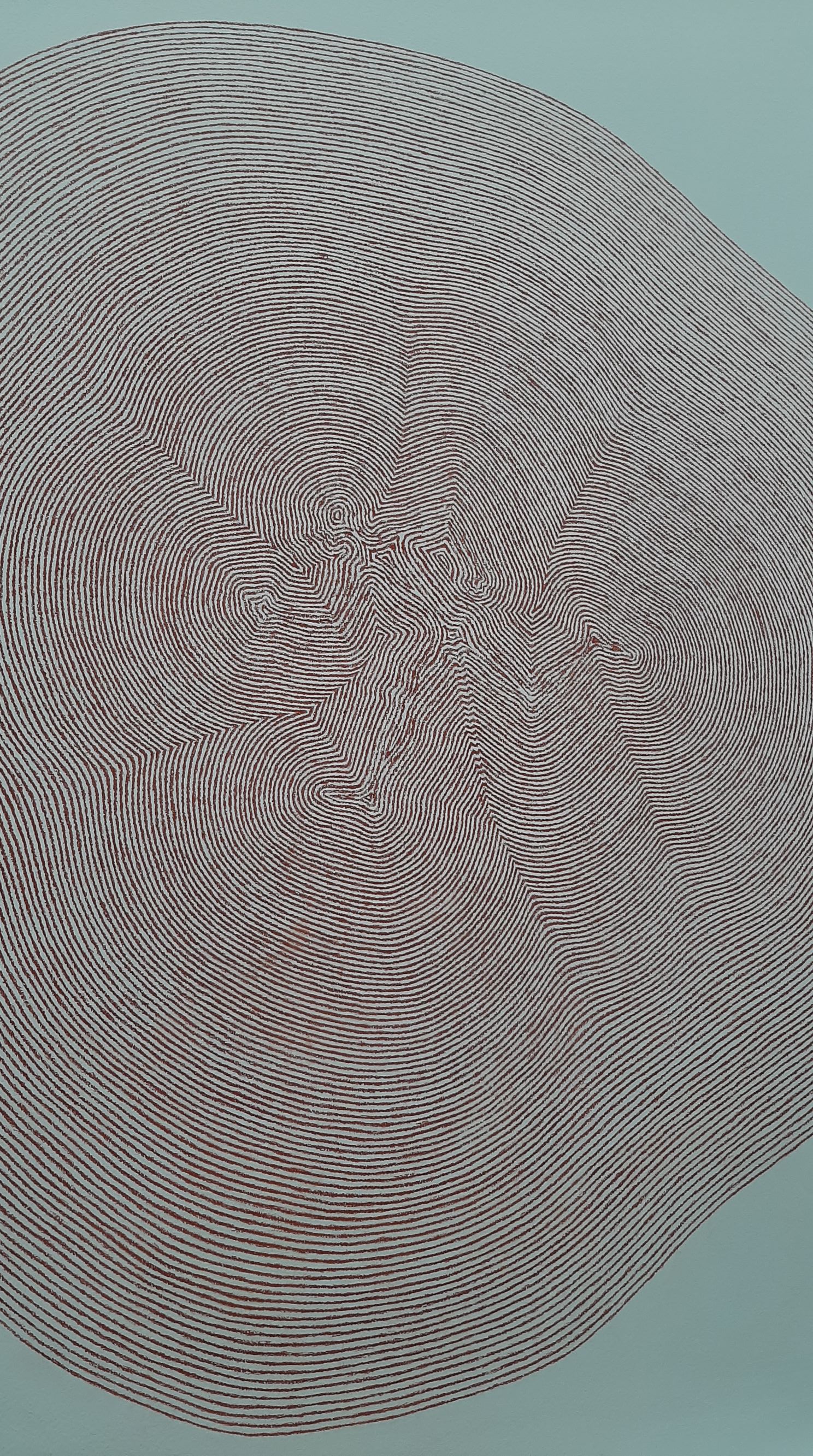
An Exercise Between Blood and Earth also explores ideas of the body, but in a slightly different way to Cave and the physical casting of the body that Gormley employs in many other pieces. This is one of his earlier works (or is a recreation of an earlier work), and is created by the artist standing in one spot and working outwards to the limit of his arm span. It explores the body as an energy field, and is described as being a balance between stillness and motion. Visually, this links quite strongly to my own work (I even referenced this piece before without knowing what it was called/about) – this idea of a unique fingerprint/tree rings/contour lines. The way the lines are stemming out from a specific shape in the middle also links to a piece I’m currently creating, where lines stem out from a particular series of rocks. However in my piece I notice the lines are being cut off by the edge of the paper as I had just planned to continue until the page was full, whereas Gormley has drawn straight onto the wall of the gallery. While I may not necessarily have a wall at my disposal to draw straight onto, I should definitely consider not being limited by the size and shape of the paper in this way: perhaps I could work on larger paper, and not up to the edges, and then cut around the pattern.


Gormley took the idea of the body’s energy field that he explored in An Exercise Between Blood and Earth and moved it to three dimensions with Body and Fruit. It is part of the Expansion series where casts are taken of his body in different positions, and then these are expanded outwards (similar to Fruits of the Earth where objects are wrapped in layers of material until they grow into something unrecognisable). These two particular pieces are expanded foetal positions, and are hung from long steel bars. Upon first glance the pieces hang stationary, but on closer inspection they sway slightly, almost as though in a slight breeze. Whether this swaying is intentional or not it makes you very aware of the presence and weight of the pieces, or is possibly even reminiscent of a slight breathing, as though there is still a living figure within the forms. The steel rods are not attached to the glass domed ceiling above – instead, tiny holes have been made in the glass and the rods are attached to something unseen outside. Again, I’m not sure whether this is intentionally part of the piece or more of a practical necessity, but either way it adds the odd impression that the forms are simply hanging from space: they are not confined to just the exhibition, but are part of the world as a whole.


The casting of the body is a trademark of Gormley’s, and is therefore seen several times throughout the exhibition. Lost Horizon I in particular places 24 iron casts of his body on the floor, walls and ceiling of a room to create a disorientating zero-gravity effect. Each cast, although seemingly identical, was taken at a different moment in time, creating 24 unique sculptures around the room. This idea of incremental changes could be related to my own work in terms of geological movement, and the capturing of this over time. While doing my contour drawings I considered how repeatedly tracing an image leads to minute changes, and the repetitive nature of lots of Gormley’s work (such as here with the similar bodyforms, or in his earlier works such as One Apple) links in well with this idea too.


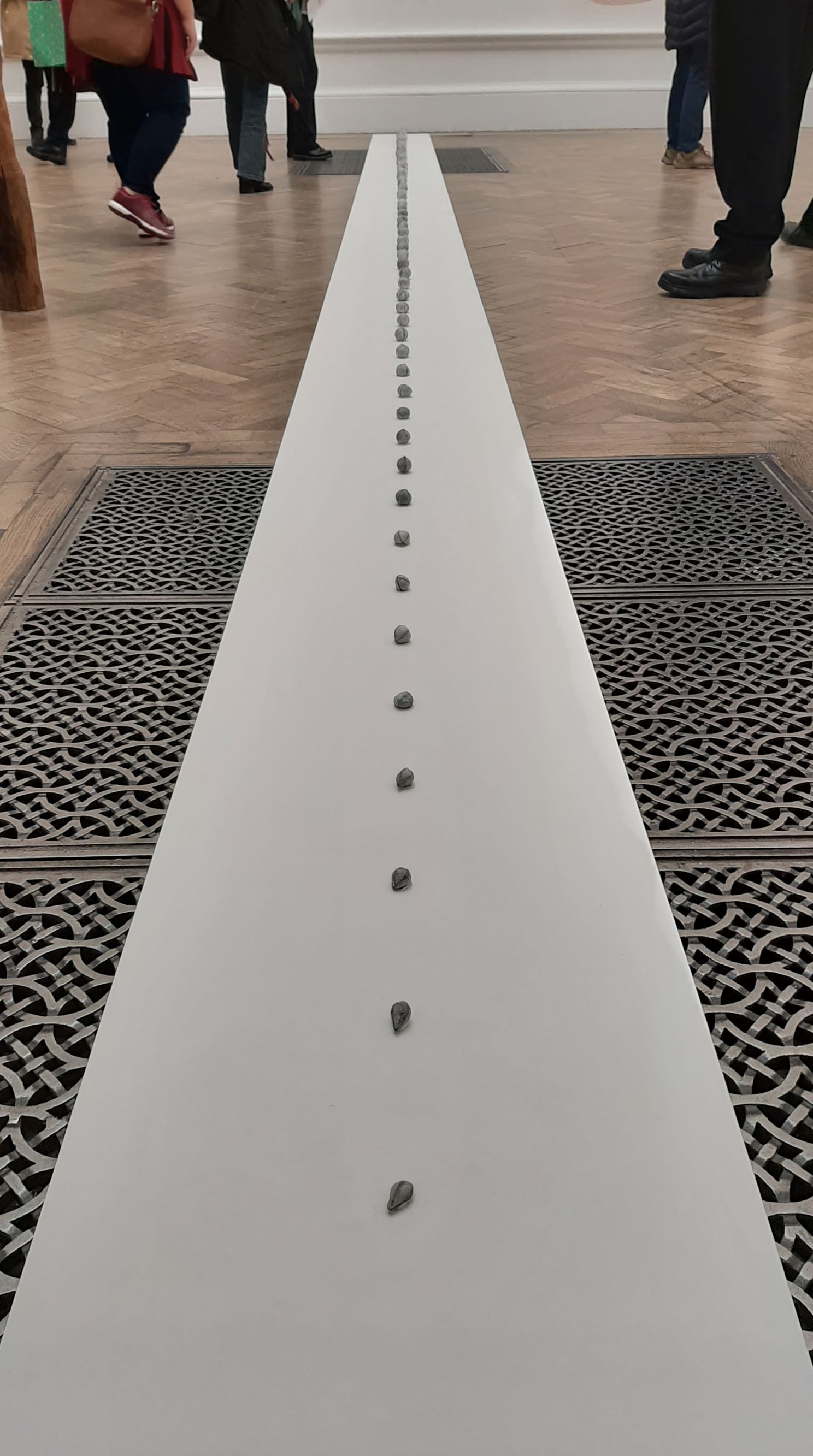
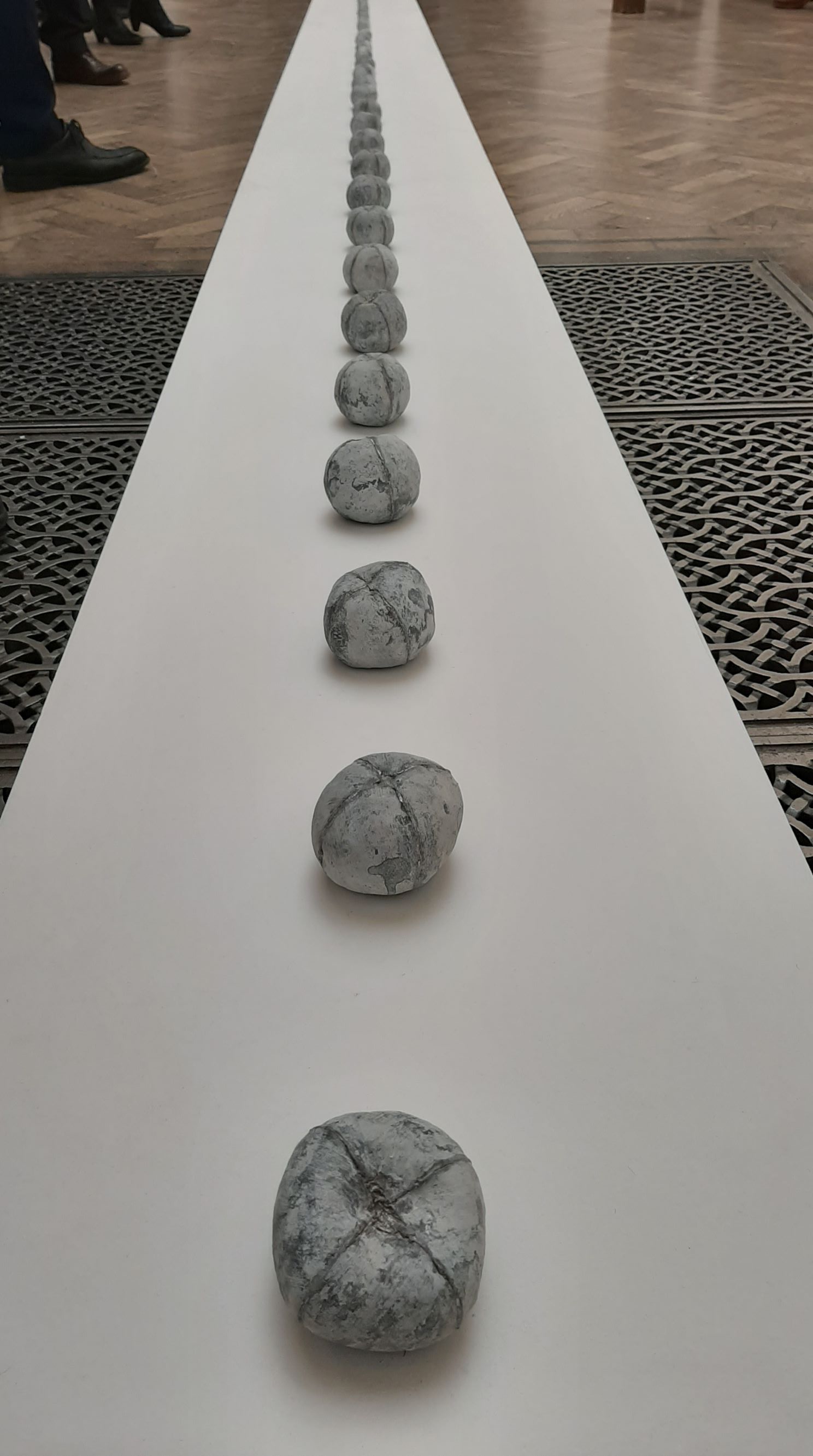
His use of materials throughout is also interesting – near the beginning of the exhibition there is a room that contains a selection of his early works. This room, compared to the rest of the exhibition, has a far greater range of materials, including bread, wax, chalk, wood/section of tree, apples, rubber, lead, blackstone, clay, blanket, water and air. His use of lead in Full Bowl is particularly interesting; it is described as being ‘a response to the idea that humans may well be responsible for their own destruction’. The rest of the exhibition is almost entirely metal (iron I think?), which gives an overall sense of coherency, a visual mode. Perhaps in his earlier works he was still experimenting with different materials, whereas further into his career he has settled on a favourite few? As I mentioned, using casts, particularly of his own body, is something he uses a lot in his work. Casting is a technique that may be interesting to explore in my own work; it has a sense of capturing a moment in time, and could be used to explore rock forms alongside my paper sculptures work. In a recent crit a member of my group had some flowers cast in resin (I believe?). There were areas in the resin where bubbles had formed, and this reminded me of bubbles in glacial ice, pockets of air from thousands of years ago that are slowly being released as the glaciers melt – another possible area of exploration through casting.


In terms of materials, the last exhibit of the show is very different to all the others. Host takes over an entire room by covering the floor with clay, and covering this in a layer of seawater. Interestingly, when I was first looking at the piece I presumed that some kind of cast resin had been used as the stillness of the water almost makes it appear more solid. Viewers are not allowed to touch the exhibit, hence its glassy surface, but this also gives us no way of knowing/testing out the material for ourself. I am aware this is standard protocol in exhibitions but I’ve often thought this raises questions of trust in the artist/establishment; they could very easily make a sculpture out of one material and then label it as another, as no viewer is in a position to check?!


Host is also typical of the quiet, contained energy that many of Gormley’s works possess. None of them are loud or vibrant, yet they all draw you in, be that how they change as you move round them, or how they activate the space in subtle and minimal ways. Clearing VII is a perfect example of this engagement with the viewer in exploring a space; aluminium tubing is literally scribbled through the air, causing the viewer to have to find their own path through it. It seems almost a visualisation of the space-time continuum, or some kind of energy lines in the room – indeed, the accompanying notes suggest that the lines could be interpreted as electron paths or a child’s scribbles. The piece plays with scale, and is left open to the interpretation of the viewer.


As the Clearing VII is moved through, perspective causes lines to move past one another, as though the piece were constantly shifting – an effect that appears in Subject II and Matrix III as well. This makes the viewer more aware of their presence and movement through the space, something that Co-ordinate VI also achieves, although through a much more minimal use of material. Like Clearing VII, (and Lost Horizon I to an extent? creating a sort of zero-gravity field) Co-ordinate VI is an almost scientific break-down of the space, this time into x,y and z axes. Unlike most of the other exhibits, it is not confined to the one room, instead reaching from his early works to through to Lost Horizon I. Along with a similar aesthetic created through the use of similar materials, this adds more continuity to the exhibition: something I should consider with my own body of work? To what extent should my work visually fit together? And can I enhance this through its presentation?


Co-ordinate VI also shares qualities with Iron Baby, a piece outside in the courtyard of the RA that you might see on the way in or out of the exhibition. A tiny figure of a baby is laid down on the ground, an iron cast of the artist’s six-day-old daughter. Like Co-ordinates VI it physically takes up very little space, but still exerts a surprising energy, engaging the space around it and drawing the viewer in. Iron Baby is made out of the same material as the core of the Earth – this use of material leads us to the artist’s goal of ‘[making] us aware of our precarious position in relation to our planetary future’. (interesting link to this article, and the idea of sustainability in art)

Another theme throughout the exhibition is the idea of a sculpture containing something at its core, be that a physical object or simply an empty space. This was present in his work from the early pieces right through to the ones made specifically for this exhibition; Fruits of the Earth and Land, Sea and Air I were both early works where he has wrapped objects until they become almost unrecognisable. These works both developed from the threat of the Cold War, which explains the use of lead as the insulator, as it can protect against radiation. Fruits of the Earth wraps a loaded gun, a machete and a bottle of wine until they become softened, organic forms, although it is still possible to identify which is which. The almost identical organic forms in Land, Sea and Air I contain a stone, water, and air: the three basic elements for life, protected against nuclear destruction. These early works have obvious links to the pieces in this exhibition such as Body and Fruit, Concrete Works (these contain the inverse impression of a body, visible only at the edges where hands/feet pass through), Cave and Matrix III, which all have a contained space at their centre. Other than perhaps Matrix III, where we can slightly make out the void at the centre, these spaces are left entirely to our imaginations, based only on what we’re told is at their centre. This is an interesting idea that again could link quite well to my own work; the possibility that these contained shapes might not see the light of day again for potentially many years, existing as a trapped moment of time, has obvious parallels with the exploration of rock layers and the past that they store. This links to Peter Randall-Page’s work too, particularly the Hundred Year Stone where a boulder was simply taken from the location and cut in half, to expose what had for so long been hidden inside.


The idea of wrapping objects links to a previous project I did on Foundation where I played around with wrapping plants as a way of exploring man’s interaction with nature. This was something I very briefly explored through this short project, but also has potential to be brought back and used again now, as I mentioned above. I was also reminded of other themes I explored last year, such as the accumulative and repetitive visual nature of Lost Horizon I and Matrix III, or the exploration of growth and expansion in Body and Fruit (among others); these were all interesting themes that I have perhaps moved on from for the moment, but I would still say I’m working in the same area of environment/land/embedded information/accumulation/man’s impact etc so these are all ideas to bear in mind for the future.
Gormley has also opted to have two rooms of primarily drawings (these rooms being entitled Drawings I and Drawings II), one of which contained four large display cases of his ‘workbooks’ from over his career. These books contain many quick studies, some of which can be seen to have been developed further into sculptures, and some of which are perhaps future sculptures in the making. These ‘behind the scenes’ are a fascinating insight into how an artist as successful as Gormley works, and they highlight to me that at times it is almost a case of quantity over quality; it can be easy to get bogged down in wanting to make ‘good’ art, rather than just getting down onto paper whatever idea may be in your head, and then using this as a visual springboard onto further work.


His drawings are less linked to specific sculptures and more stand-alone pieces, although still with obvious thematic links to the pieces around them, perhaps a way of experimenting with an idea on a smaller scale. Like An Exercise Between Blood and Earth, some of them use the physicality of the body, using the arm at full stretch or the full height of the body. The second room of drawings in particular link with his early works through their use of natural materials such as untreated red earth, blood and clay. The drawings explore the interior of the body, a running theme in the exhibition, although perhaps here in a more literal/scientific sense than the rest of the exhibition. An example of this is Cells (another link back to some of my work from last year), which again continues the theme mentioned earlier of visual repetition as well. These drawings are an interesting choice for the last room in the exhibition; it rounds off the show not with a characteristic metal cast or large sculpture, but instead with a dim room filled with natural materials, and accompanied by the smell and humidity of the ‘primordial soup’ of Host in the adjacent room.


 Anna Harris