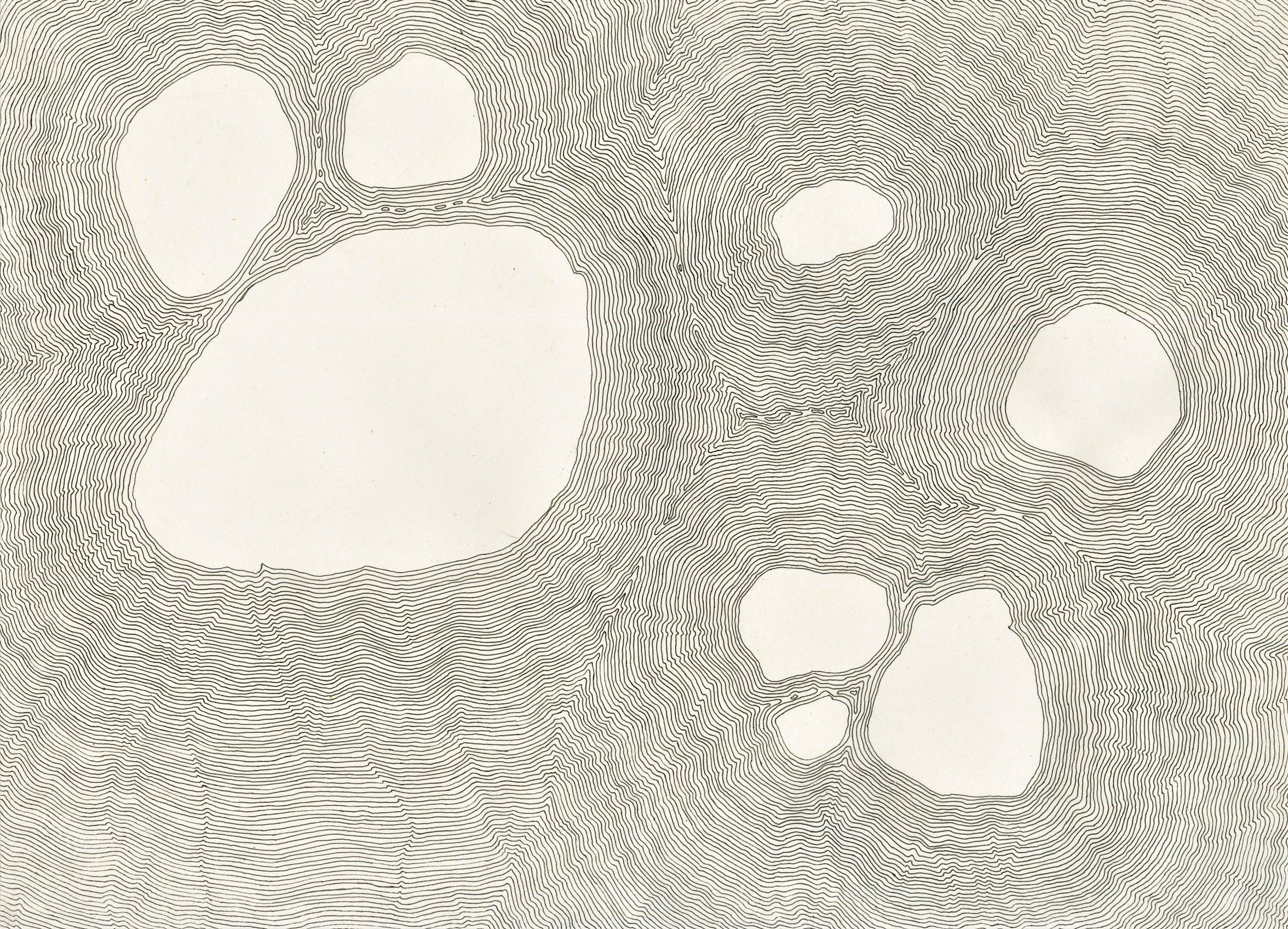
My most recent development has been directly inspired by Gormley’s An Exercise Between Blood and Earth. For a while I have been looking at pieces similar to this, such as Penone’s fingerprint work, so it felt only suitable for it to manifest itself physically into my work. Rather than a human figure at the centre, however, I have the outlines of several rocks. The piece can be displayed either as the standalone drawing, or horizontally, with the rocks placed in the appropriate spaces.


I started by literally just placing the rocks on the page, fairly randomly, and drawing around them, creating this series of lines that are reminiscent of tree rings, contour lines or fingerprints. I feel the lines really explore the space between the rocks, especially when presented without the rocks present, as just blank spaces. There is a visual link to Jim Lambie’s work here, in terms of the use of line to explore a space, but I’m not sure that conceptually there is much that can be taken from his work into mine. This piece also reminds me of Andy Goldsworthy’s Grass Stalk Line and Mud Covered Rocks, of which he says:
Drawing at its most essential is an exploring line alert to changes of rhythm and feelings of surface and space, playing from one to the other with the aesthetic rooted in movement. A stone charges a place with its presence, with time filling in and flowing around it, just as a sea or river rock affects the surrounding water by creating waves, pools and currents. Drawing touches, works, explores and makes visible the relationship between rock and place. […] The line must have its focus deep inside the stone. By working on its outside, I have become more aware of its internal space.
‘Stone’, Andy Goldsworthy (page 82-83)


Zobop, Jim Lambie – Image from https://www.ratholegallery.com/exhibitions/2015/01Lambie/release-en.htm

Considering that this piece explores the space between the rocks, it would be better to have used the positioning of the rocks as I found them to play with the idea of chance/random variation in the natural world/capturing a moment in time. Perhaps in a future piece, as well as taking this into account, I could also work onto a larger surface so that the shape can be left whole, with rounded edges, without being cut off by the edge of the page. Using a continuous line, instead of concentric circles, could bring a new aspect to the work, or I could take it into three dimensions; this would allow me to start considering the enclosing and containing of an object that I was starting to consider from Gormley’s exhibition.
I feel this piece is also somewhat process-led, in that the slow, repetitive process is in itself reflective of ideas that the piece explores. Its time-consuming nature, like with the paper sculptures, means that there is an element of time bound up in its creation, accumulating with each line that is added. This accumulation of the lines, too, was interesting to observe; they spread out, like ripples, from the inner rocks, growing outwards to the edge of the paper. To me, this is reminiscent of the idea of growth that I looked at in some of my previous work, both in terms of the growth of bacteria, the growth of civilisation over a landscape, and growth in an abstract, uncontextualized form. I could capture this in a time-lapse/stop-motion form, scanning in an image after every additional ring and stringing these together, which could perhaps go on to form the basis of a time-based piece.
The variation from line to line was also interesting; over the course of many lines there was a slightly unpredictable effect regarding whether small imperfections were smoothed over, moved or exaggerated. In many ways this reminds me of unpredictable natural processes such as erosion, which in turn links back to Randall-Page’s work and the idea of natural pattern formation vs random variation.
Images of the process/different variations of compositional ideas etc:


Alongside this drawn piece I have also been creating another paper sculpture, this one based off tree rings. Although technically not directly related to one another, their processes share this idea of accumulation/growth/expansion. I could potentially create a similar form of time-lapse/stop-motion as I suggested earlier with this, which would emulate the growth of the tree itself.
Unlike the rock sculptures, I’m not sure in what ways I could add variation to the pieces made in this way. I could consider introducing new materials which would then perhaps form different thicknesses in different rings, or take inspiration from Nash Gill’s woodcuts and aim for more sculptural forms rather than a standard, regimented circular piece. I could also play around with pattern here: scanning in the flat surface allows me to isolate and flatten the piece, or I could even try printing with the flat surface. However, I’m not sure this would advance the piece much conceptually, it would be more of a purely aesthetic exploration.


scanned image 
scanned image

 Anna Harris