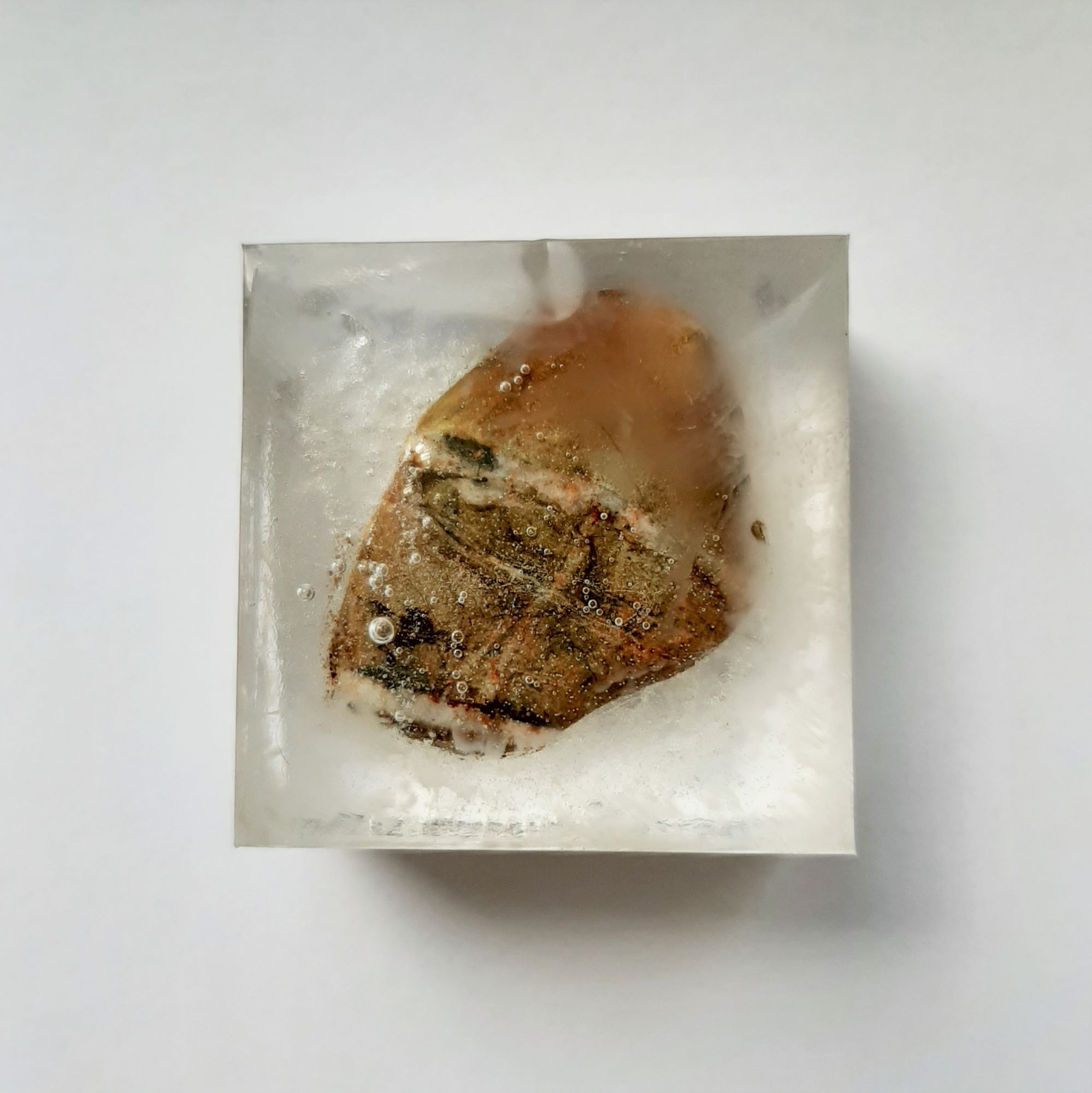
Off the back of ideas in Gormley’s work about containment, and considering what’s inside in Randall-Page’s Hundred Year Stone, I have started briefly experimenting with some casting; something I mentioned would be an interesting route to pursue in my self evaluation. I’ve tried two different approaches: casting a rock in resin and leaving this embedded, and making a mould from clay and plaster to create an exact replica.
I have made three resin pieces so far: one just clear resin and bubbles, and two containing rocks.

1 
1 
1 
2 
2 
2 


The first one I made (labelled 1 above) was not the most technically perfect as there is significant clouding underneath the rock so it does not look to be suspended within the block. I analysed why this might have happened in my journal, but aesthetically it does remind me of Gormley’s Host as it looks be sat upon some kind of seabed. Leading on from this idea I could perhaps introduce sediment (such as sand, dust, soil etc) to build on this, or just play around with layers.

The bubbles on the first one quite heavily obscure the rock inside which, although accidental, does work well in suggesting this idea that something is hidden within. As I mentioned previously, the larger bubbles that can form in resin remind me of pockets of air that become trapped in glacial ice; small samples of an atmosphere from thousands of years ago. These are slowly being released as glaciers melt, so there is potential here for an exploration of an environmental link.

The resin itself is in fact not great for the environment as it is plastic-based, so this is something that I feel is important to consider before making vast quantities of work with it. However, this is something I could use to my advantage to further explore this environmental link; I could make a mould and make physical copies of the rocks out of plastic, then exhibit these alongside the real rocks as a way of contrasting the two. Or instead of embedding the rocks in these boxes of resin I could instead add a thinner, more exact coating of resin; this would use less but would still have a similar effect.
The second piece (labelled number 2) was technically a lot more successful, although the bubbles remained an issue. I did explore the bubbles in a separate piece, and although I didn’t manage to capture any of the large, glacial-type bubbles, I do enjoy the visual repetition and accumulation of them. It reminds me somewhat of the surface of water, and could perhaps be used as a screen to view objects through as it has an interesting balance between obscurity and transparency. There are some larger bubbles in the second piece, which look as though they are coming from the rock, almost as though it were a living, breathing organism that has become trapped. There are also some cloudy patches on the sides but these actually focus the attention on the rock I feel so they aren’t entirely bad. Nonetheless I would like to create at least one more in a similar vein to see if I can iron out a few more of these technical issues.
As well as these resin pieces, I also created a plaster cast of another rock, with the aim of creating an exact replica. Again, the technical details of how it was created can be found in my journal, but it was roughly made with a clay mould and then plaster poured in. I used plaster so that it could be painted afterwards, but after seeing it fresh from the mould I was slightly tempted to leave it unpainted; where bits of clay had remained on the white surface it made a very natural, organic texture that nicely emulated that of the original rock, and the white surface also visually links well with my previous paper rocks.


Vija Celmin’s To Fix the Image in Memory may have been on my mind when I decided to do an exact copy as it is a piece I have looked at previously. When I first saw this piece I didn’t realise that copies had been made, I thought that identical rocks had been found and exhibited as found objects. Whether this was the artist’s intention or not, it does raise interesting questions about the uniqueness of the rocks, and chance in nature more widely. Could this ever actually happen? The piece certainly raises questions about looking carefully at objects, the ‘idea of concentrated looking/a long relationship with a piece of nature’ (https://www.moma.org/audio/playlist/17/90 and https://www.moma.org/collection/works/100210). It also plays with the idea of trust in the artist/trust in your own eyes/visual deception (which I again talked about when considering Gormley’s work), and there are strong links to the idea of historical doubling in art which the Surrealists in particular used a lot (https://www.jstor.org/stable/43308220?seq=1).

Practically speaking this was quite challenging visually as I was aiming to exactly replicate the rock that would be sat alongside the replica. I’m generally quite happy with the result but overall the tone of the replica rock is much cooler than that of the real one. I saw this happening throughout which is odd as I was using no blue whatsoever, and I mixed in an increasing amount of yellows to try and create a warmer base grey. I’m not sure if perhaps it kept drying to a slightly different tone, or if the plaster itself was in some way affecting it, but nonetheless overall the general effect is successful. I found that sponging/dry brushing on different tones and colours was the most effective way of recreating the surface texture of the rock, and that moving both simultaneously between different lightings was helpful in ensuring they were as closely matched as possible.


Going forwards it would be interesting to consider if and how these two methods could work together: casting a rock out of resin, casting one rock inside another, making believable rocks out of different materials etc.

 Anna Harris