‘Olafur Eliasson: In Real Life’ is a collection of works from throughout Eliasson’s 40 year career. There is a broad range of works shown in the exhibition, spanning both subject matter and media. The subject matter can be grouped broadly into three themes: nature (often inspired by experiences in Iceland), geometry and ‘how we perceive, feel about and shape the world around us’.
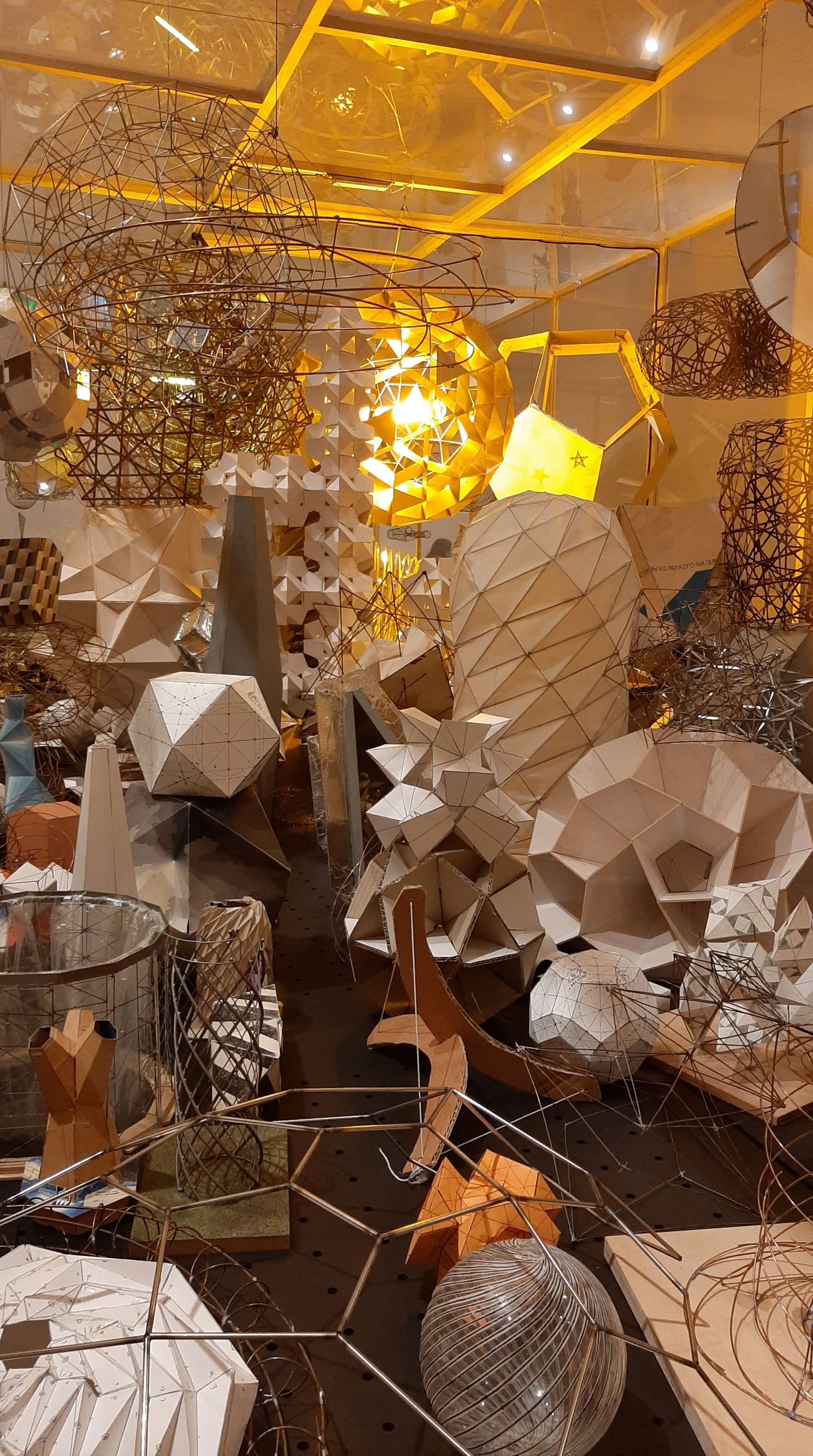
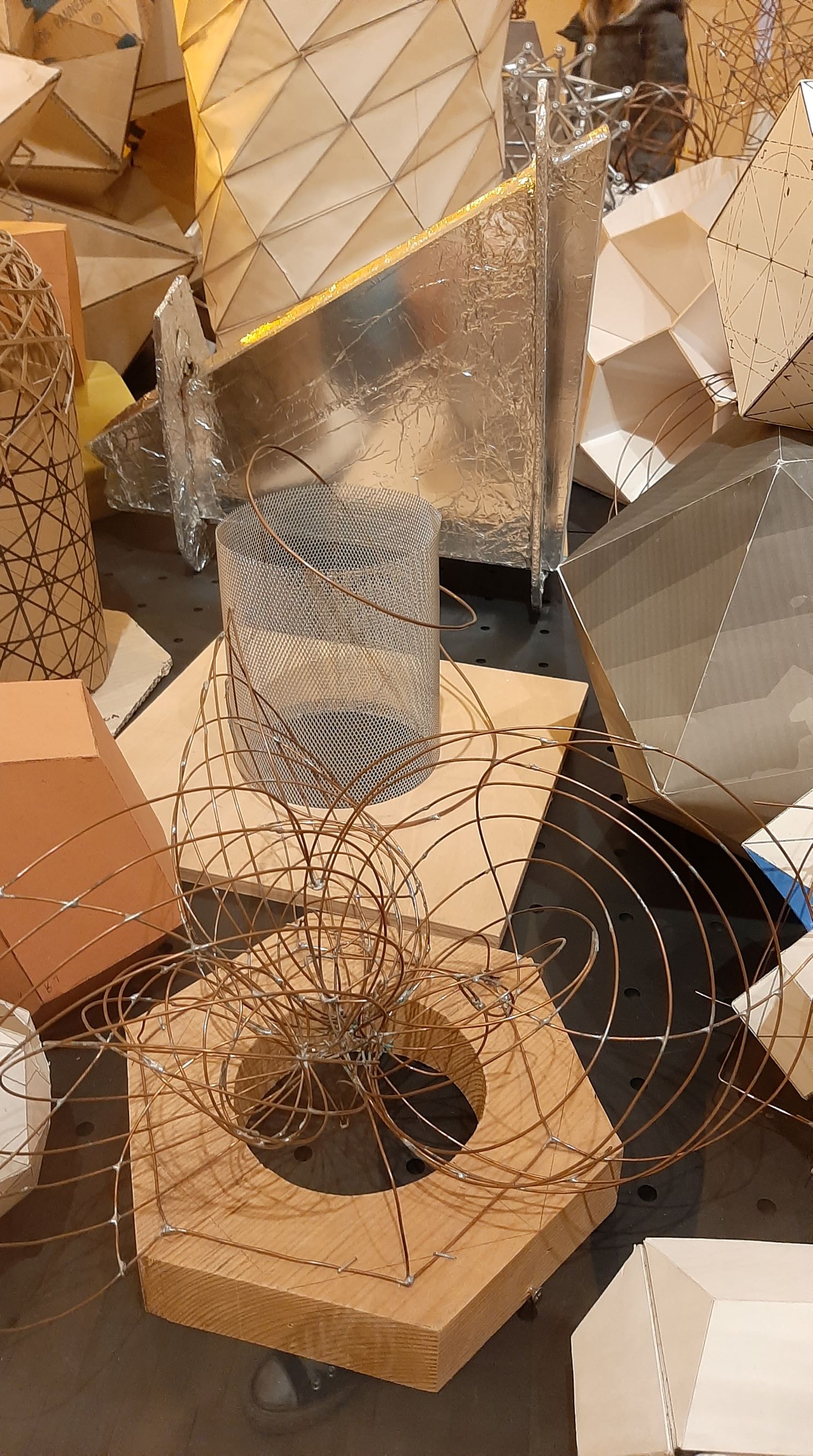
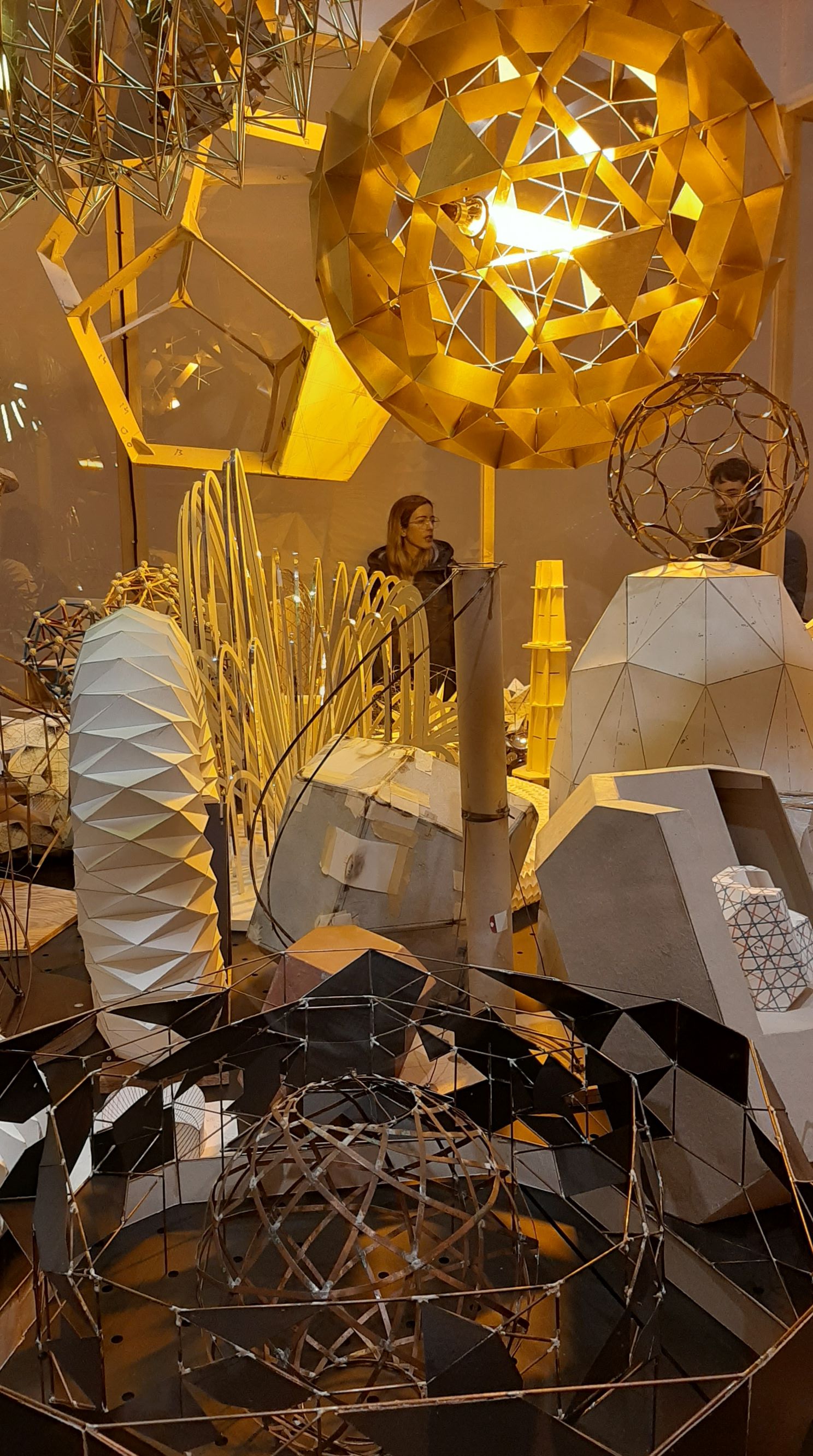
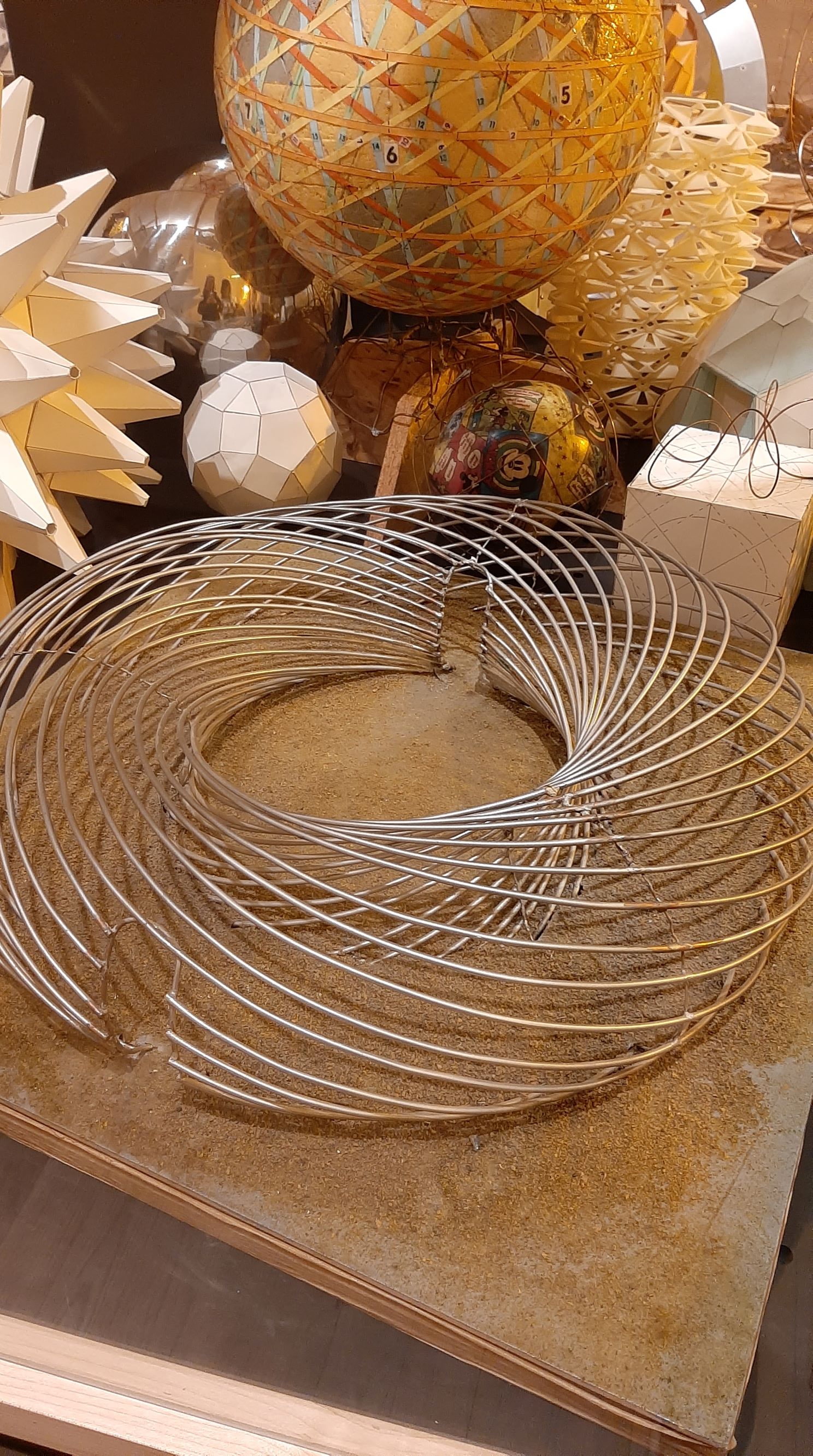
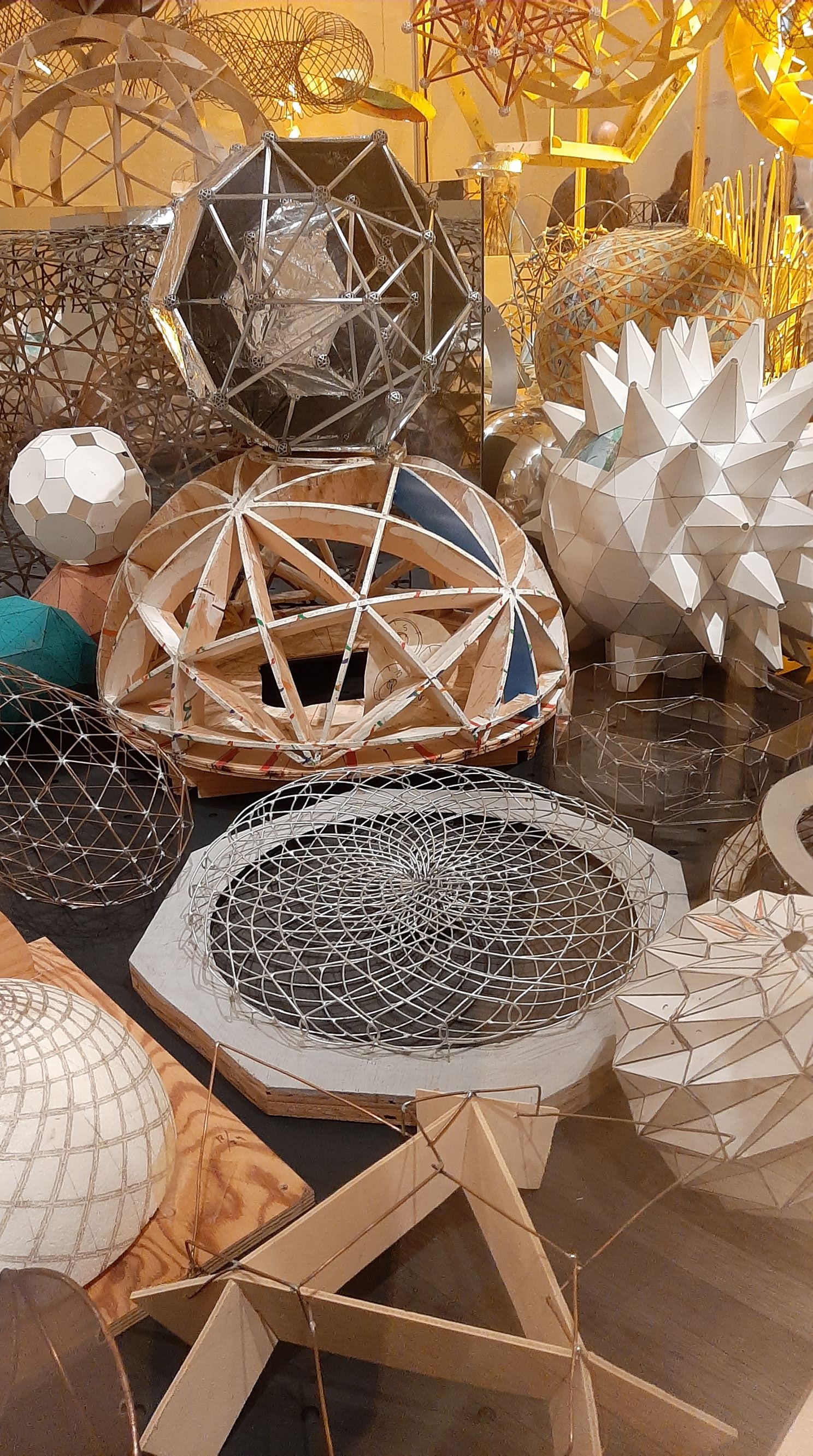
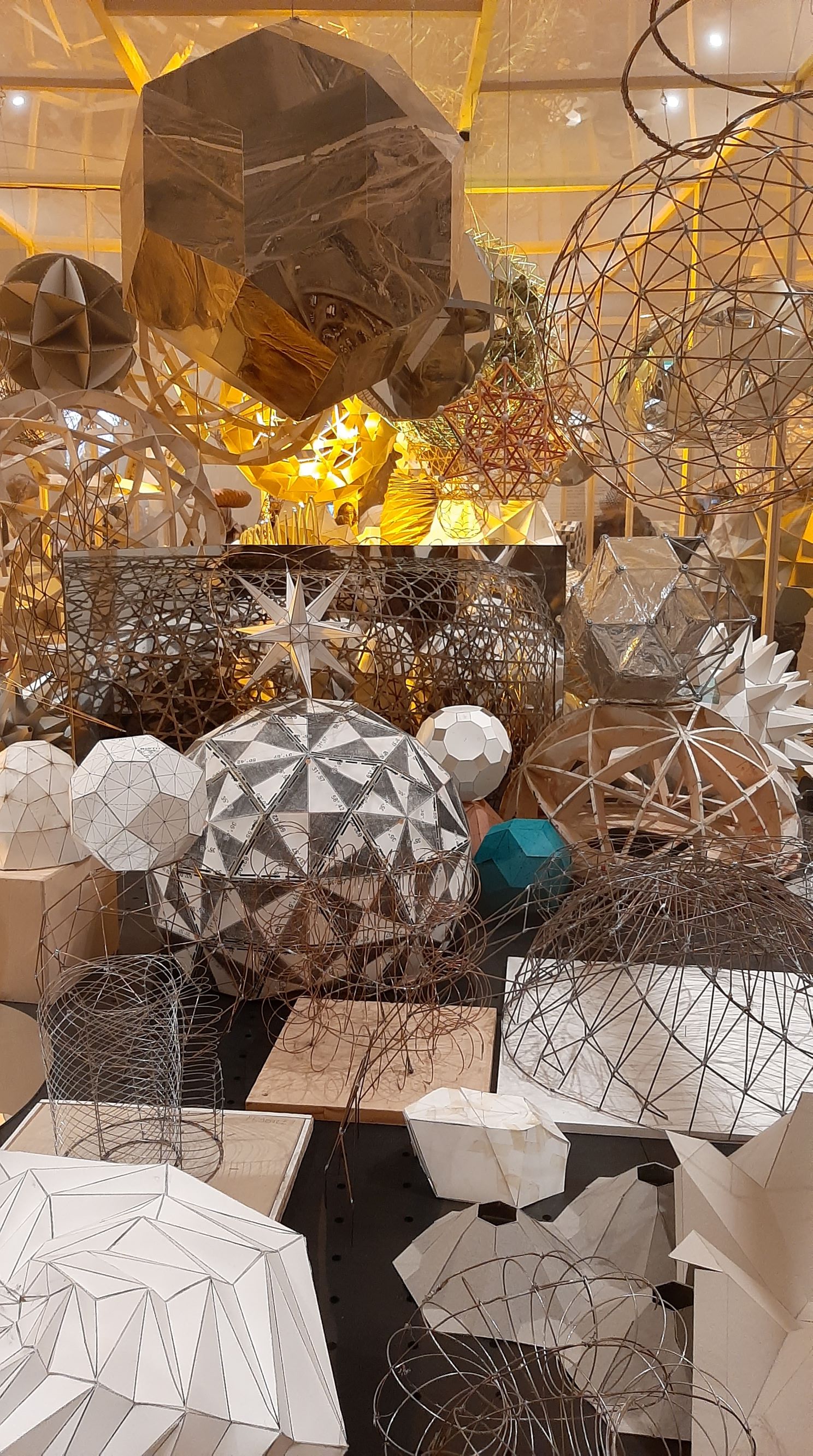
Upon first entering the exhibition the viewer is presented with the Model Room, a room taken up solely by a giant display cabinet filled with hundreds of models, prototypes and maquettes, all of which explore three dimensional geometric properties. The models in some cases have gone on to be developed for Eliasson’s artwork, and I imagine in other cases have gone on to be used in one of his other pursuits such as product design or architecture. In many ways this area of Eliasson’s practice is reminiscent of Peter Randall-Page’s work due to its use of geometry and symmetry, and its potential architectural uses.
Next, in a room of his early works, there is more of a focus on nature and natural phenomena. Wavemachines 1995, Regenfenster 1999 and Moss wall 1994 all bring elements from the natural world into the gallery in a different way. Wavemachines comprises four long containers full of water, coloured yellow presumably for visual ease (although the use of yellow is somewhat of a theme in his work – see his work with yellow monochromatic light), each with a simple paddle mechanism creating waves. The waves travel down the length of the rectangular containers and bounce off the end, passing through other waves on their return journey. This natural phenomena, witnessed all the time on beaches, rivers and lakes, has been removed from nature and placed in the gallery, almost in a sterile manner, as though to subtract any of the stereotypical ‘natureness’ or beauty from it. This reminds me of Mountain Machine by Tania Kovats which also stripped nature back to its core physical principles and then exhibited the result. Perhaps this is the contemporary take on the landscape? As we, the public, become more aware of climate change (again, something Eliasson looks at in his work), perhaps we grow more aware of the importance of the science behind our favourite landscapes? Or maybe it is more of an exploration of the dynamic between indoors and outdoors, the natural and the man-made? Both Regenfenster and Moss wall join this conversation: Regenfenster (Rain window) recreates the effect of heavy rain running down a window and Moss wall coats an entire gallery wall with Scandinavian reindeer lichen. Regenfenster in particular is an interesting interplay between man-made and natural, indoors and outdoors, as it is created solely by an interaction between the two. Moss wall perhaps more blatantly brings the outside inside, creating an experience for multiple senses through the piece’s aroma and texture. I often struggle in my own work to build upon what I find interesting in the natural world so this idea of taking the pure mechanics of the situation and exploring this, disregarding particular aesthetics, would be a useful one to take forward.


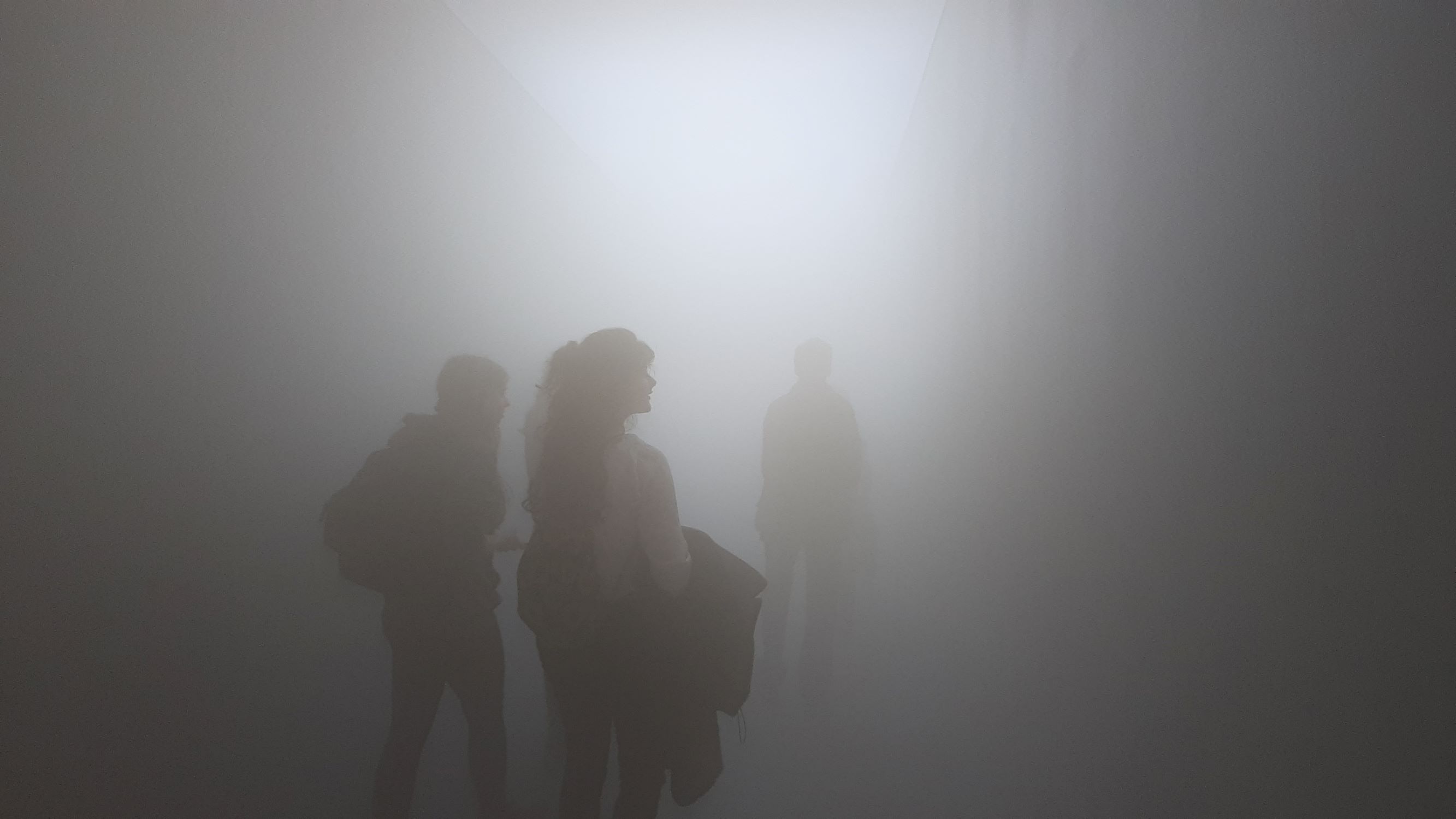
The multi-sensory nature of Moss wall is another common characteristic of Eliasson’s work throughout the show. Many of his pieces are experiential such as Din blinde passage (Your blind passenger), a 40m tunnel filled with coloured fog that reduces visibility to around 1.5m. This piece removes the viewer from the white cube exhibition room to an almost dream-like space where awareness of other senses become heightened. Your spiral view, too, is an all-encompassing piece where viewers are invited to walk through a kaleidoscopic tunnel which alters how the space around them is perceived. Given the interactive nature of the show, it isn’t surprising that the exhibition was very busy, with a particularly noticeable number of children. Indeed, in the documentary ‘Abstract: The Art of Design’, Eliasson spoke about the importance of the audience to his art. His attitude is summed up in the piece Beauty (which was unfortunately out of action when I visited) wherein a white light is shone through a fine mist to create a rainbow; the rainbow is created by the angle between the light and the eye, so without the eye there is no art. According to him, each individual viewer will bring their own memories and associations with them to the art, as well as forming new experiences alongside other people as they interact with the pieces; the viewer completes the artwork.


This experiential and accessible nature of the work ensures that the viewer is more likely to take something away with them, into the outside world, which is particularly important for the more climate-centred pieces. Ice Watch and Little Sun are both examples of projects Eliasson has undertaken that are more explicitly aiming to make a difference environmentally. Ice Watch was a brilliantly simple piece where lumps of Arctic ice were moved to London, and the public allowed to walk round, touch and interact with them as they wished. The melting of the Arctic ice could then be seen in real time, emphasising the here and now nature of the problem, rather than something that is happening on a far pole of the planet. The Little Sun project was perhaps more product design in nature, and is a small portable solar lamp, in the shape of a sun, that was initially designed to bring light to people without electricity in Ethiopia. The project has since grown and multiple designs have been created, and sales profits go towards sending more to people off-grid worldwide. For me personally, this is reminiscent of a talk I attended by a small business (Art and Energy) exploring the artistic side of solar panels; if people are able to personalise their solar panels, rather than having great dark squares on top of their house, perhaps this would go some way as to increase their popularity? Creating artworks that can also charge your phone is a great way of bringing renewable energy into the home: making it more accessible.


These all raise interesting questions about the role of the artist: do we become more designers when we make practical items like this? Or should art always be functional? The boundaries between art and science are definitely being tested in works like this, and this scientific element was apparent particularly in the last room of the exhibition – The Expanded Studio. It is described as ‘evoking the broader interests and activities that Eliasson’s studio in Berlin pursues’ and is effectively a large collection of questions, articles, newspaper clippings, images and films around topics of Eliasson’s interest, particularly climate-based. Like with the Model Room, it shows us more of a process, the gathering and collecting, than a particular finalised piece. A lot of the way I work is through gathering and collecting like this, and it is heartening to see an artist of Eliasson’s calibre actually exhibiting the method itself at the Tate. Rather than looking at nature and trying to mimic it, we can analyse it more critically, creating a likeness instead out of the mechanisms behind it and the science surrounding it.


References:
- https://littlesun.com/about/
- Exhibition leaflet
- Abstract: The Art of Design (Netflix documentary)
- https://artandenergy.org/
- https://www.soe.tv/

 Anna Harris