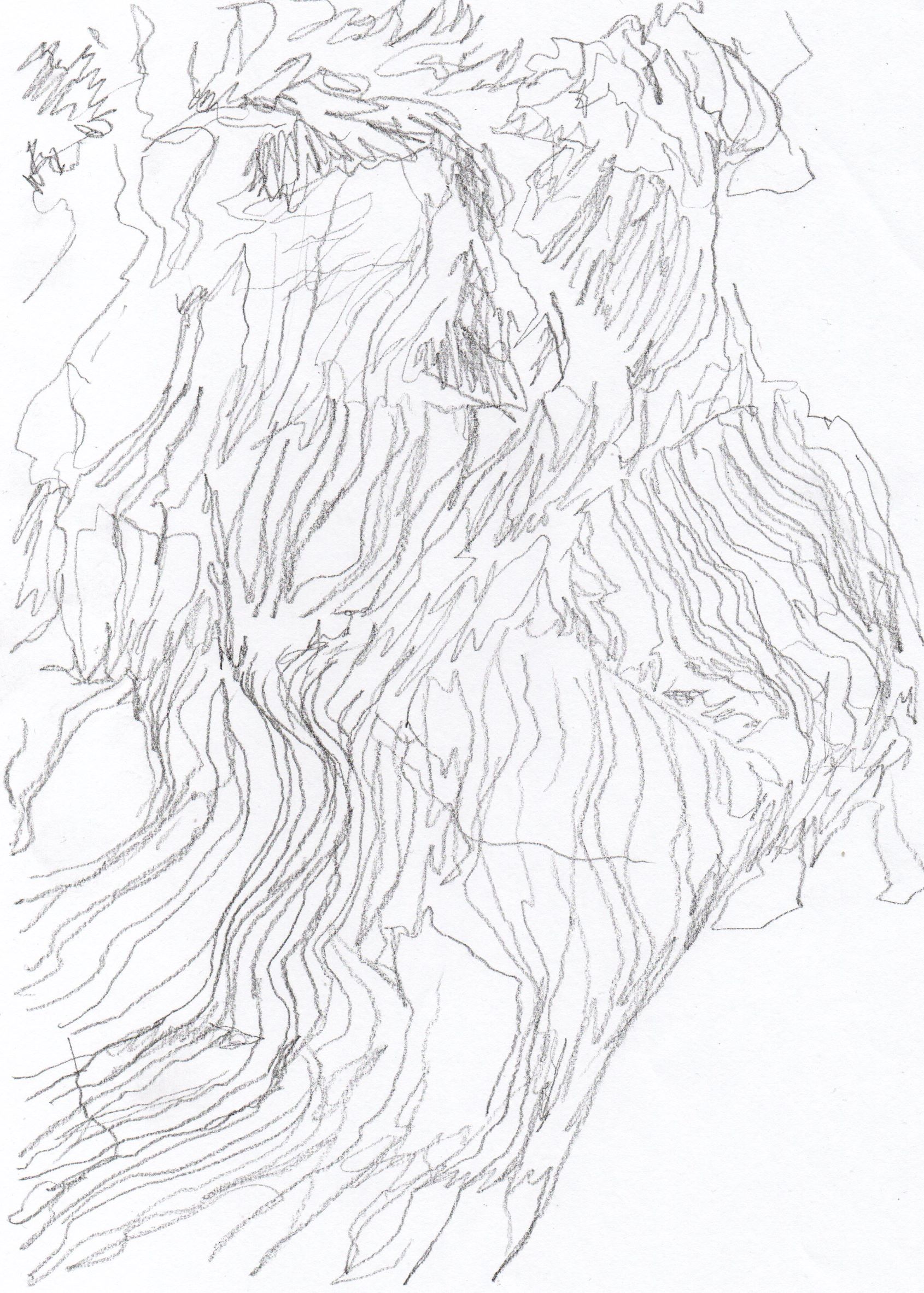
Although I plan on picking up where I left off before Christmas in terms of the work I’m producing, I do still feel as though I need a bit of a kick start to get me going again. I’ve been gathering photos, source material, from walks, and from this I thought a good way to ease back into thinking creatively again was with some drawing from this. This has a lot to do with the work of Tania Kovats, especially her ‘Drawing Book’, that I have been looking at recently, in which she explores drawing as an incredibly versatile medium that can be useful as a way of thinking and playing around with ideas.
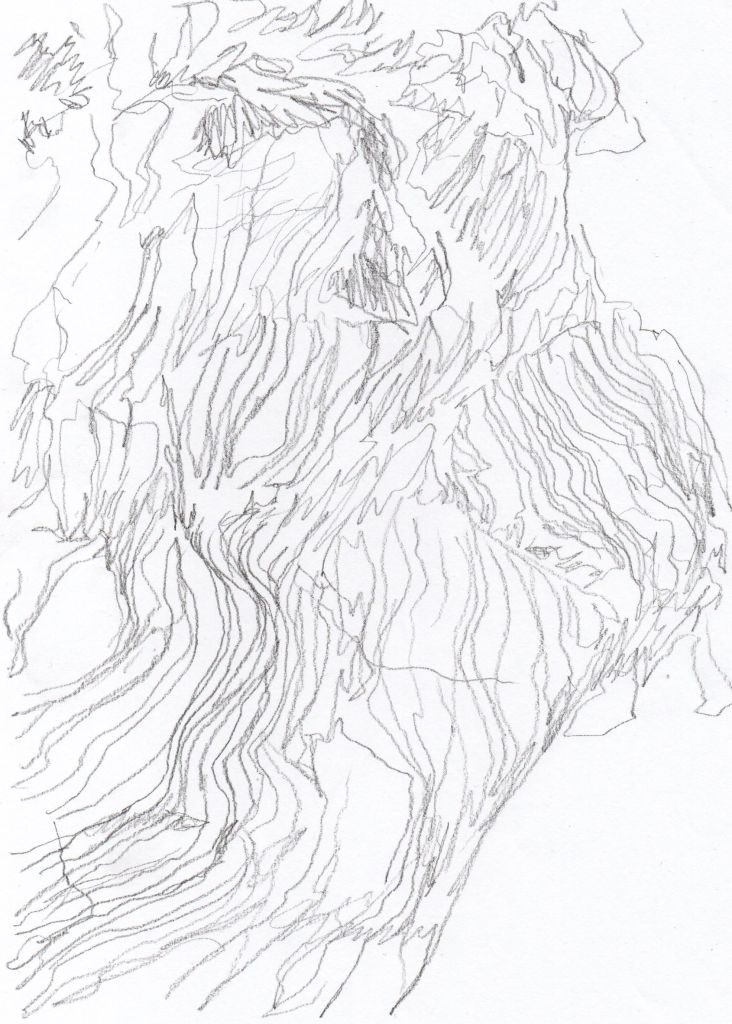
I find I can often overthink my work so I was aiming to purely generate some visual material, even if it wasn’t the most conceptually advanced. I started off with drawing a close-up, cropped surface pattern from a photo of a rock, exploring the flowing lines and shapes created in its formation. Upon completion of the drawing I found if rotated from portrait (as I had initially drawn it) to landscape the piece developed a different feel; to me it is reminiscent of a wild landscape, with conditions not dissimilar to the day the photo was taken. The rotation of the photo was perhaps influenced by Hiroshi Sugimoto’s Revolution where he rotates landscapes onto their side so as the viewer may begin to consider how the horizon is not simply a line but a segment of a far greater sphere hanging in space.

Carribian Sea, Yukatan, 1990 
Arctic Ocean, Nord Kapp. 1990 
Red Sea, Safaga, 1992 
N. Pacific Ocean, Ohkurosaki, 2002

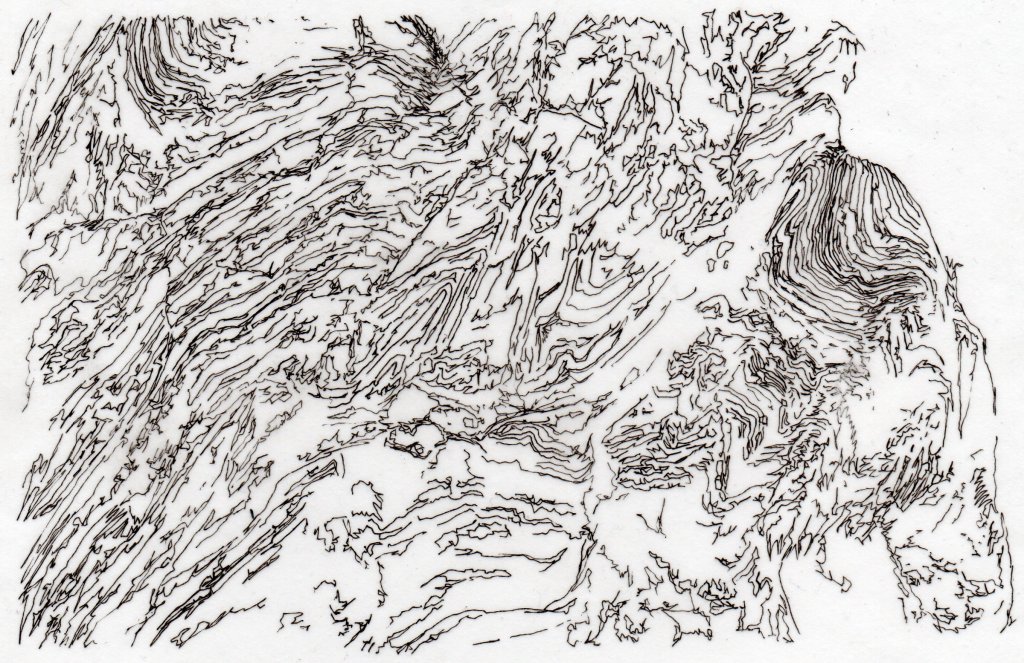
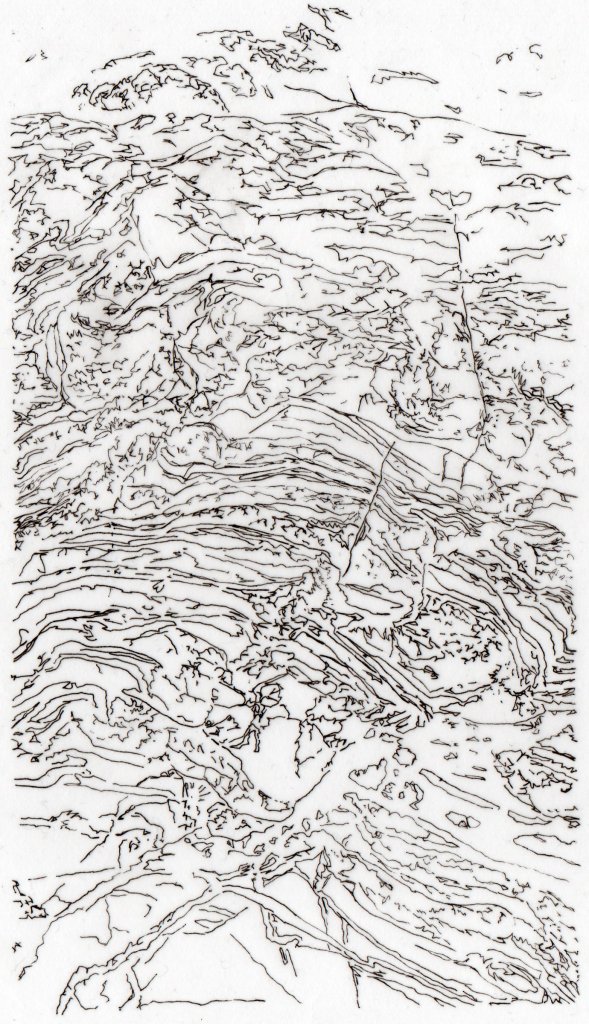
The abstract suggestion of a wild landscape hints almost at energy contained within the rock, the way it once would have flowed and then solidified into what we see today. This was apparent, too, in my next few drawings where I continued to explore intricate surface patterns of the rocks – as these ones were more detailed I traced them instead of drawing from a photo which created a different end result. Unlike perhaps what I would have expected, the traced patterns were looser, seemingly describing abstract forms or masses, forming quite sculptural outcomes. Where the line has become looser this adds an implied energy, once again as if the rock were flowing how it once would have done – perhaps this is a good way of starting to unlock/access this idea of deep time, taking the rock back in time to the start of its creation, when it was still malleable? Considering rocks as malleable would also be an interesting theme to explore from a material perspective, challenging/contradicting the viewers’ expectation of a material or object. From a drawing point of view this might also be interesting to explore on a larger scale to get a fuller sense of these flowing lines.
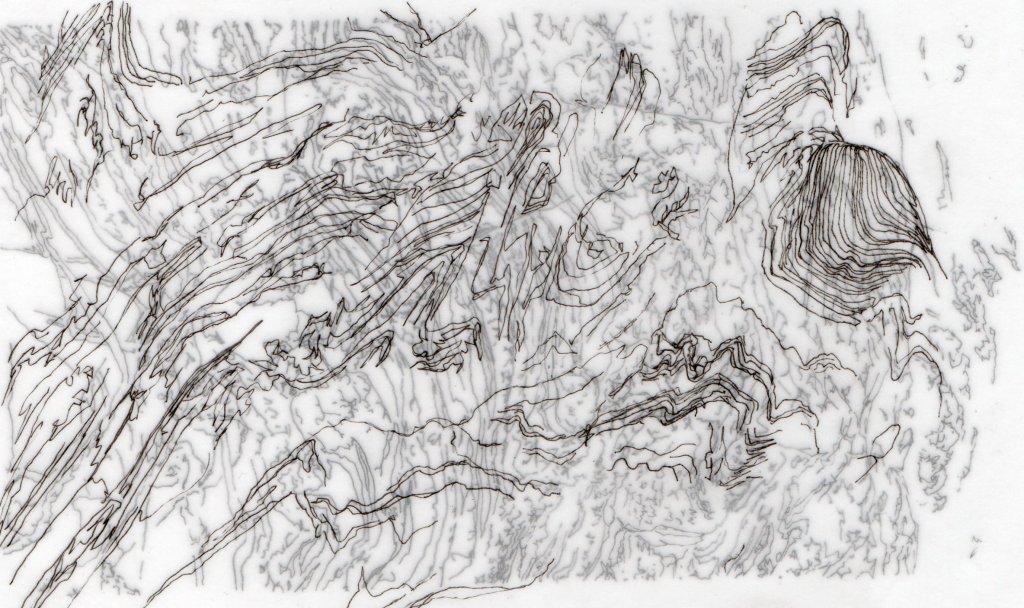
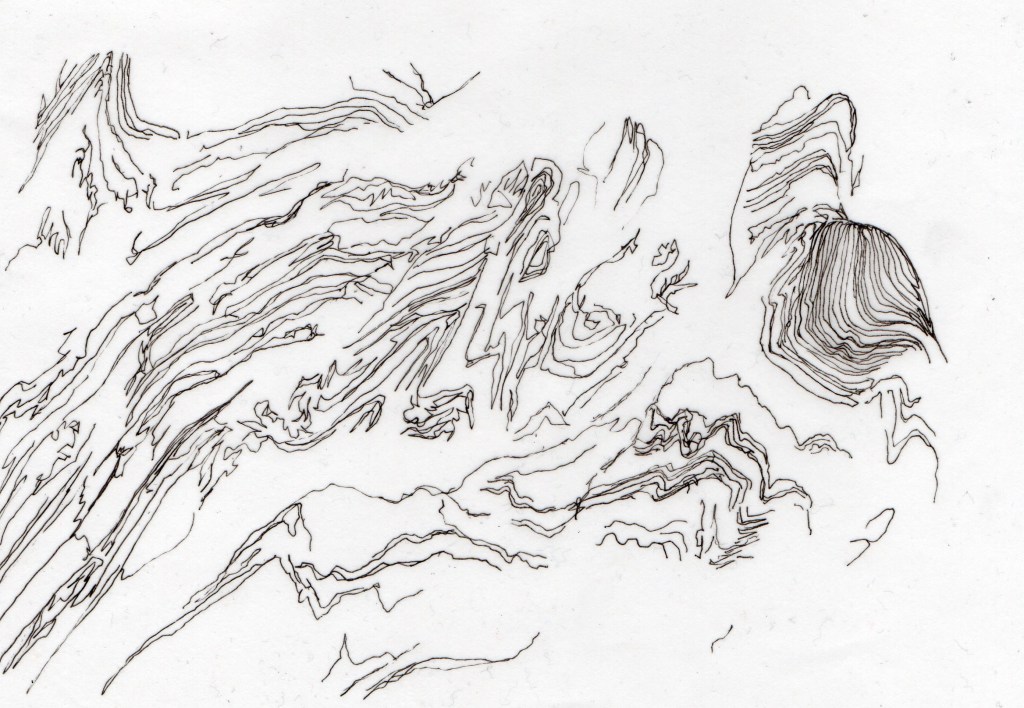
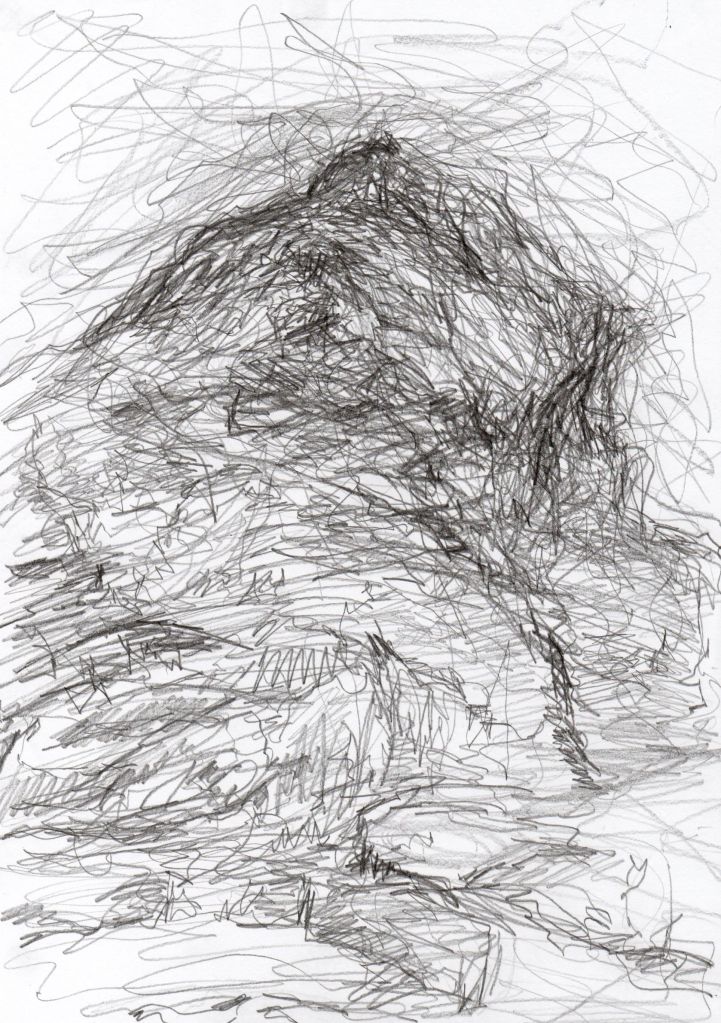
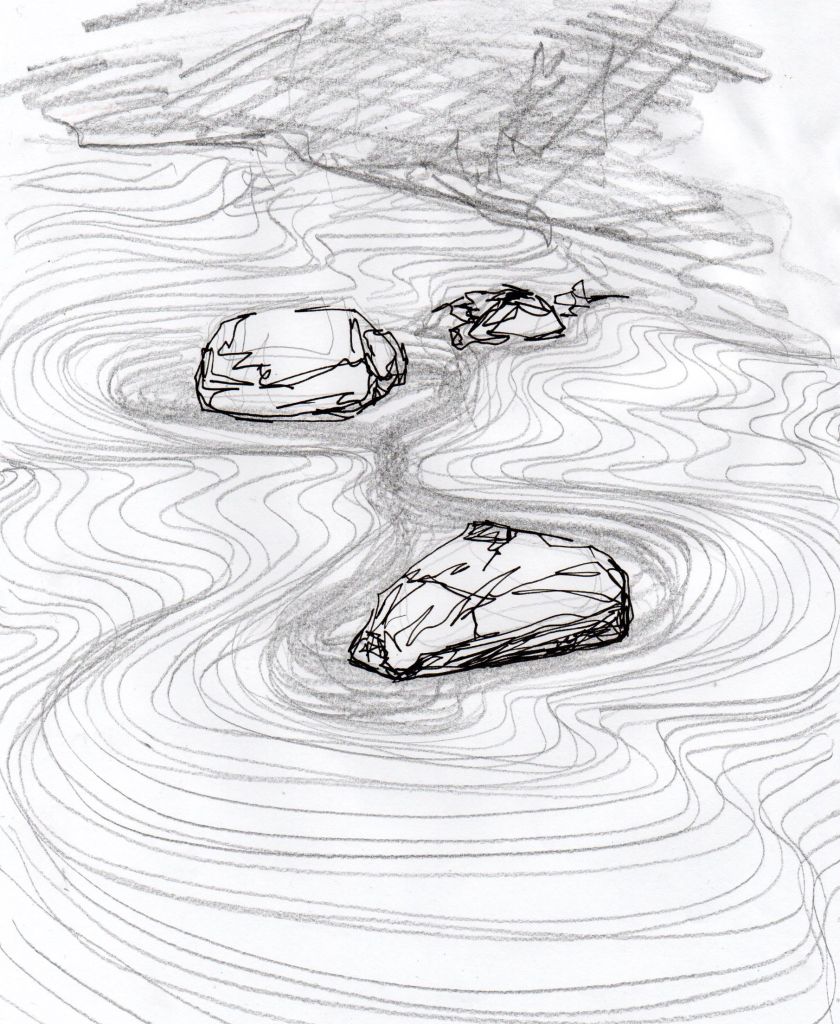
My last few drawings concentrated on the idea of trying to convey the ‘energy’ of a rock that I mentioned above, exploring less of the surface patterns and instead considering the masses/forms in space. I used messy, rapid mark-making to work in a sense of energy, with the three drawings showing slightly different variations of this. While I prefer the first and second drawings, the lines flying out of the third one does remind me of Andy Goldsworthy’s work (see below). Perhaps if I were to alter the lines flying out of the rock formation so they were more similar to Goldsworthy’s work – so they stemmed from/centred around some kind of inner core – they would have a more successful overall effect of creating energy/field lines.
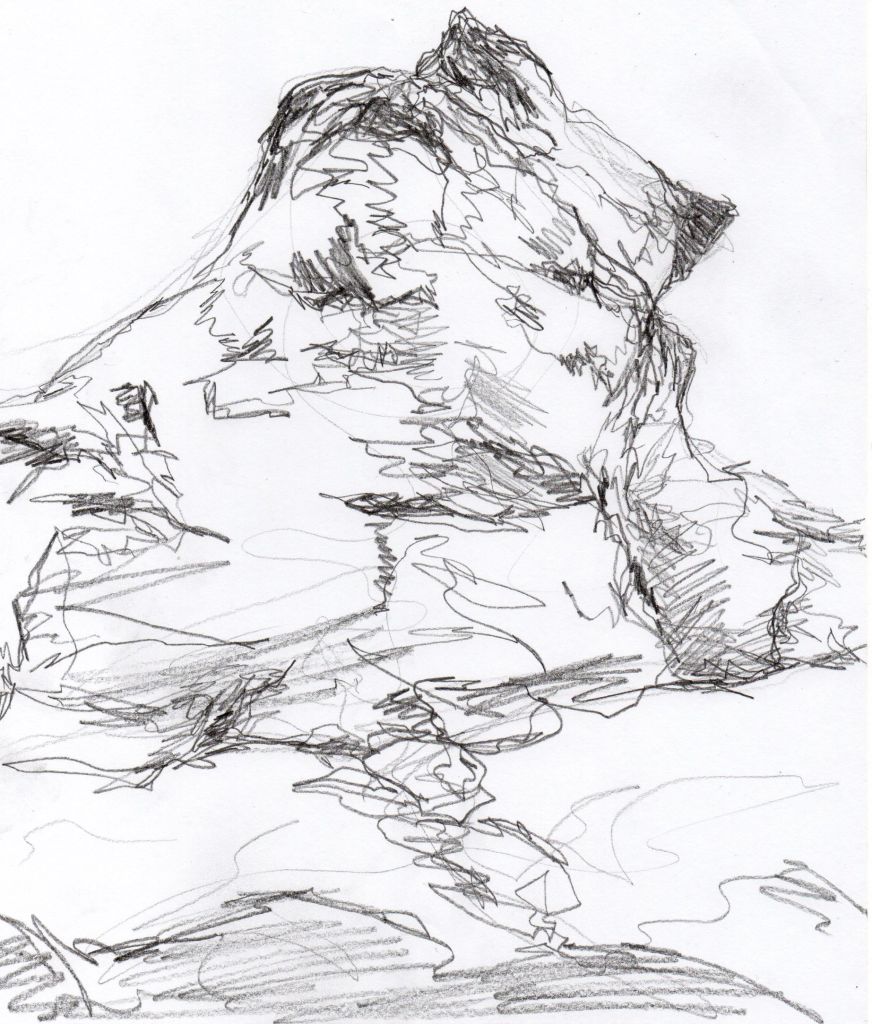
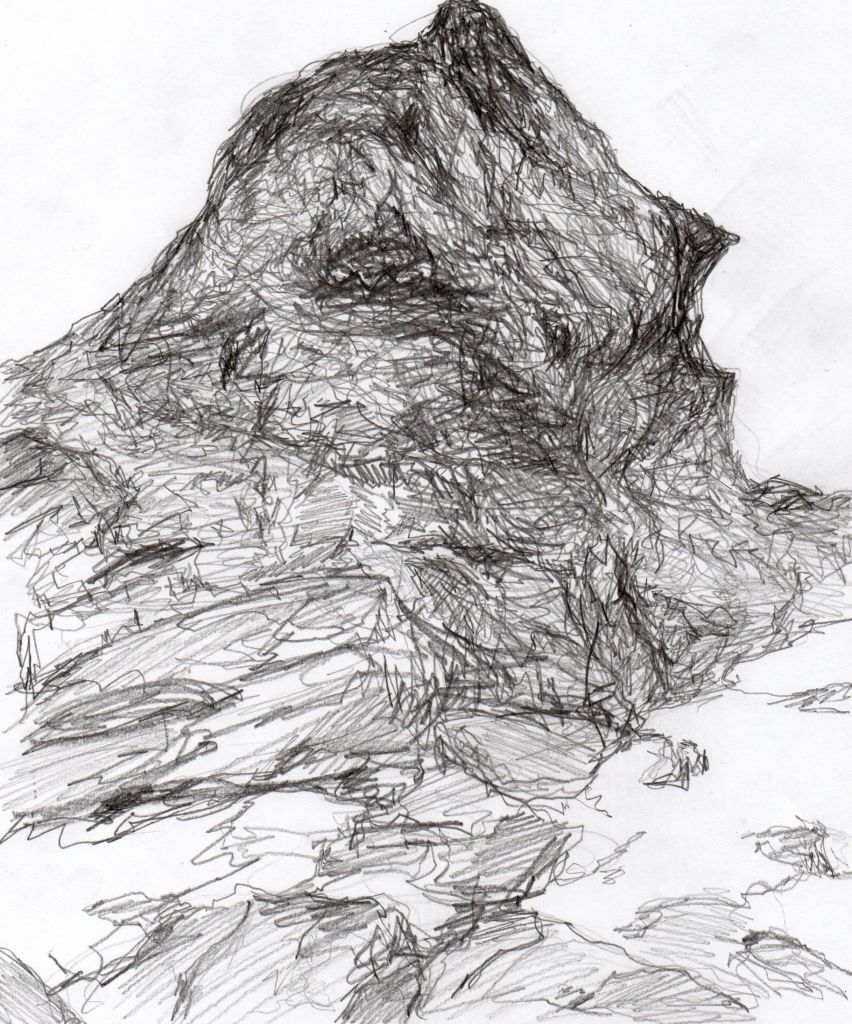

Goldsworthy said “A stone charges a place with its presence, with time filling in and flowing around it, just as a sea or river rock affects the surrounding water by creating waves, pools and currents.”, which suitably sums up this exploration of the energy and presence of rocks that my drawings have explored. Just as Goldsworthy says, a sea or river rock visibly affects its surrounding landscape, just as sand will wash away from large rocks on beaches, leaving water to pool around them. My last couple of drawings stem from this idea, this physical manifestation of time and space flowing around solid, unmoving rock. Of course, over geological periods of time rocks are not unmoving so exploring this static vs moving nature of rock is a good access point to exploring deep time. Similarly, with many of these initial explorations being from beach walks, sand and water crop up as two more potentially interesting materials from the same environment; if we are considering the stationary vs flowing nature of rock, sand embodies this well as elementally it is rock yet it can flow, and similarly water, an obviously flowing material, is nearly as old as the earth itself so is another, perhaps more unusual, way of approaching these geological timescales from a material perspective. (https://www.nationalgeographic.com/news/2014/10/141030-starstruck-earth-water-origin-vesta-science/)


 Anna Harris