One of the prompts we were working with recently in studio sessions was ‘assemblages’. I played around a little with arranging the found objects that I have collected in my space but these were primarily visual experiments without much conceptual drive:
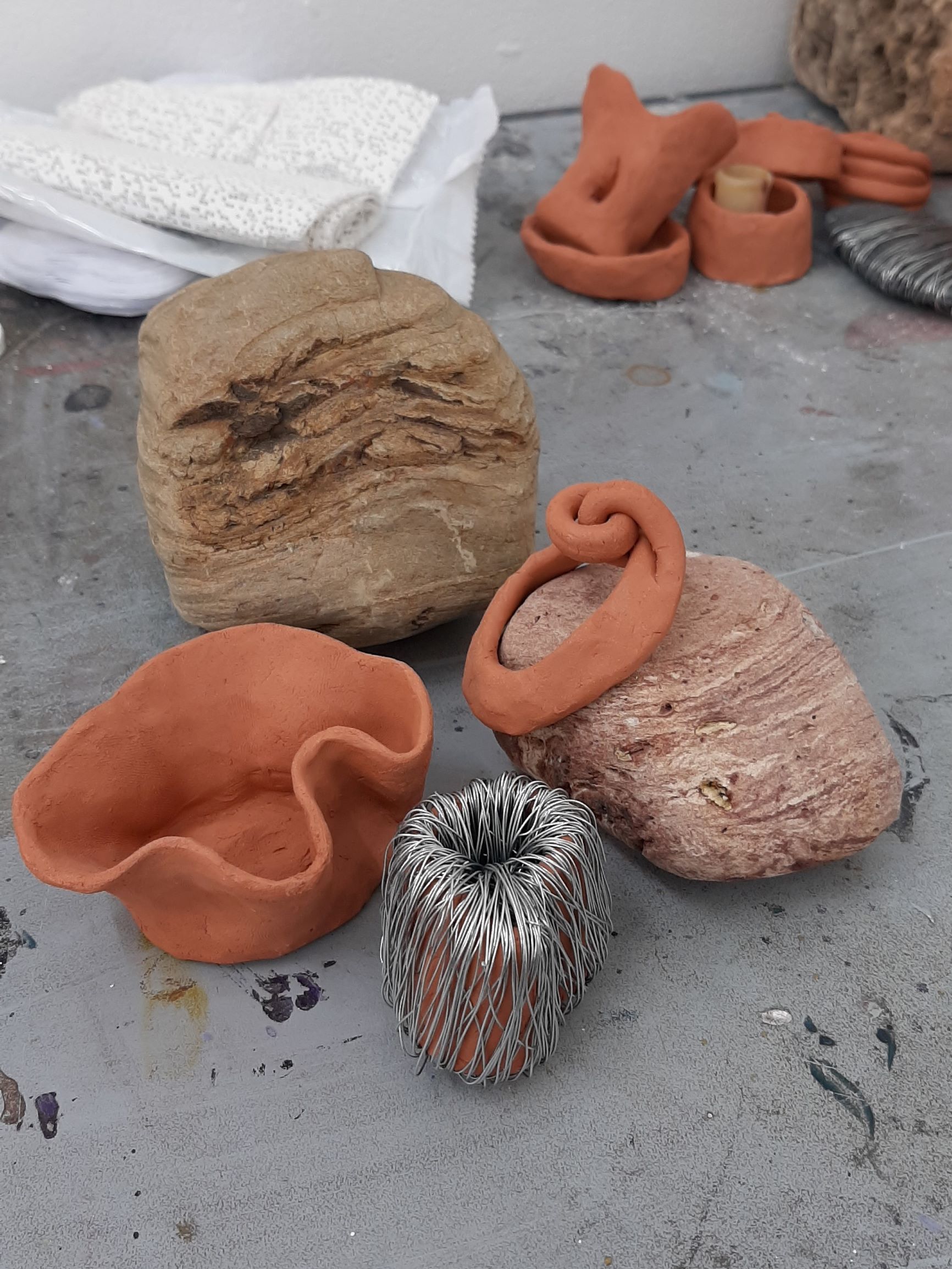
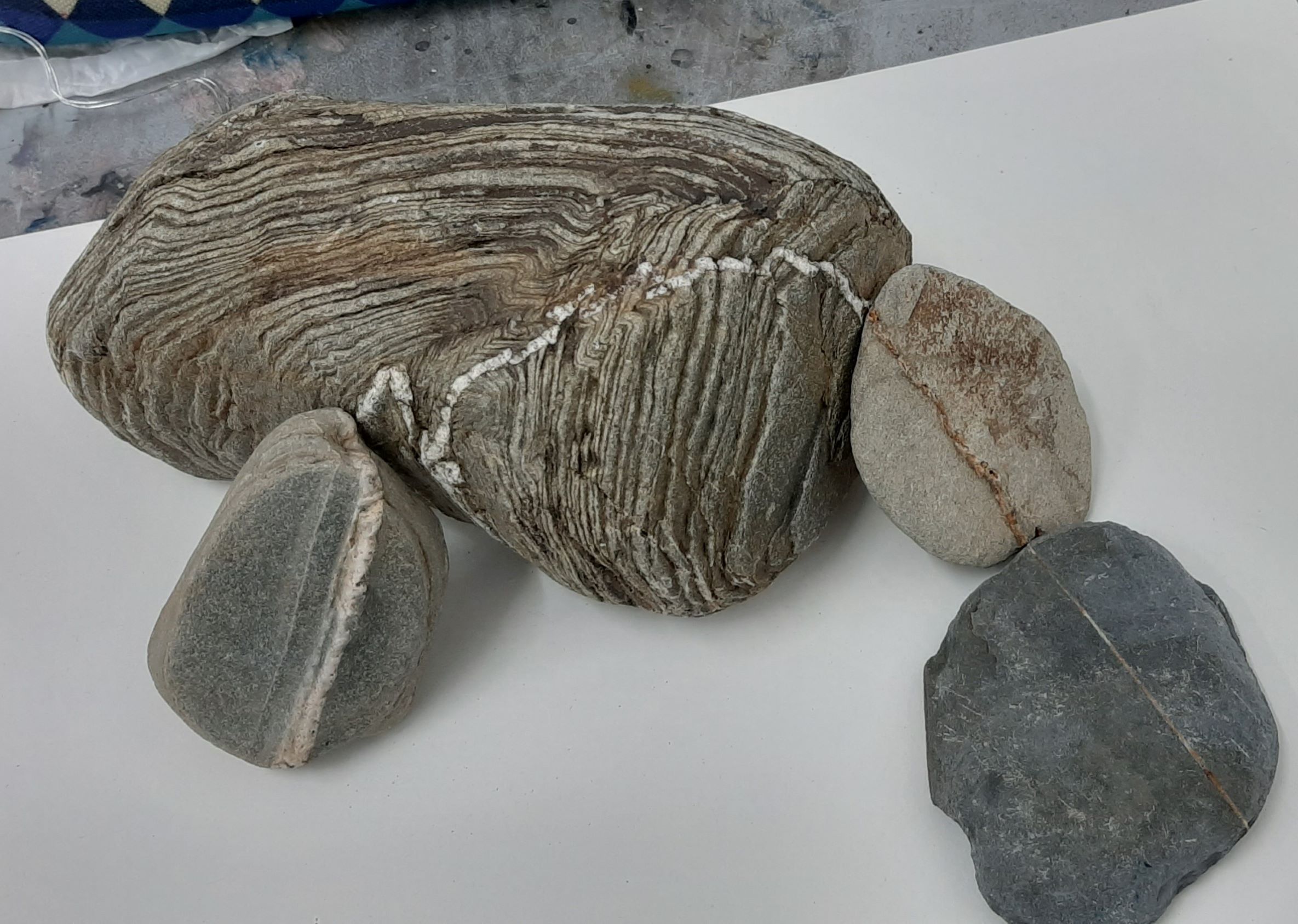
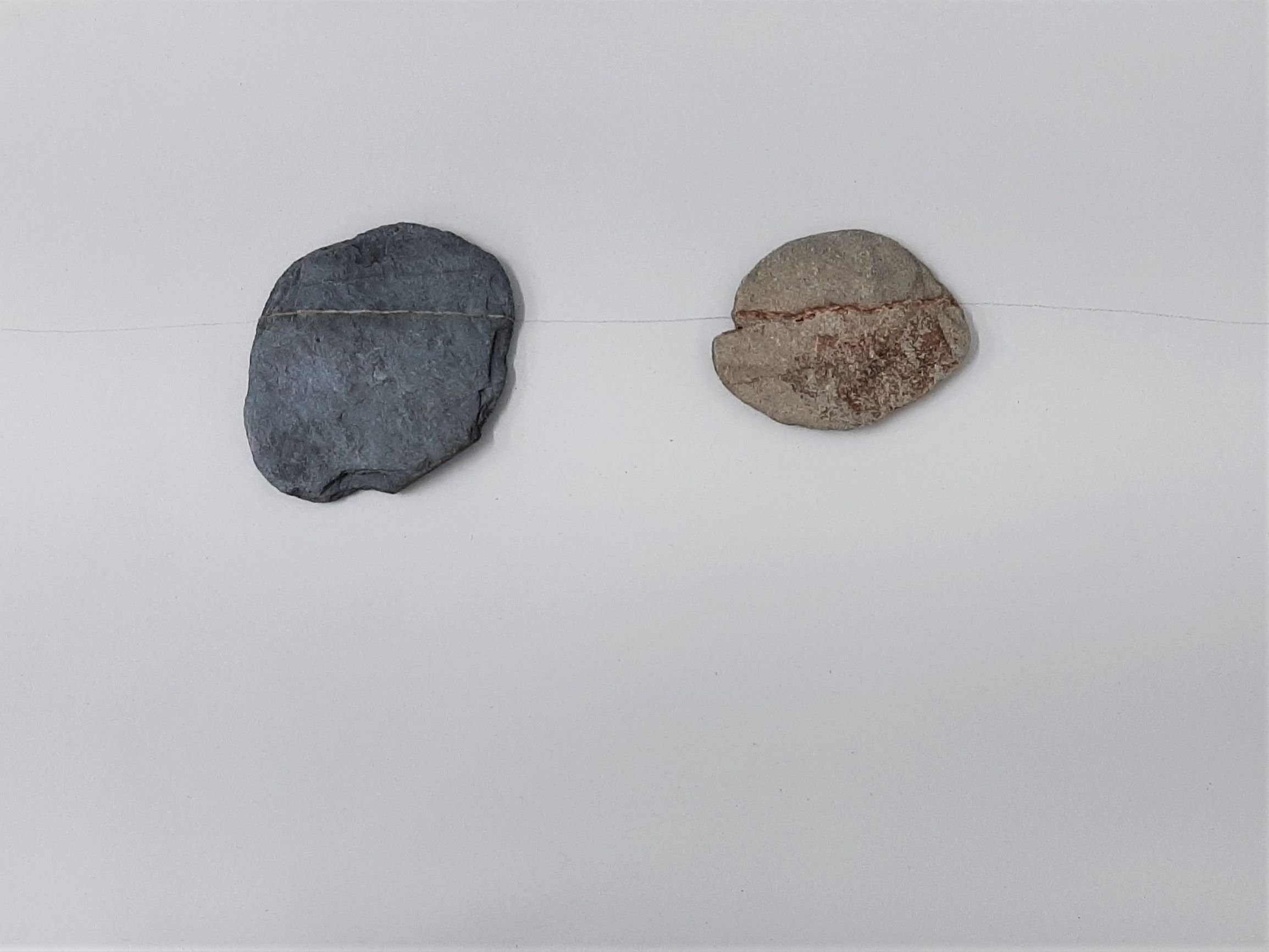
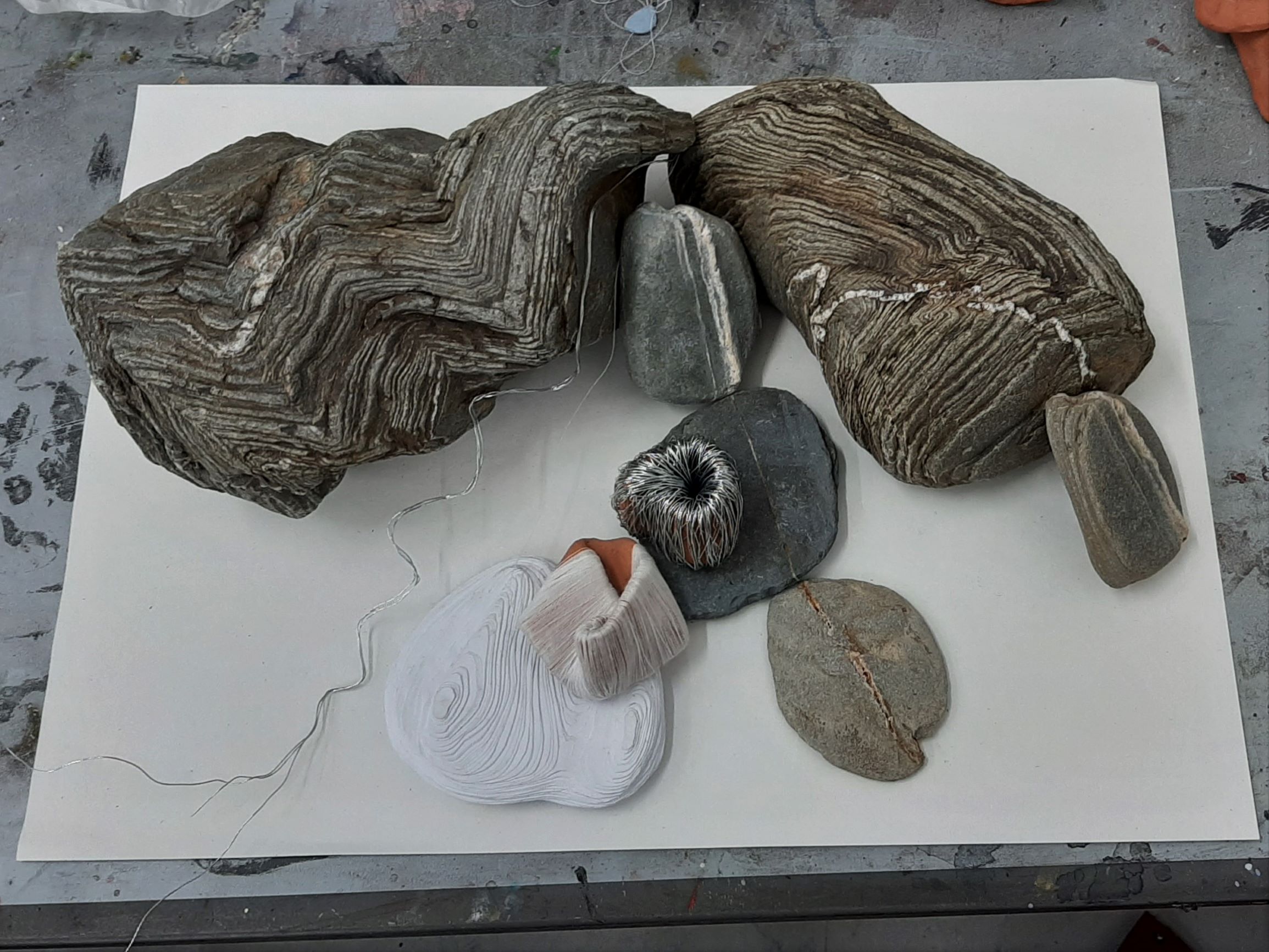
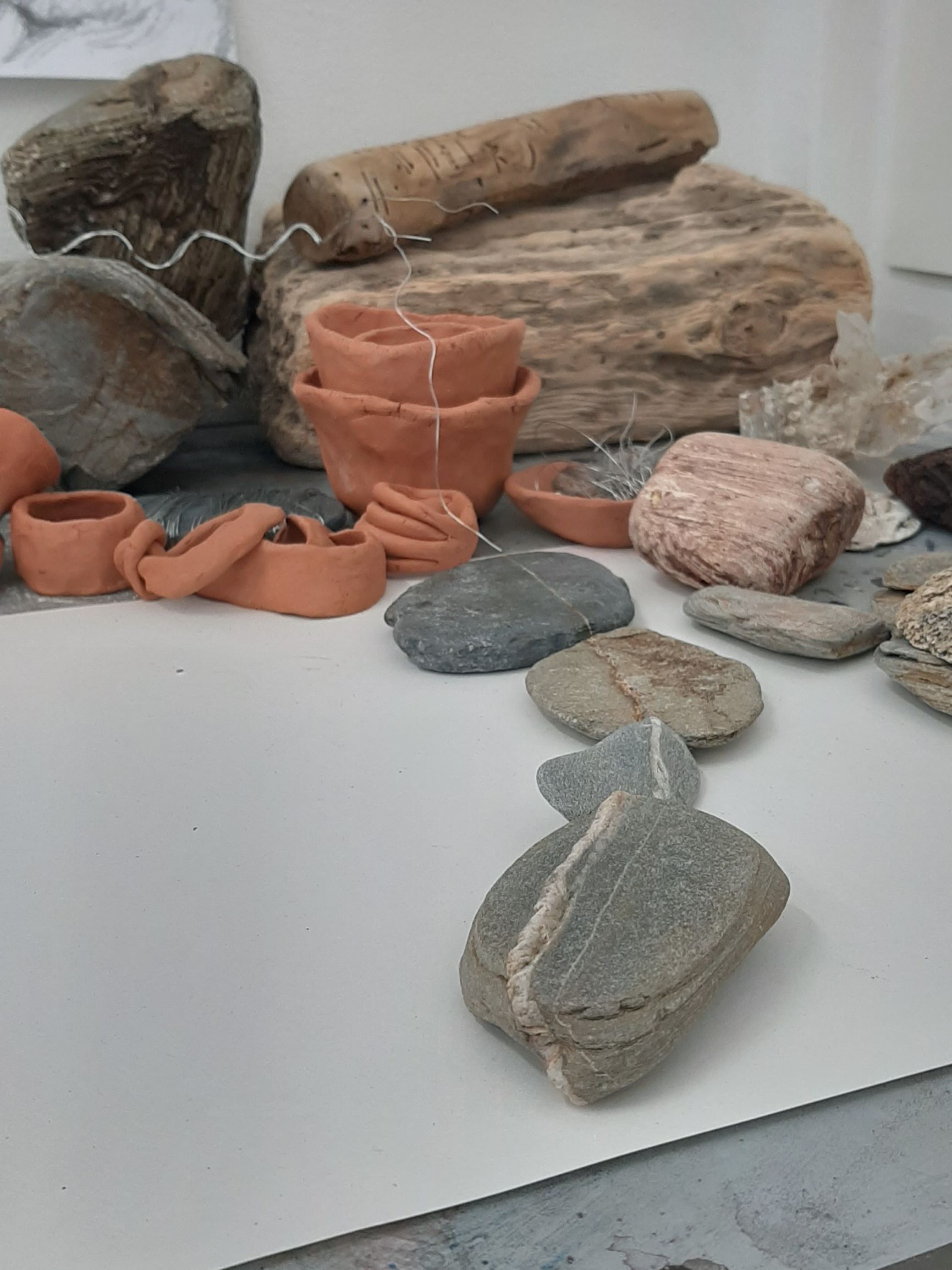
I felt a little limited for space just using my studio desk so I took several of my objects into a separate installation room and began to play around with them here. I found this was an interesting new way of looking at them as, compared to the desk where it felt a bit overcrowded, here they were somewhat dwarfed by the space. As they were all laid out on the floor I began to consider how you were made to walk around them, how their presence impacted the room. This links back to the theme that keeps recurring in my work, as articulated by Andy Goldsworthy: ‘A stone charges a place with its presence, with time filling in and flowing around it, just as a sea or river rock affects the surrounding water by creating waves, pools and currents’. I didn’t just have stones, however, I had a mixture of other materials as well as objects that verged on mimicking the rocks such as those made of paper. I therefore decided to refer back to the idea I explored in the rock line pieces, but this time trying to in some way account for the differing materials.
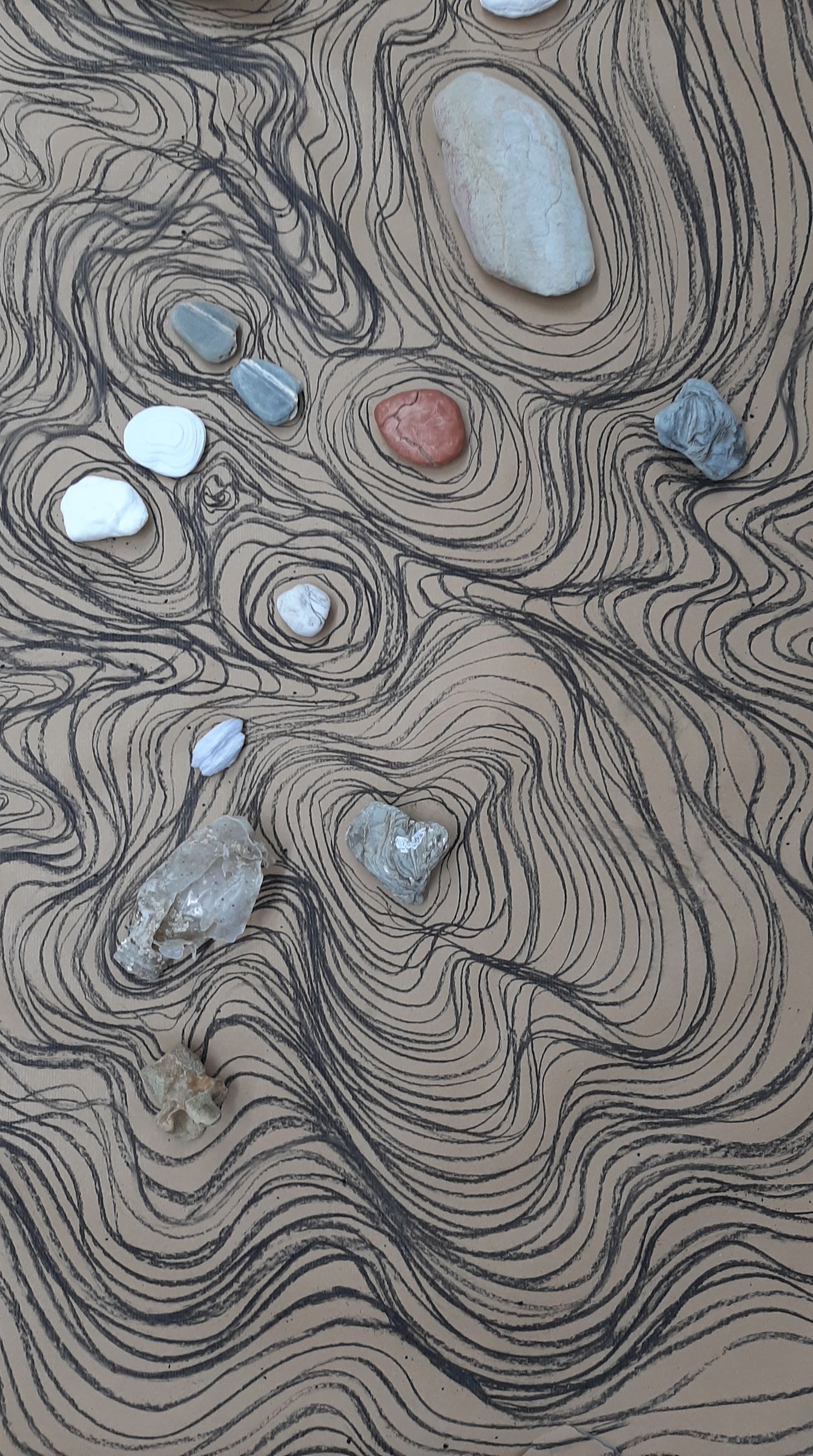
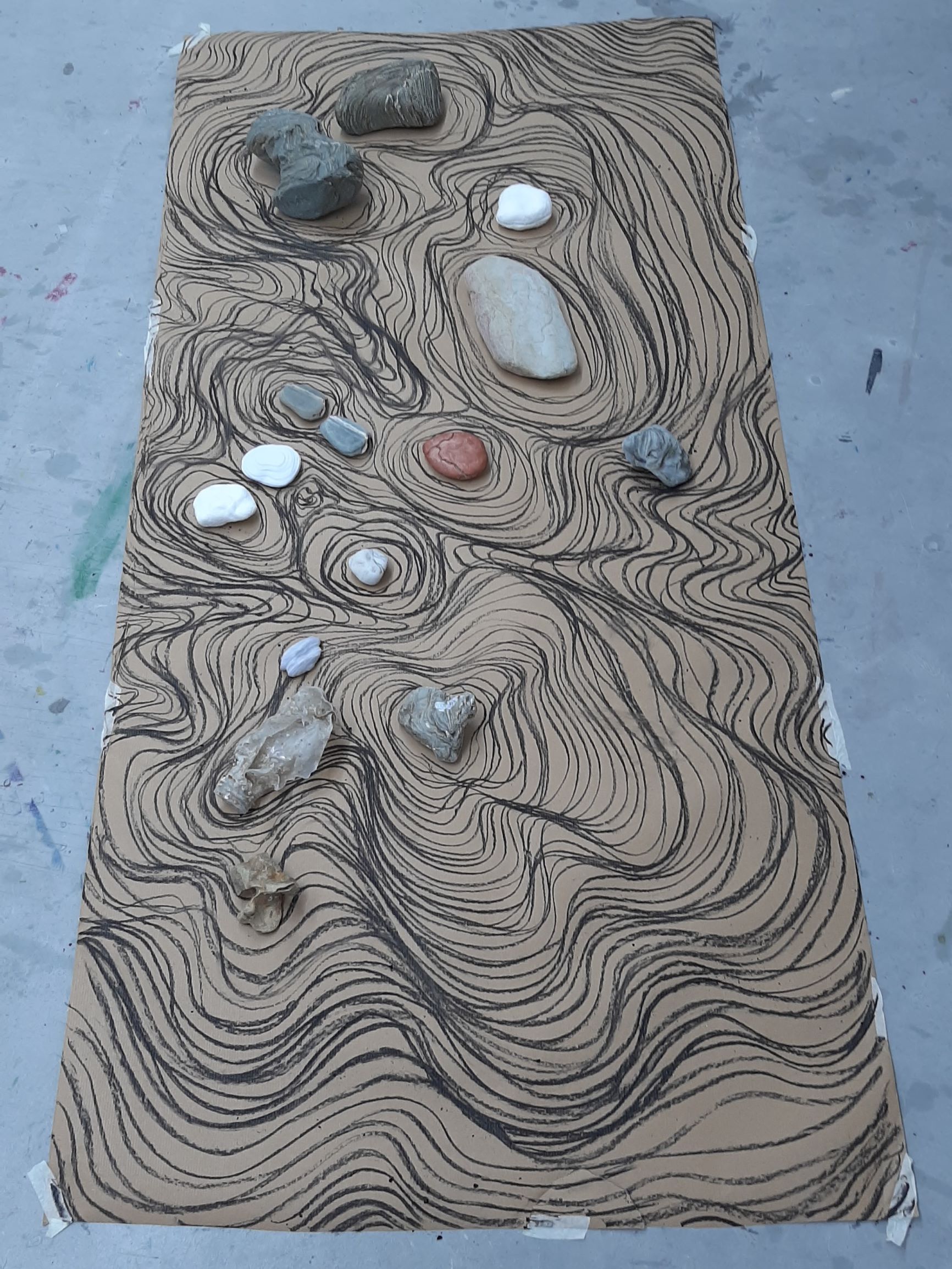
It would have been interesting to have drawn straight onto the floor but for practical reasons I thought it best to draw onto paper. I placed the objects entirely randomly and, as before, drew around the stones but this time also deflected the line a little where other objects were placed, as if the older the object the larger an impact it had on the line. However, unlike my previous pieces, this one required a lot more movement to create due to its size and as a result the finished pattern is very energised, the use of charcoal – bold, expressive and of earthy origin – emphasising this greatly. As a result the piece has a different feel to the subtler pieces from before, as if it really creates an awareness of these abstract flowing energies. The scale and assertiveness means it could also be displayed differently; it wouldn’t be lost or overlooked if presented on the floor, plinth-less and grounded, whereas the smaller ones would likely need to be elevated on a plinth to draw attention to them.
The strong flowing lines are the most successful element of this piece but I feel that they do overshadow the interaction between the old and the new objects. As the lines are freer, and therefore less precise, than the carefully calculated fine-liner ones of the previous pieces, the deflections at the non-stone objects are not particularly apparent. The piece could just be presented without these other objects as they would not leave too obvious a gap, but at present I am unsure as to if I would do this or not. The interaction between the selection of ‘real’ and ‘fake’ rocks is interesting however and something I would like to go on to explore further. Perhaps creating more ‘fake’ rocks and/or disguising ‘real’ rocks as though they were not, or even taking found objects and painting them as though a rock had formed in such a way? This may be a clearer way to take the investigation of age and authenticity that I began to probe here further.
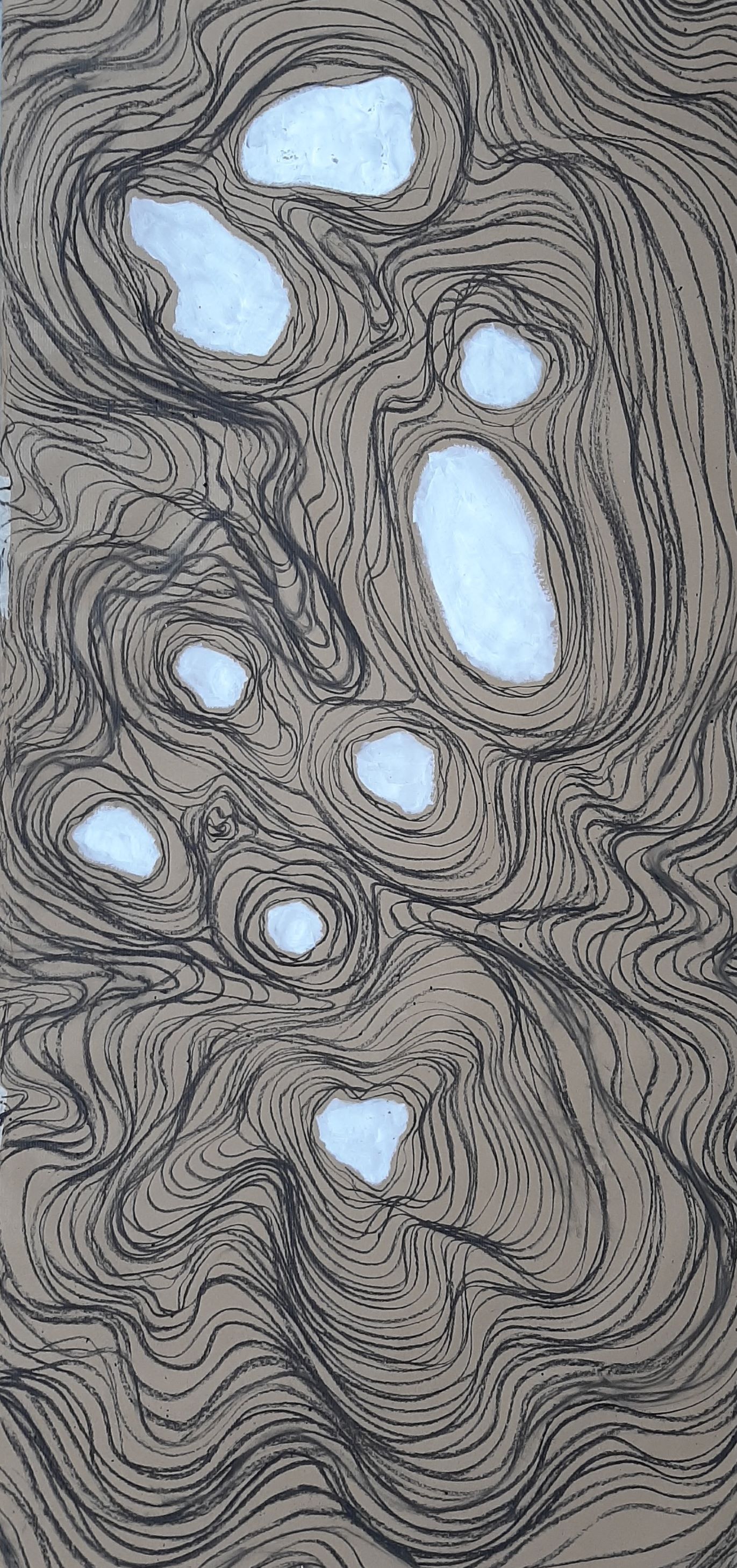
The process of forming this piece was interesting in itself; although I am satisfied with the finished image, I did like the more topographical formations that came from leaving the image halfway completed:
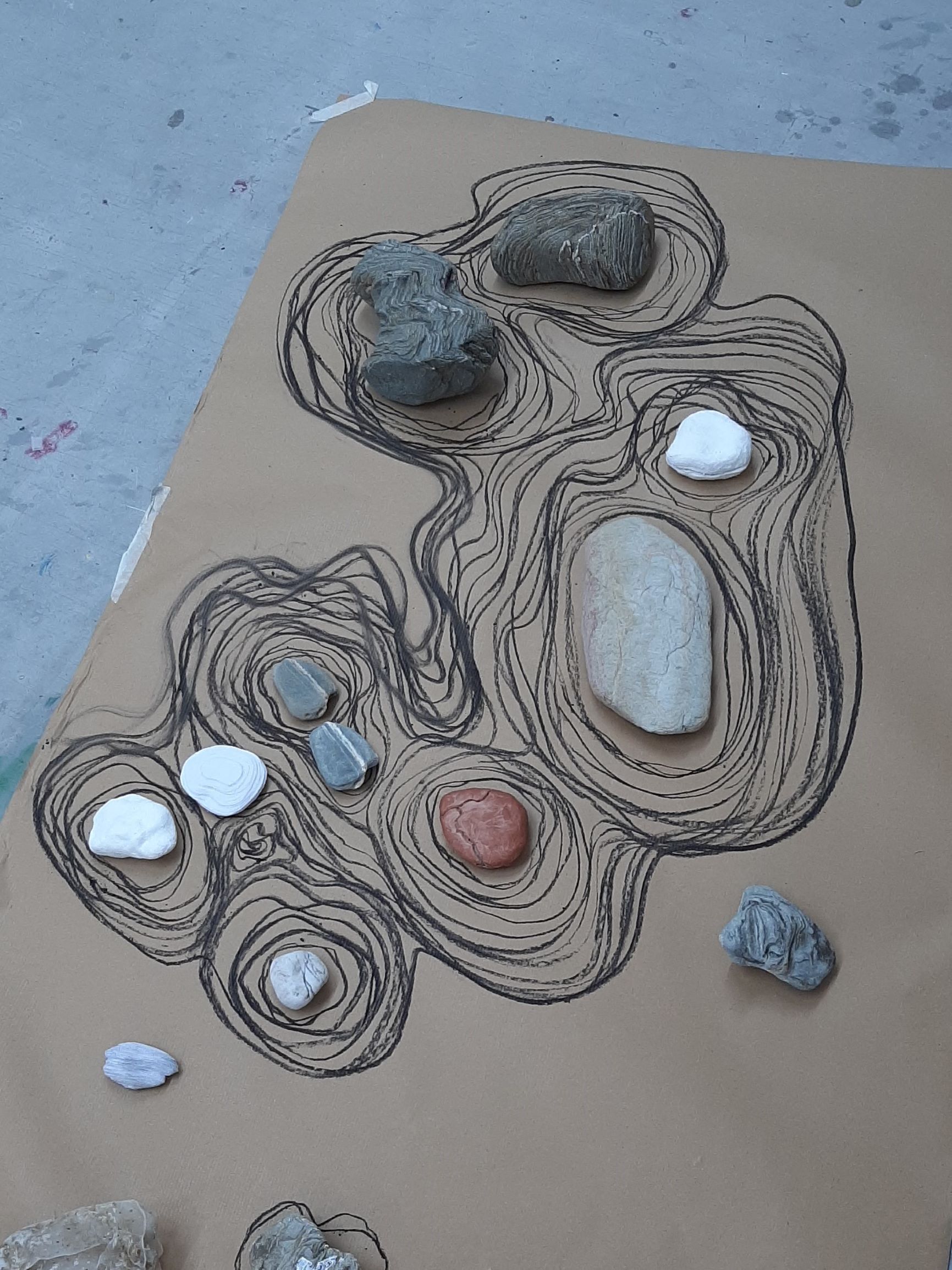
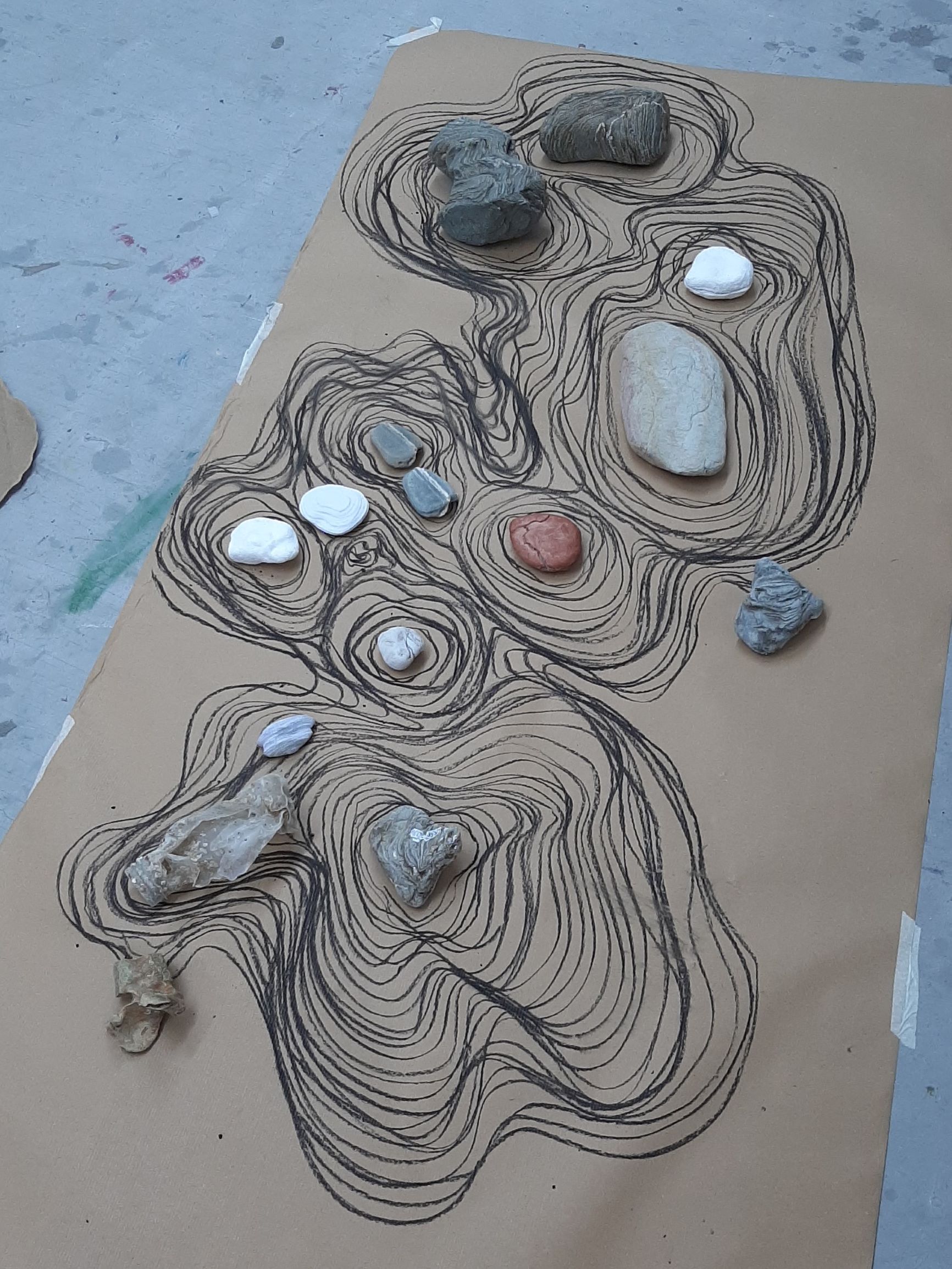
Working right up to the edges perhaps draws attention too much to the paper as it becomes a defining restrictive force in the piece. It is the rocks that are of importance so the work should be focussed, and limited by, those only – perhaps on a further attempt I should spread the paper more widely so as I can create equally large patterns but without being cut off at the edges, just leaving them as rounded edges. The scale of the piece also meant it was quite a physical job to draw the lines, requiring the whole body to bend and flex around the centre points. This may have been an influential factor in how well the piece flows, with difficulties clearly arising in the same areas each time to create this sense of contraction and release that travels across all the lines. To me this links back to Gormley’s use of the body as both a tool and restrictive force in An Exercise Between Blood and Earth, and is an interesting representation of the creation of a piece being evident in the final product, something that he talks about in many of his sculptures.
In all, it was refreshing to work on a different scale, and a larger one at that: the effects of smaller choices are magnified, energised by the use of the whole body. At the moment I see the piece as one more addition to the previous rock line works, but with the continuation of other previous themes and opening up future themes such as installation – larger scales and the incorporation of objects into a 3D space – and the idea of material authenticity.

 Anna Harris