To understand a landscape one must learn its bones. Rocks gorge and flood plain, ice-smoothed hill or upthrust ridge record the earth’s experience like wrinkles on an old face…The underground bones control the growth above, the green skin of earth revealing what lies below.
Marion Campbell, ‘Argyll: The Enduring Heartland’

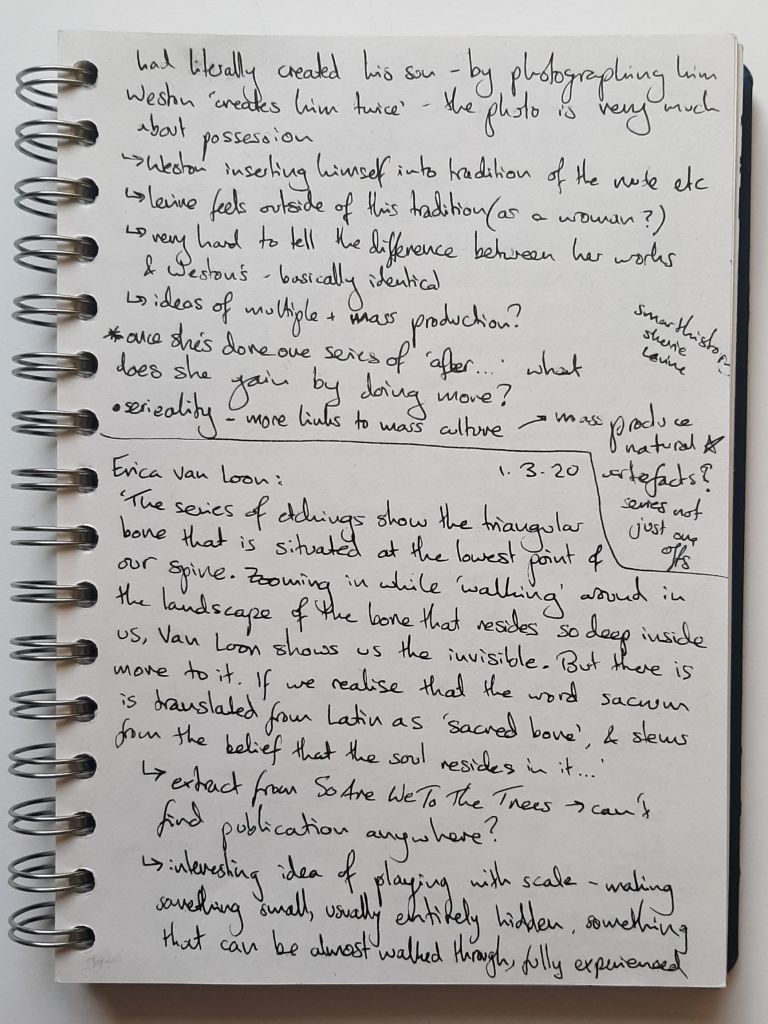
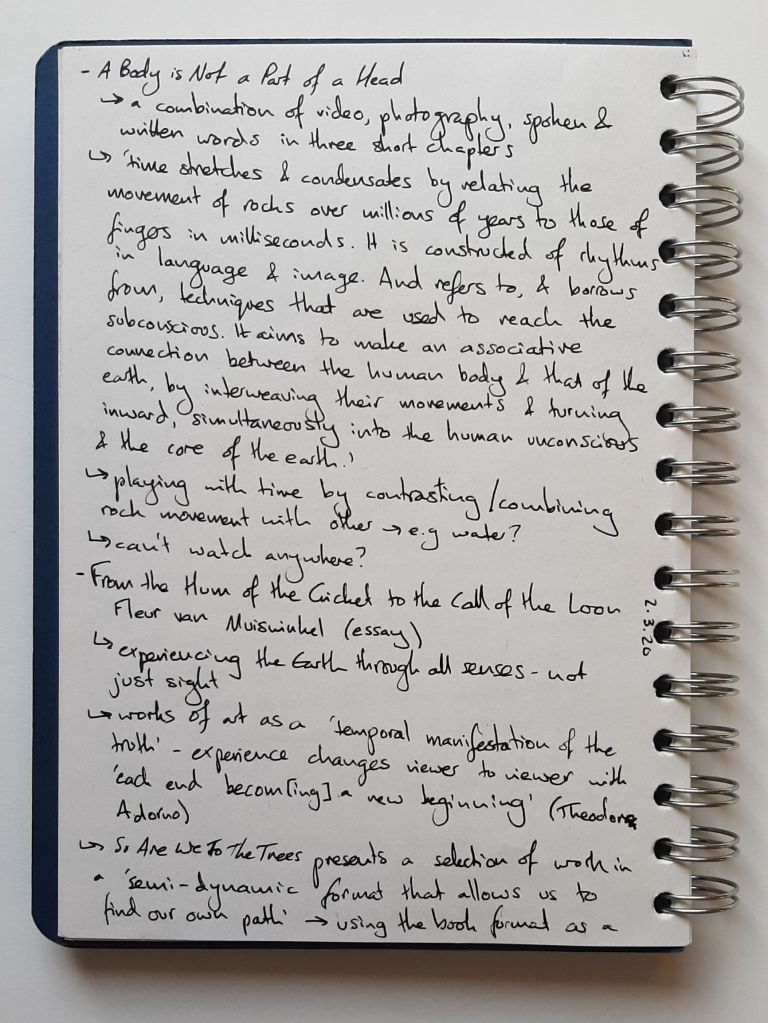
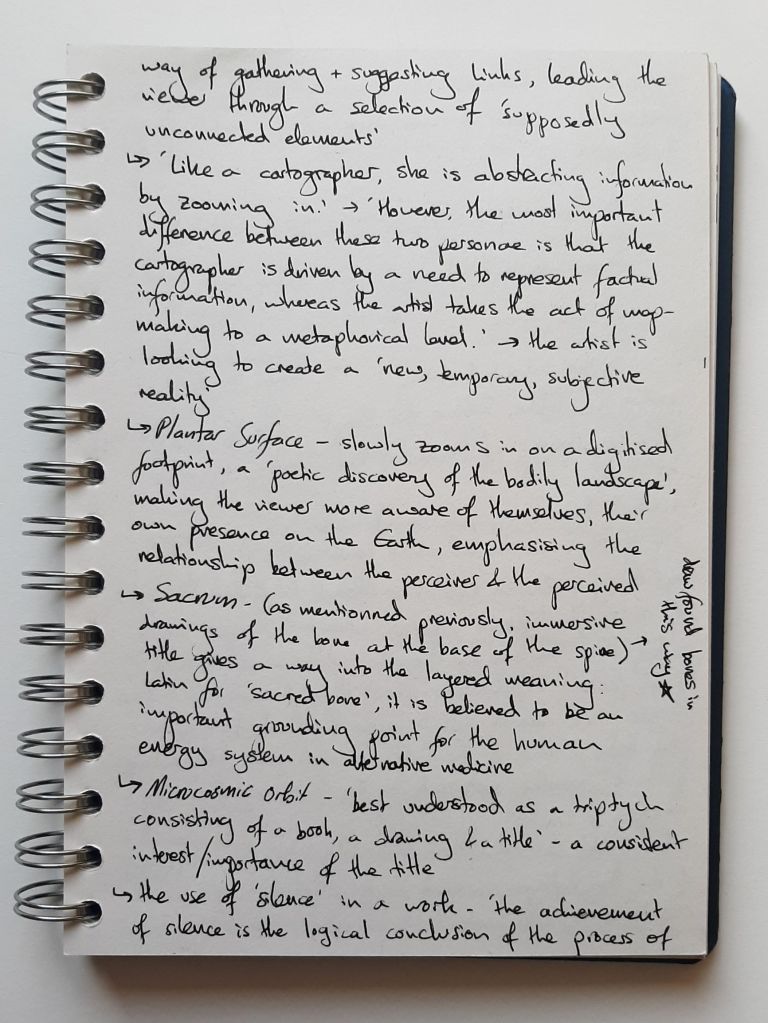
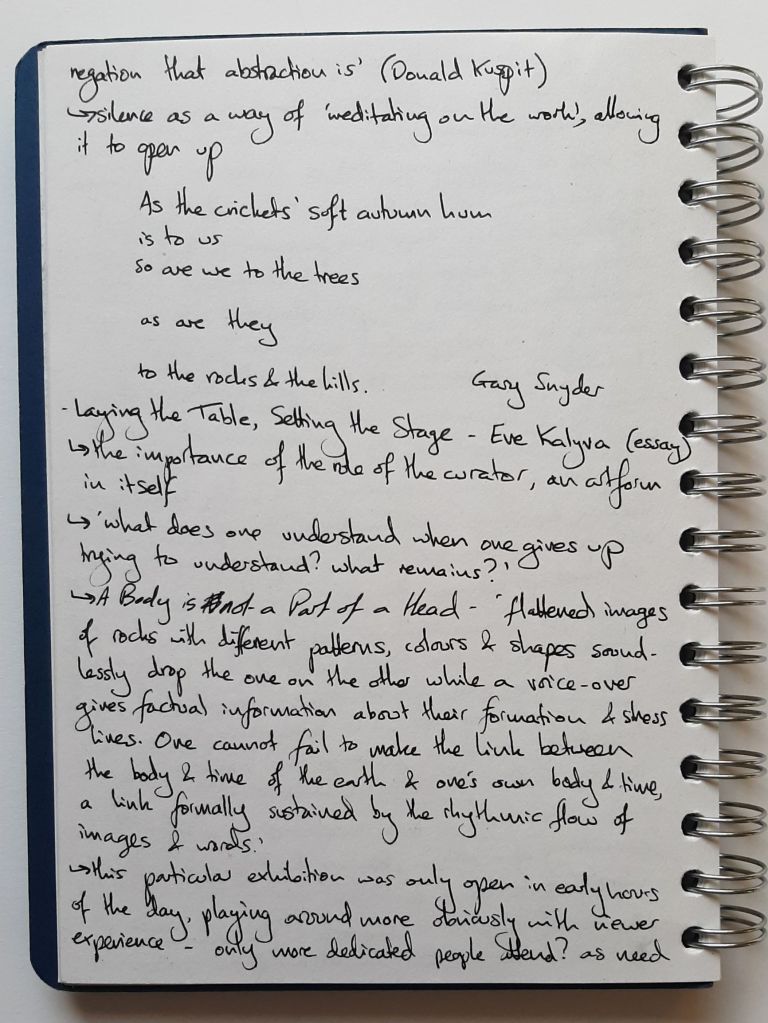
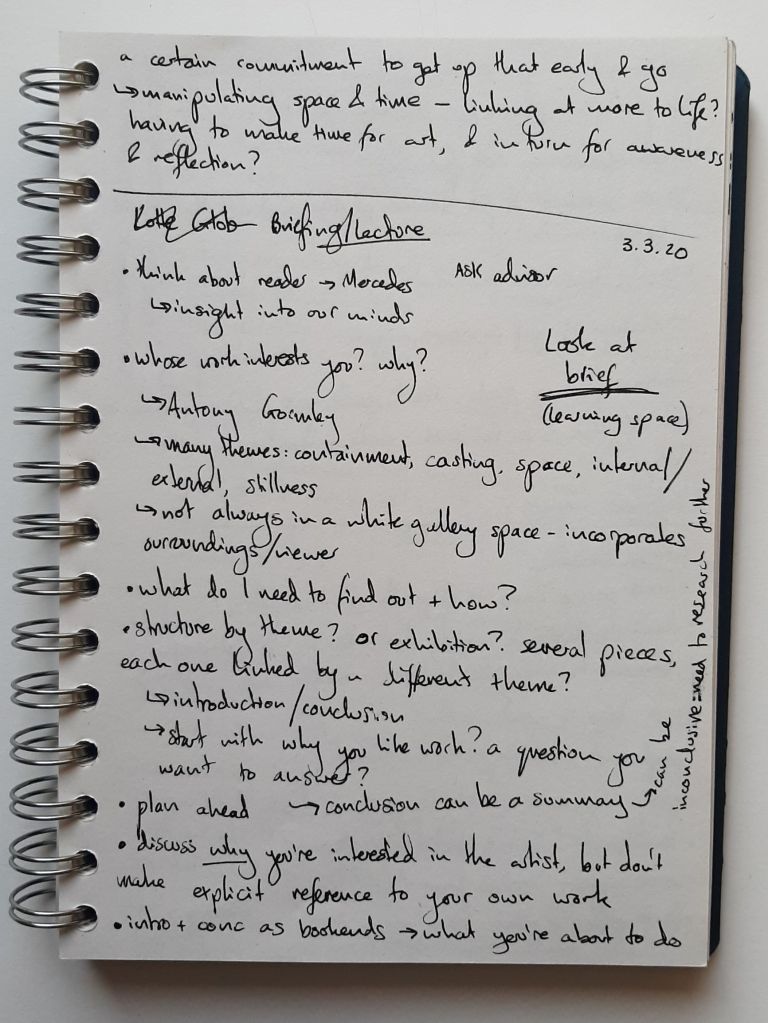
Based on the above collection of research I have produced some drawings exploring further ideas of immersion discussed in previous posts. As can be seen in the above notes, Erica Van Loon’s piece Sacrum is an etching of a human spinal bone, zoomed in as though a landscape around which the audience can walk. By chance, on a recent beach walk I discovered a vertebrae (of an unknown animal) so my first drawing explores very similar ideas to Van Loon’s. My piece enlarges the bone, immersing the viewer, the composition aiming to draw the eye through the piece into the imagined centre of the object. The cropped composition is influenced by the zines I created; cropping compositions, abstracting them, playing with macro and micro, is a good tactic of drawing the audience in and creating an immersive experience in small objects. I chose to use intricate mark-making to heighten this desire to look closer, the intricacy hopefully also providing an attractive force to viewers. This mark-making also means the process of creating the work was relatively time-consuming, something I have spoken about before as being an important aspect to the work (particularly when sculptural) as time almost becomes bound up in the final result. Their close-up nature also really emphasised to me how drawing can become the process of looking, spending time with and understanding the object in question.


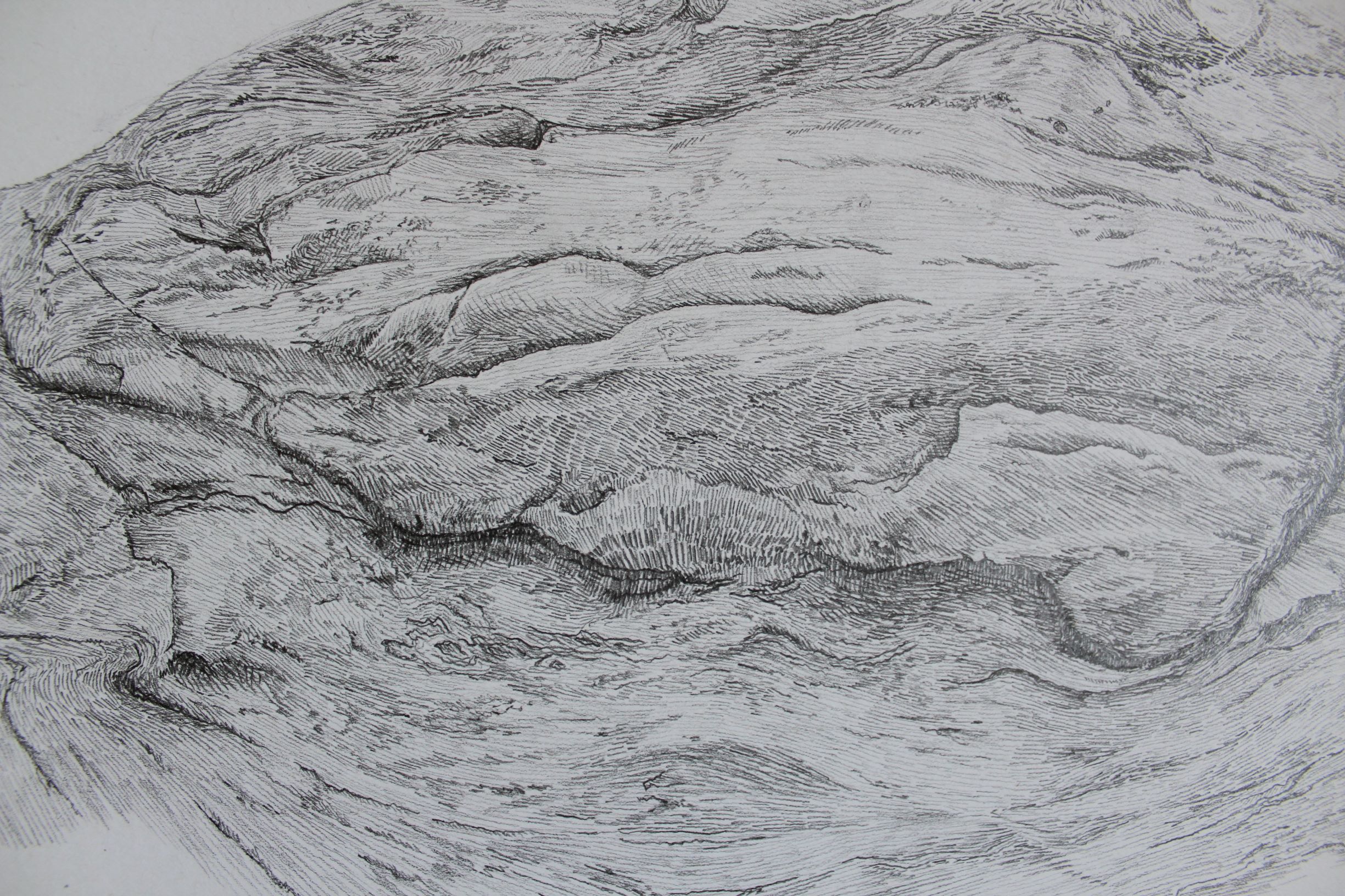
I also thought it made sense to explore this same process with rocks, zooming into their surfaces, exploring them as though they were landscapes. As opposed to the bone, rock really can form landscapes which brings in an additional element of intrigue; perhaps at first glance it may appear as though simply a drawing of a landscape/rock formation but then there are often subtle differences between the small-scale patterns/textures/forms and the large scale.


This drawing had some areas that I felt were successful and some that weren’t so much. I like how the intricate mark-making of the first one has developed here, creating a highly detailed finish; to me it even leans close to the style of older engravings/etchings, as though it were a (mythical?) book illustration or something in this realm (another link back to zines/books). However, overall I don’t feel as though the piece has the landscape-style effect I was envisaging, instead appearing still as an individual pebble. The piece needs to be more immersive, ideally compositionally as the first one was, physically drawing the eye in and encompassing the viewer. The problem in part lies with my drawing being too similar to what I was drawing from: I struggle to draw from imagination alone, or even alter references to fit a different image in my mind, so perhaps this is something I need to work on. This may be helped by approaching drawings less formally – some rougher compositional sketches may have helped here as it would have allowed me to try out different ideas without committing so much time to each one.
My third drawing (currently in progress) therefore aims to maintain this level of intricate detail but compositionally delve further into the landscape-like patterns. I have taken a slightly different approach in that this time the drawing is from a more flat perspective, as though a bird’s eye view of a landscape, rather than from eye-level of someone on it. Whereas the first two were A3 in size this one if far bigger (roughly A1 but from a roll of paper so not exactly), perhaps even as though it were a map with the contours and plains of the surface (landscape/rock) laid out for all to see.


I have yet to see how this particular drawing will turn out but potentially it could be interesting to approach a landscape drawing in a similar way – large scale and from an aerial perspective. There are many possibilities for how I could select the landscape: random (linking to the Boyle Family’s work?), related to the area a particular stone was found (the two drawings could then form a diptych of sorts?), or maybe a quarry? I could also re-attempt a more conventional landscape, from a ‘land’ perspective rather than aerial, but on this new larger scale, and with having first done some rougher sketches to work out the composition.
(later edit: completed pictures below)


 Anna Harris