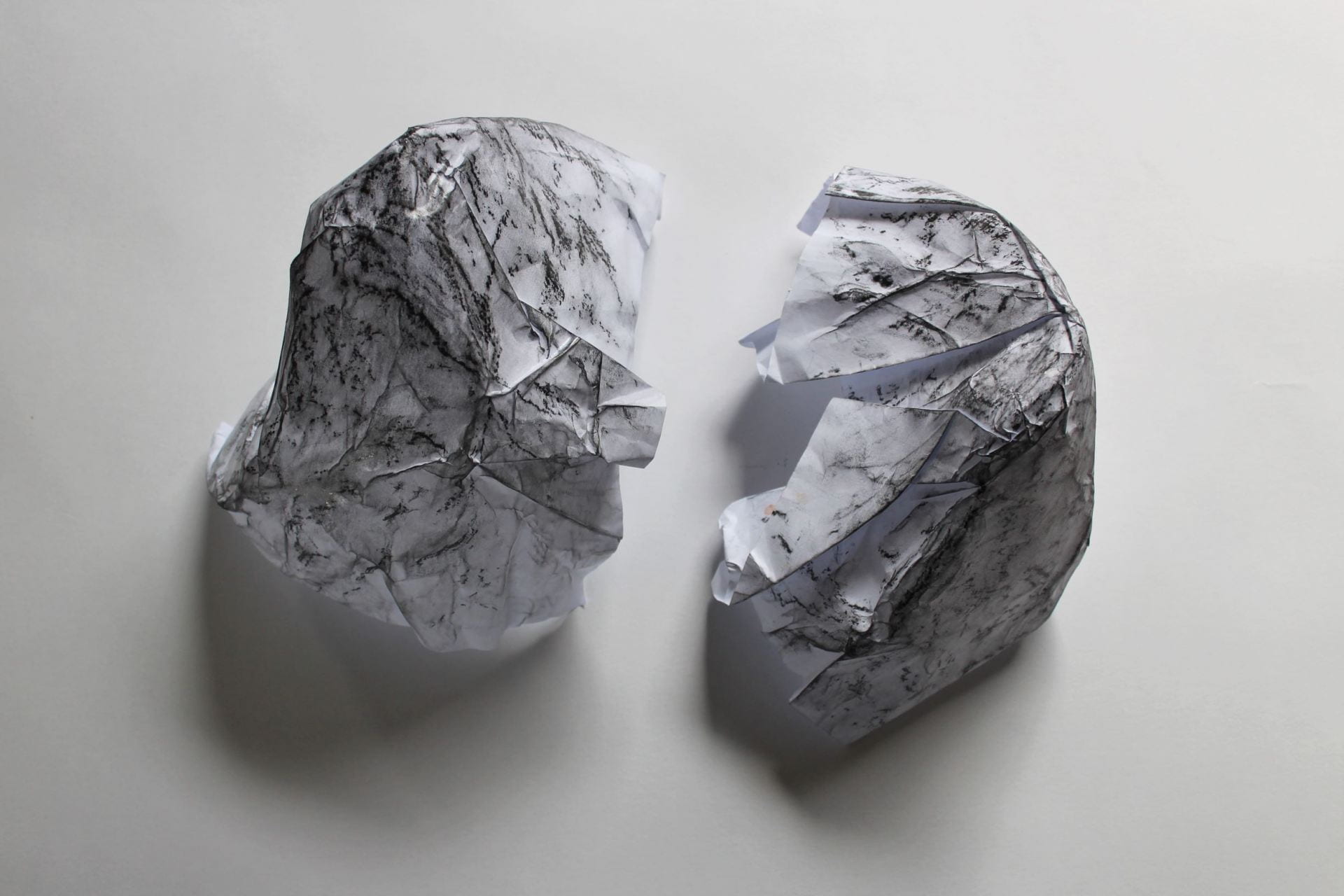
A theme that has been slowly emerging in my work for some time now is the idea of concealing or containing. I realised while out walking, and highlighted in my open studio reflection, that this is a way of tapping into the natural curiosity into the unknown that we all have; by covering something, curiosity is immediately raised in the viewer into what it is that’s being covered, what it is that they are being denied access to. This sets the mind racing with the possibilities and reasons behind the concealment, something I am looking to harness and use to direct attention towards a rock’s materiality and deep time connotations.
One of the most interesting elements that I took last year from Antony Gormley’s RA show was his portrayal of the body as a vessel, a container for experience that we all share. He encourages his audience to consider the body as a physical place that we inhabit, especially accessed when we close our eyes and are alone in our own dark space. Many of his works convey this through creating a ‘bodily black hole’; in Cave you could physically walk into and explore this dark space, but in works such as Body and Fruit or Fruits of the Earth, as well as his well-known body casts, the space is more implied, totally concealed from view and left up to the imagination of the viewer.


Body and Fruit, Antony Gormley 
Fruits of the Earth, Antony Gormley
What would this mean if applied to rocks and/or other inanimate objects? Instead of being vessels for universal shared experiences, could we instead consider them as vessels and containers of experiences outside of us, whether known or unknown. By provoking thoughts of what the object is, what it could look like, the mind wonders further onto the story behind it, how it was made/formed, how it came to be where it is today, where it has been, how old it is – the story behind it, the object’s ‘soul’.


This particular group of works/experiments developed from taking some rubbings from the surface of a rock. As I rubbed the graphite stick across the page it fell into each nook and trough and rode over each crest and peak, a three-dimensional exploration of the surface. The paper, as a result, began to follow the same pattern, mimicking the texture of the surface until becoming almost an exact skin. The resulting drawing was then very sculptural, capturing a physical presence of the rock that lay beneath. It also, crucially, obscures what was once beneath, capturing only a hint/a shadow of what was once there, and therefore playing into this device of the unknown as a provocation.
Recognising the potential of this sculptural drawing, I went on further to create some more explicitly sculptural pieces. Instead of using a flat surface embedded with rock (as was used for the previous rubbing), this time I selected one large rock. The resulting rubbing was what I can only describe as a ‘shell’ of the initial rocks: an outline in three-dimension, capturing the entire shape and surface but empty inside. They are strangely delicate, almost ephemeral in comparison to the heavy, immovable stone they describe through their central voids. Indeed, in an odd inverting, the larger the original stone, the more delicate the resulting shells will be.


I feel these paper shells are curious objects that are effective at exploring a rock’s surface as a skin or interface between the beholder and what’s contained within; something I have been looking at for some time now and am continually searching for new ways to explore. I am finding it to be an iterative process, especially when the method is as quick as this one; I can make many pieces, each one a little different, and then come back to them after a little time has passed to critique them with fresh eyes. In this manner I have found my work from last year to be surprisingly helpful in starting off this year’s work; the time that has elapsed since making the work is allowing me to analyse more critically what I feel worked, what themes are continuing to emerge and what ideas and works would be good to revisit.
The idea of capturing a sense of an object/rock’s physical material presence, not just as a vessel for experience but also simply as a vessel of matter, is one that I am continually drawn to. This is something that I feel casting is particularly successful at, but also something that is explored through these paper shells. I wanted to explore this idea further in perhaps an even more ephemeral way, or a way that gives the viewer more of a way into the space, a visualising of the interior space previously occupied by stone. As such, I am also experimenting with using cling film to create shells in the hope that they will embody this same sense of the ephemeral and the ‘skin’ of what was previously there, yet will be more all-encompassing, and will fully contain the space once occupied by rock. Being able to see the interior of a piece perhaps articulates more explicitly the idea of a captured space/moment, although this is something I currently cannot fully assess as the works are still in progress.


The in-progress shots, as taken for the open studios event, do have an interesting connotation of the man-made/the plastic smothering the natural, a clear link to the ongoing climate crisis. Again, this is a link I have found to crop up a few times in my work, something that is perhaps inevitable when working with natural and man-made materials in the contemporary climate. This is something I enjoy about making work that isn’t overly explicit in its message, that takes a bit of probing into and considering; the material and composition can be read into in a variety of ways, not all of them ways that perhaps I would have intended or thought of myself, but that’s not to say they aren’t still valid interpretations.
Going forward from these I will see how effective the cling film is at holding its shape – it is possible that a stronger material such as resin could offer an alternative if the cling film alone is not strong enough. Resin is another material with plastic associations, and would also be good for capturing a certain space, then allowing an interior to be visible to the viewer. Perhaps casting a rock in resin, as well as making resin outlines, would also be an intriguing piece to make.

 Anna Harris