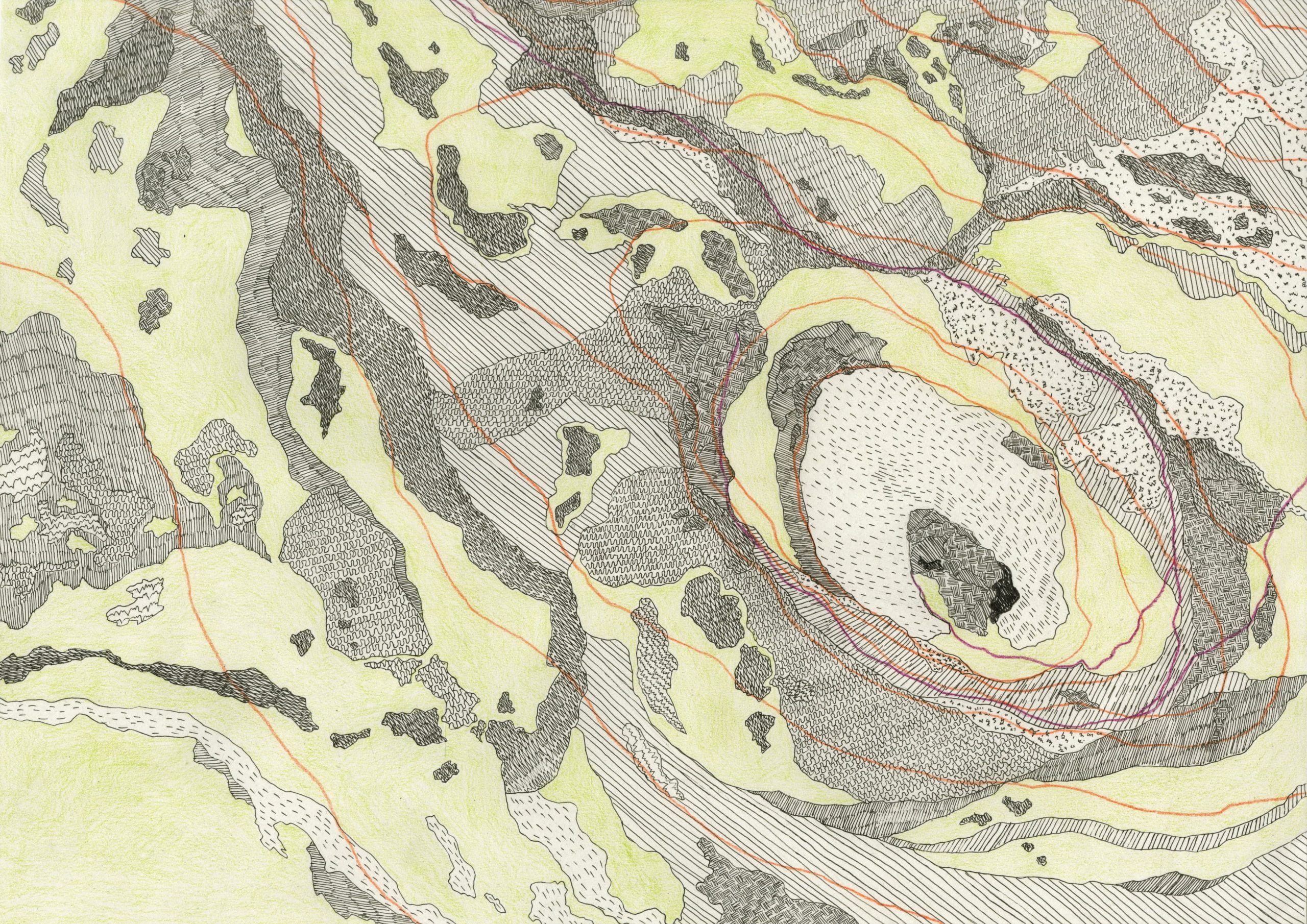
This ‘rock map’ is a piece I have been working on since the week 2 research seminar, based on some feedback on the ‘rock landscape’ pieces I made last year. The group picked up on a ‘fictionalising of the surface’ and commented that it was the plurality/complexity of the different registers of mark-making that draws the viewer into the image, particularly linking this to a cartographic method of image-making. I have long found maps to be intriguing, striking at an intersection between science and art to create abstract images that, conversely, are exactly representational of the world. As such I chose to make this piece, similar to the previous rock landscapes, but this time bringing out the mapping element more explicitly.


What I enjoyed about the rock landscapes were their ambiguity in scale, a confusion between the macro and the micro; they were drawings of tiny areas but their explosion to a much larger scale created whole landscapes for the eye and mind to wander through. The viewer can become immersed in an object that can sit in the palm of the hand, an idea that I am also exploring in the medal project. There is a certain sparking of the imagination, too, that is running through my thought and work at the moment – as I mentioned in, for example, the ‘walking’ and ‘rock shells’ posts, I have realised that the unknown can be harnessed to provoke the imagination, something that I have been trying to use a little more consciously. Although this piece doesn’t use the same concealment as I wrote about previously, the ambiguity in scale, along with the fictionalising of the surface, does still have a similar effect in terms of encouraging the mind to wander and the imagination to roam, firstly over the surface but then beyond this, into perhaps the rock, its past, its deep time and the stories contained within it.
An extract from Nicholas Chare’s ‘Writing Perceptions’ sums up these ideas well:
“In his essay ‘Art as Technique’, Victor Shkilovsky argues that art provides the remedy to habit in that in that it can make the familiar appear strange. He contends that “art exists that one may recover the sensation of life; it exists to make the stone stony. The purpose of art is to impart the sensation of things as they are perceived and not as they are known.” …writing about art can become artful… Can fulfil the purpose Shkilovsky ascribes to the work of art. Artful art history can make the familiar object of study strange, make the stone stony, so as to bring it back to perception. […]The materiality of things can only be returned to them through a writing that encourages deceleration, an extension of the length of perception, an attention to detail, even if this entails coming close to inertia.”
This idea of making the familiar appear strange is exactly what I feel this rock map is striving to do; factually, just like conventional maps, the drawing is an entirely accurate depiction of the rock’s surface, simply reproducing it on a slightly larger scale. However, it becomes abstracted in the process, meaning the once familiar idea of a rock’s surface becomes something to be inquiring of, something to explore. The attention to detail, too, is an important part of the work. As with many of my pieces, the process of creation is also important, becoming almost performative in some senses. The piece required an intense studying of small details (as the A3 drawing is based on an area of rock no bigger than 4x3cm) and a long time spent studying these. There becomes a strange sense of experiencing time with the rock, alongside it, although obviously for an imperceptible fraction of the rock’s lifespan.
This process of spending time with an object, examining it in high levels of detail, links to the work of Vija Celmins whose work I have been looking at for the Mediascape essay. Celmins’ work shows an extreme attention to detail, a record of concentrated looking, of ‘moments of attention’. She says of her work: ‘art offers its beautiful stillness…a sense of wonder constructed over time…of sustained emotions’, tapping into this idea that time spent creating an artwork can form a kind of accumulation, a visual intrigue to draw a viewer into a piece. Interestingly, Celmins also describes her work as abstract:
‘One decision was that I was going to go back to a more abstract kind of work…that kind of double reality, where there’s an image, but the image is here in another form, and … when you look at the work, you have that kind of double thing you should have all the time, where you’re looking at the making…a kind of redescribing of the surface, and the image is interwoven with that surface’
This is interesting given that, superficially at least, her work is by very definition representational in its extreme likeness to its subject matter. However, it is this likeness that serves as an abstraction in and of itself, creating this ‘redescription’, paying extreme attention to the formal properties of the materials and abandoning a traditional use of perspective. In this way, there are similarities between Celmins’ work and cartography: both are true, realistic depictions of the world, while simultaneously playing with notions of the abstract.

In terms of the recent provocation of ‘free fall’, this piece links nicely due to its use of the ‘bird’s eye view’/aerial perspective as is typical for mapping. This places it within the contemporary theme and visual mode of the use of vertical perspectives through modern technologies, as discussed in Hito Steryl’s Free Fall text. It would be interesting to take this piece a step further, perhaps even comically so, and digitise it, allowing a Google-Maps-style street view of the rock surface, allowing virtual roaming through imaginary landscapes. There is certainly a slight playfulness evident in this piece that was not evident in the rock landscape drawings – the move into colour, into more explicit differences in mark-making perhaps means it takes itself slightly less seriously and in this way may even be a more accessible piece? Another fun idea going forwards would be to play with scale further and develop this into a larger, maybe even comically over-sized, piece the size of an OS map, folding out into an anthropomorphic scale.

 Anna Harris