Ideas and Intentions
Describe your body of practice-based work including the aspirations and ambition for your work.
- I have been carrying on where I left off at the end of last year – studying rocks’ materiality and age and how this can be used to access ideas of deep time.
- I created a couple of ‘fake rocks’ last year to begin a critical investigation into the materiality and processes of rocks; when two apparently identical objects are sat side by side this sparks an investigation, both aesthetically and conceptually, into the differences between the two. I have identified these pieces as some of the most successful from my previous body of work so am looking to continue this, perhaps pushing further to create more than one copy to make more of a ‘field’ of identical objects.
- Another area I was looking at previously was how to express the idea of rocks as masses in space, with an interior and an exterior, perhaps even as containers of sorts. I’d like to look further at harnessing this idea of the contained unknown as a device to spark the viewer’s imagination.
- Drawing a viewer into a small object in this way is another theme I’m keen to explore further, this idea of immersion in small objects, a confusion between the macro and the micro.
- The provocation of the far future has made me consider my work’s relation to the human slightly more explicitly, especially in regard to considering deep time in terms of the future and not just the past. This is something I intend to explore particularly through the medal project, this idea of the transience of humans and landscapes and the interaction between the two, especially using the materiality of the medal itself (bronze, melting, mining, local historical connections to the landscape (Cornish tin)).
Form and Materials
Describe the materials, mediums and the form your work is taking in relation to your concepts and ideas.
- Whereas I initially made the fake rocks with an alginate mold and a plaster cast, I would like to look into using other materials. Firstly, making silicon molds, rather than alginate, that allow me to create more than one replica of a rock, pushing this idea of an unnatural duplicate of a uniquely formed natural object to its limits. And then secondly casting in concrete to create a more ‘rock-like’ feeling to the copy when handled so the illusion continues beyond the visual to the tactile.
- With the exploration of masses in space I have been making rock ‘shells’ with a combination of cling film and PVA, and other pieces in resin, to create lightweight, translucent three-dimensional outlines. There is also an unintended element of climate commentary here with the interaction of the natural rock and the smothering plastic which could perhaps feed back into the investigation of the interaction between human and landscape, especially in terms of looking forwards at human impact on deep timescales.
- I have also been using clay for a few pieces: a clay rock and some clay maquettes for the medal project. The clay rock explores the idea of a copy without an original, again continuing on from last year’s work around what makes a ‘fake’ rock. The clay maquettes are impressions of rock that simultaneously suggest a miniature landscape, playing on this confusion between the macro and the micro and the immersion in the small and hand-held. Some other maquettes (for the flip side of the medal) are impressions of a palm, looking to introduce this human aspect and an interaction between the two sides/ideas. Some of the maquettes are also in wax, and will soon be cast in bronze.
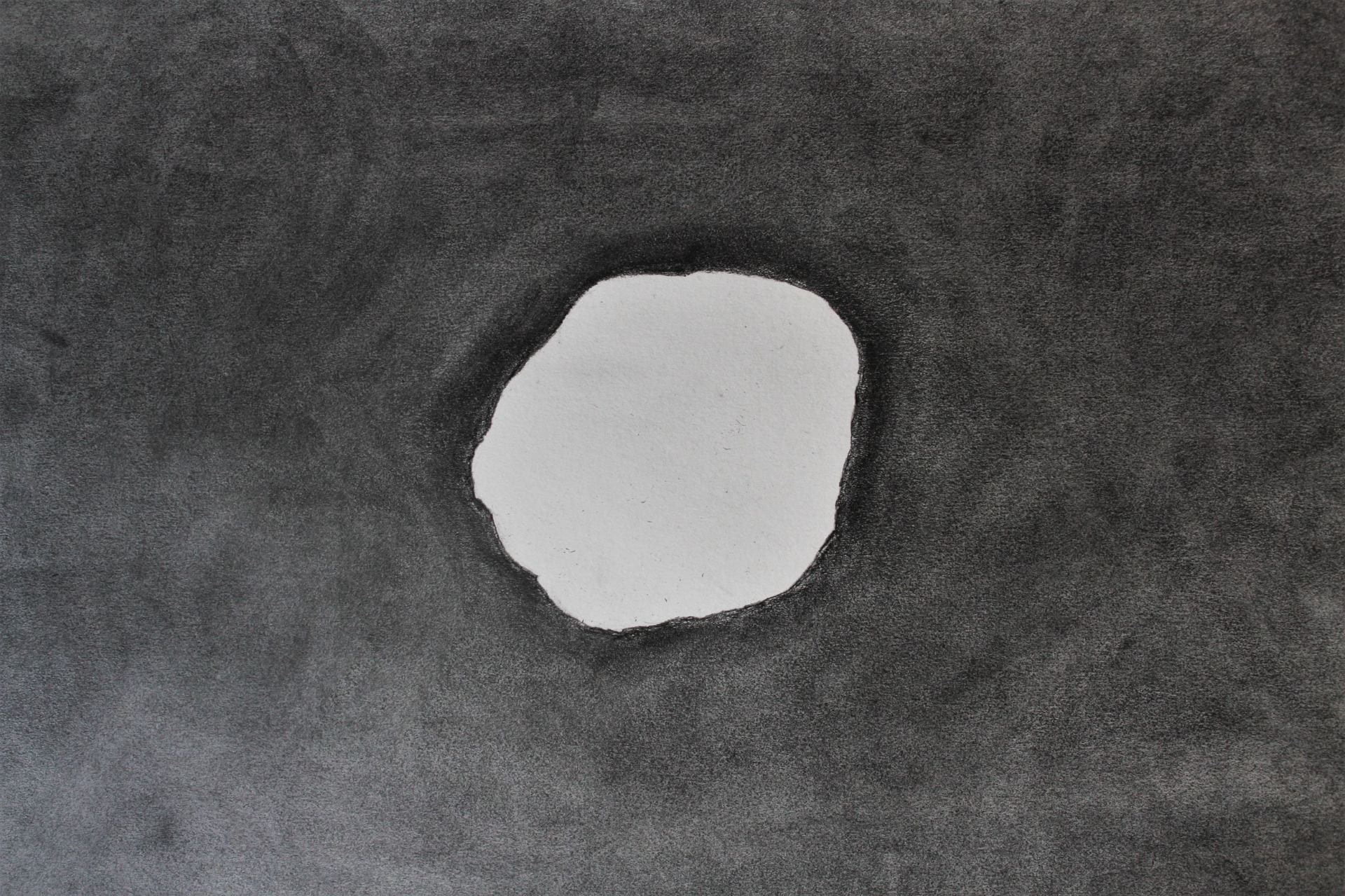
- The only other media I have been using is pen and pencil/graphite powder to make a series of exploratory sketches as well as a couple of larger pieces. The pen sketches explore ideas of flow around rocks – water as a deep time material is something I keep touching on briefly and is an area I’d like to come back to at some point. I also have a somewhat abstract drawing that maps the surface of a rock in order to explore this idea of immersion in a small object, and again also looks to provoke the imagination by fictionalizing the surface. Another piece is a pencil drawing, a still life (?) of a singular rock, inspired by the work of Vija Celmins. There is also a series exploring the concept of three dimensional negative space/voids projected onto two dimensions.
Imagination and Creativity
Describe the ways in which you have approached your work in a speculative and imaginative way. What risks have you taken? What have been the key challenges?
- I have been pushing myself to truly embody ‘thinking through making’, letting the outcomes of my material experiments determine what I make next and not being too prescriptive of my work ahead of time. In this way I am challenging the way I have conventionally been working; I am prone to lingering in the planning/theoretical research stage of making which can often result in quite a stilted body of work. I am learning that in some cases it is almost a case of quantity over quality just in the sense that having a wide range of visual stimuli is more conducive to being selective of the most successful pieces going forwards.
- I have also been using new techniques and materials such as taking my casting work into concrete and using silicon, rather than alginate, for making the molds.
- A key challenge at the moment is actually writing about the work, trying to explain and contextualise what it is I am looking at. It’s an ongoing challenge to find a balance between working too conceptually (getting stuck planning out ideas and not making enough) and working too physically (not putting enough time aside to reflect and contextualise what I’m doing). Previously I have felt I’ve been too conceptual so pushed myself to make more which I do feel like I am succeeding at, I just need to ensure it isn’t at the expense of writing about my work as this is an equally important part of my practice.
Critical Reflection and Evaluation
Discuss the artists and themes that are influencing your work and how you see your work fitting into the wider context of contemporary art.
- The provocation of ‘the far future’ has been hugely helpful in showing me where my work sits in relation to other artists exploring deep time. Whereas I have been looking at deep time in the sense of the past this has opened up the possibility of considering the future too, an idea of the legacy and longevity of the art I make. This is particularly relevant to the materiality of the media I choose to use which again is something I was looking at previously but that has been put in a new light.
- There are many artists and thinkers working in this realm of deep time whose work I have encountered through lectures and screenings including Katie Paterson, Joseph Beuys, John Cage, Jem Finer, Bebe Williams, IC-98, John Latham, Neal White and James Turrell. Going forwards I intend to research their work more closely and reflect on exactly where my work sits in relation to theirs.
- I have been researching the work of Vija Celmins closely for the essay and her work has also fed into my own. She explores the tension between abstraction and figuration through her practice of ‘redescribing’ particular objects and images, and her pieces often have a meticulous, quiet energy to them that I feel is present in some of my own work.
- Other influential artists include Tania Kovats, Peter Randall-Page, Matt Chivers, Ken Gill and David Nash.
Personal Development and Professional Studies
In what professional context would you like to see your work? How have you developed professionally this module? What have you learnt?
- I have had a couple of professional opportunities lately but neither of them explicitly linked to my practice – one was making an Instagram story for the Tate Collective and the other was having an old piece used on the packaging of Padstow Brewery’s new release.
- I have been volunteering at the Newlyn Art Gallery and the Fish Factory Art Space in Penryn, both of which allow me gain greater understanding of how these professional art establishments function behind the scenes.
- I am on the team for the Woodlane Windows space which again I hope will give me more experience in the behind the scenes, curatorial role of running an art space.
- I have also been taking part in the Tate Collective Producers program which allowed me the paid opportunity to create the Instagram story as mentioned above. I have also gained wider skills in collaborative art making and events organisation.
- An area I could improve in terms of how I present my work to a potential audience would be my Instagram. At the moment it feels a little stark and lacking a focus/personality so putting a little more thought into this would be a good way of expanding and improving my professional image.
- I don’t currently feel in a position to exhibit but I hope that by the end of this study block I’d have enough work to put together a small exhibition. Whether or not this is something that could actually happen aside, I think it would be beneficial to me to consider this prospect seriously, perhaps treating the December hand-in as an exhibition of sorts, considering how I would hypothetically like the work to be displayed and what writing I would have alongside the pieces.

 Anna Harris