A collection of notes and quotes for use in the Mediascape essay
Vija Celmins: To Fix The Image in Memory, Gary Garrels
- Pg 13
- ‘Art offers its beautiful stillness…a sense of wonder constructed over time…sustained emotions’ (Vija Celmins)
- The work asks us to stop, pause, truly see and attempt to remember
- ‘They reflect an extraordinary attention to materials and possess a level of detail and subtlety that can only be fully grasped in a physical encounter’
- Idea that she isn’t widely known outside of the art world, but is so well known within it
- A ‘singular artist’ – doesn’t align with particular theoretical frameworks or groups etc
- Pg 14
- She ‘redescribes’ her subjects – ‘extreme distillation’
- ‘One decision was that I was going to go back to a more abstract kind of work…that kind of double reality, where there’s an image, but the image is here in another form, and … when you look at the work, you have that kind of double thing you should have all the time, where you’re looking at the making…a kind of redescribing of the surface, and the image is interwoven with that surface’ (Celmins) – really interesting that she describes her work as abstract when conventionally speaking it is almost the opposite of abstract – it is entirely representational a lot of the time
- ‘I want the feeling that the image was developed as far as it could go, and that it can stand a lot of inspection’ (Celmins)
- Pg 15
- She never used an eraser and would start again if a mistake was made – the idea of the process, the experience
- The edge of the works are important as the image is defined by it, the ‘illusion of continuous space’ is broken
- Relationship between paper and image
- Pg 16
- ‘it’s a kind of record of moments of attention’ (celmins)
- Comb is a ‘memorial piece for Magritte’ (celmins) – ‘the juxtaposition of “the real and the illusionary”’ in Les valeurs personnelles
- Pg 17
- Began collecting rocks with constellations on (after having done series of drawings of constellations, desert floors etc) and inspired by Jasper Johns’ casting of everyday objects in bronze started to cast them and paint them
- ‘I developed this desire to try and put them into an art context, sort of mocking art in a way, but also to affirm the act of making: the act of looking and making as a primal act of art’ (Celmins)
- Also ‘a piece that was as devoid as possible from manipulation, ego, idealisation and distortion. Just moments of consciousness’
- Pg 18
- Began becoming more interested in painting – more layering, ‘a more complicated spatial experience’ (Celmins)
- She sands the surfaces of the paintings down so they’re flat and uniform – ‘a very tight skin’ (Celmins)
- The process of layering – painting and sanding repetitively – ‘And in that way I think time is somewhere in the work’ (Celmins)
- Pg 19
- ‘paintings and drawings that insist on their status as objects while also emphasing their flat, two-dimensional character’
- ‘its surface was already made by school kids and time’ (Celmins)
- ‘combination of found and made objects creates an invitation to look harder than you would look normally’ (Celmins) – a bit of a fun/playful side to this too
- Pg 20
- Returned to still lifes later but now really zoomed in, the surfaces filling the spaces right to the edge of the canvas, like her sky and water pieces
- Pg21
- Revisiting painting the same image over her life-exploring time through her own body/relationship to the image – A Painting in Six Parts (potential for essay work?)
The Image Found Me: Vija Celmins in Los Angeles, Russel Ferguson
- Pg 57
- ‘an extraordinary body of work that defies conventional categorization by period or movement’
- ‘she was attempting to find a way beyond the increasingly ineffective rhetoric of abstraction’
- Her early (uni) work was being produced at the time after abstract expressionism (?) and pop art was just emerging – questions of authenticity were being raised, e.g. through warhols soup cans
- Pg 58
- New Painting of Common Objects and Six Painters and the Object were two exhibitions on near Celmins while she was at uni and would have been influential to the way at least people around her were thinking
- she emerged as a painter around the same time as many others who were heavily influenced by pop, but she didn’t see herself as Californian and therefore not one of them – ‘I’m from a grey land, Latvia. I’m not from California. I’m from a place where there was soot and trains and bombs from my very early times.’ – this idea of soot quite important? A general vibe in her work?
- Pg 59
- Robert Irwin – her tutor at ucla – shared an interest in the process of looking and how a viewer responds to the presence of a work in a room – ‘seeing is forgetting the name of the thing one sees’
- Pg 60
- Also influenced by Giorgio morandi – ‘a powerful painting that was still small’
- ‘I wanted it to be still. I wanted it to lie down more on the surface.’
- Pg 61
- Heavy influence of jasper johns
- The process of creation as a key part of the work – ‘the intensity of what is depicted is controlled by the process of depicting it’ (TV)
- Pg 62
- Gun with hand #2 – violent, hot (like heater) and rapid action slowed down through the contemplative, painstaking process of painting, and removed one step further through the use of monochrome (grisaille)
- pg 63
- ‘meditations on looking’
- ‘always looking longer and more intensely than anyone else’
Redescribing the Photograph, Frances Jacobus-Parker
- Pg 85
- ‘redescribing’ as opposed to copying or reproducing – ‘a layered process of notation and repetition’
- Pg 86
- Interesting interaction between painting and photography, often using photography as a bridge between the two as it takes the first step of rendering a three-dimensional object in a flat plane
- No need to grapple with artistic ‘distortion’/technologies of linear perspective etc – ‘[she] arrived at a methodology that combined abstraction’s attention to the formal properties of a medium with representation’s observation of the world’
- **link to contemporary drawing exhibition MOA**
- Pg 87
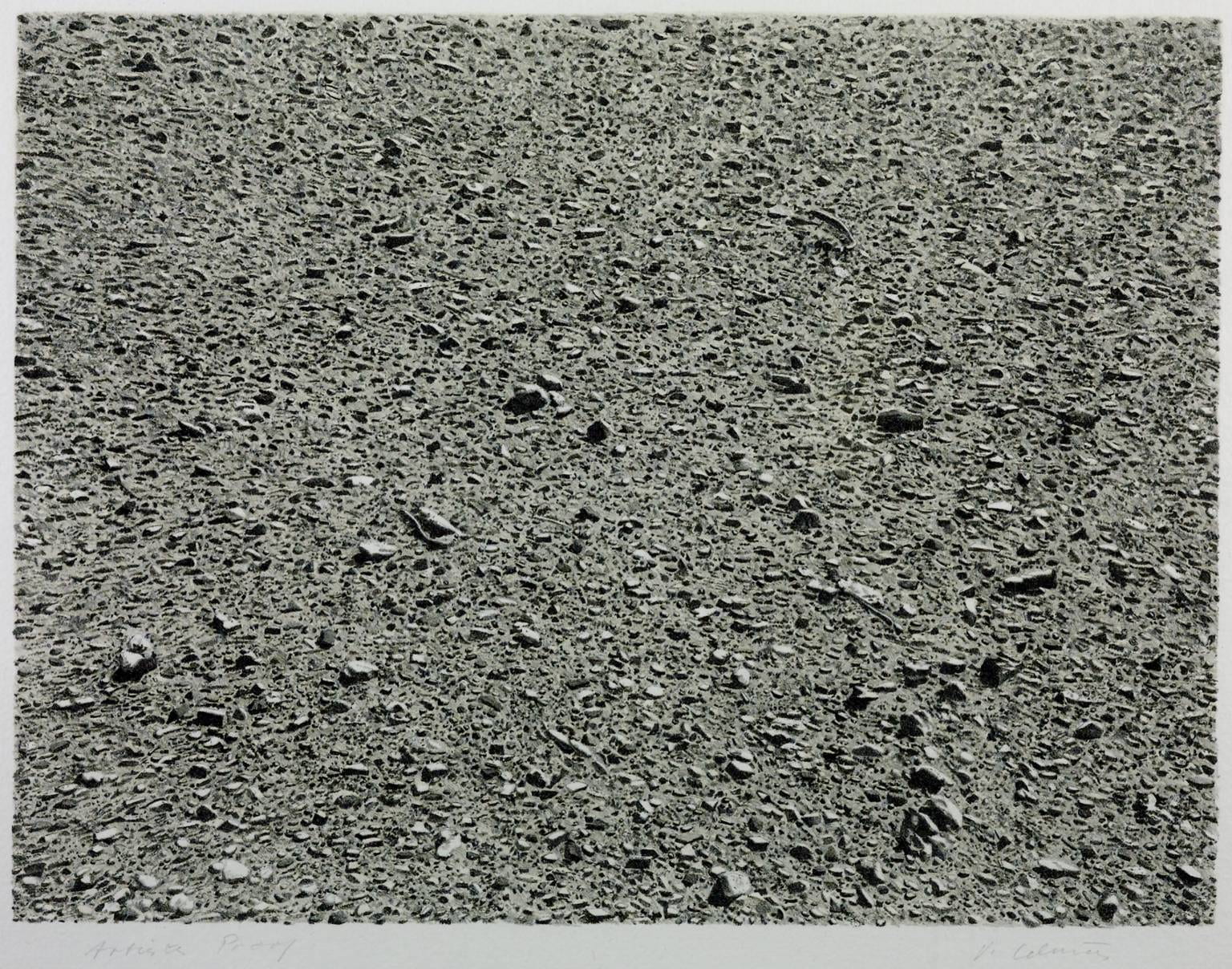
- She then moved into images of desert floors, the night sky, spiders webs, the ocean etc – ‘they picture repetitive but irregular patterns found in nature; they are allover with composition; without horizons or landmarks; and they are without colour’ – potential link to Peter Randall Page with repetition vs irregular patterns
- Gerhard Richter’s Atlas
- Robert Rauscheburg’s collages
- Andy Warhol’s silkscreens (repeatable)
- Ed Ruscha’s ‘city-spanning photo books’
- ^all artists working at a similar time ‘with appropriated mass media images and amateur snapshots to reflect on photography’s pervasive influence on the world around them’
- ^although perhaps Celmins explores more the relationship with the single image
- Pg 88
- A Painting in Six Parts highlights the reproductive nature of the work
- related to pop but also minimalism – Robert Ryman and Brice Marden’s ‘literalness of the painted surface’
- she seeks to ‘activate the whole surface’
- Mondrian’s pier and ocean paintings – moved from figuration to abstraction, where Celmins explores a dialogue between the two
- Pg 89
- Her sculptural pieces, as opposed to her painted/flat pieces, show that she doesn’t need photography in her work and in doing this shows that ‘photography is a means but not the end’
- **photography/mass production of images as a key contextual point**
- ‘Redescription’s provocation is that it abandons perspectival illusionism yet remains representational, scrambling the lines traditionally drawn in Modernism to distinguish abstraction from figuration’
Moving Out, Suzanne Hudson
- Pg 131
- Does the fact that an artwork take a long time make it more or less valid?
- James McNeill Whistler lawsuit (?) against John Ruskin for accusing him of producing work too quickly
- Early work link to Bruce Nauman – ‘my conclusion was that I was an artist and I was in the studio, then whatever it was I was doing in the studio must be art’ (Nauman)
- Her pieces don’t have a specific place or time
- Pg 132
- ‘Celmins’ allover compositions, so disorienting in their parallax between macro and micro, appear to diffuse personhood into a million glinting flecks of a pencil and then leave you there, alone with them.’
- Pg 133
- ‘Do we need to be reminded that in an age of space travel a pictorial semblance of an open void is just as inviting to imaginary penetration as the pictorial semblance of a receding landscape was formerly to a man on foot?’ Leo Steinberg, 1972
- There is nowhere to go in Celmins’ images
- Pg 134
- ‘This is hot things looked and will look, one imagines, before we came and after we are gone, the sight of them not mattering. This choice of iconography – though, of course, it amounts to more than that: a diminishing of our egos – is brought off very simply by a selection of photographic images lacking any internal evidence to place or fate them.’ Max Kozloff (critic), 1974
- Trevor Paglen The Last Pictures – not necessarily relevant to the essay but interesting piece – images put into orbit that will circulate until the earth itself is no more
Longer Than Anywhere in the World: Vija Celmins on the East Coast, Ian Alteveer
- Pg 157
- The influence of her choice of art schools on her work and peers
- Pg 160
- ‘turning the readymade back into the made’
- Pg 162
- Robert Gober similarities?
Exercises in Abstraction, Briony Fer
- Pg 196
- Celmins work within the context of observational drawing
- John Ruskin’s The Elements of Drawing – how to draw a stone described over 20 pages (exercise viii)
- ‘The drawing Ruskin used to illustrate the exercise was not of a stone but of a fossil sea urchin, symptomatic of his view that everything bears geology’s cast.’
- ‘…Celmins work taps into a longer history of a geology of drawing, if we can call it that, now mediated in the context of a post-photographic age’
- This exercise ‘combines the repetitive with the exploratory’
- Each drawing is ‘a rendering of a ready-made image and not a record of the vastness of the ocean’
- Pg 197
- ‘The use of everyday images and objects, especially those that are ready-made or found, links Celmins’ method to that of many of her contemporaries but also roots it in the work of Jasper Johns, particularly its rebus effect and ambiguous oscillations between surface and subject.’
- Balance between indifference to and intimacy with the work
- The way she paints objects ‘encrypt[s] rather than reveal[s] her subjects’ – ‘if an object’s centered position says ‘look at me’, the rendering says the opposite’
- Pg 199
- To Fix The Image in Memory – makes a sort of field from all the pairs
- ‘The process of casting and laborious hand-painting holds up a strange mirror to the language of the readymade determined by mass production and consumption, revealing its strange prehistory in nature.’
- Think about the context of even her larger art practice – can contextualise an artwork within a larger body of work
- John Ashbury ‘the passage into impossible detail’
Vija Celmins: In The Artist’s Words, On life and art
- Pg 228
- Talking about how the war dominated her childhood/a sense of displacement – gravitating back towards some of the more child-like objects in her sculptures – comb, pencil etc – perhaps ‘an edge of humour’ to it
On other artists
- Pg 229
- The importance of abstract expressionists such as de Kooning – ‘doing away with the foreground, middle distance, background and making the whole surface…’
- This didn’t start with the abstract expressionists however but with cezanne – she openly speaks about her intentional studying of his work and how she believes the abstract expressionists then used what he developed and added the unconscious
- ‘Cezanne recognised and gave value to the space that is in front of you, here and now.’ (see continued quote in book)
- In a sense Celmins rejected influences where possible however – see Simon Grant interview
- Pg 230
- Several artists working with objects in the 1960s – Warhol, Oldenburg, Johns, Morley
- Also morandi and magritte
- ‘we’re all stuck between cezanne and duchamp’
- ‘De Chirico, I liked his early work’
- She wants her pieces to always be unframed so the viewer can see how the image has been made, that it has been made. So in a sense her 2d pieces are constructions (which she also talks about with Chuck Close on this page) and have a spatial element to them despite their flatness
- Pg 231
- The interaction between the image and the surface
- ‘[…] it becomes a different experience than anything you would have if you’re walking out under a night sky. Because the painting is the thing! The painting has to be made, however you make it, it has to remain, that’s the interesting thing’
On drawing
- The layers that she builds up with the pencil become ‘like a chord’ – ‘Even though you only see the top surface, you begin to have a feeling that there’s a depth there.’ – another example of a physicality to all her work, not just sculpture
- ‘The paper has a skin and I put another skin on it.’
- ‘Making fields of lead with tiny dots left to make the image.’
On source images and making art
- Pg 234
- Again talking about how her pieces are constructed almost as though 3d objects: ‘It’s a thing that’s grounded pretty much in the turn of the century and an awareness of the artificiality of art, that art is not just an illustration but that it is a sort of invention.’
- ‘the photograph is really the subject, the photograph itself. It’s not really like a reference. A reference implies that I’m just lifting the image off, but actually I’m not just lifting the image off. I’m redescribing it.’
- ‘I thought of it as putting the images that I found in books and magazines back in the real world – in real time. Because when you look at the work you confront the here and now. It’s right there.’
- ‘Their small size allowed for an intimacy with the subject.’
- Pg 235
- ‘I like this double reality, that this is giant, maybe, and deep and so forth, but in fact it’s flat and made by somebody right there in front of you.’ ‘The image comes with a memory of what it’s like in real life.’
- ‘I like scientific images, they’re so anonymous’
- Interesting conversation with Ken Price about whether art should be explained/discussed – ‘rational explanation destroys the faith that art requires of us’ – ‘art should be like a well-planned crime’ (i.e. not discussed before or much after either)
Chronology
- Pg 238
- Morandi’s influence – ‘we were all trying to paint big and were gesturing all over… I was so impressed with these things that have collapsed into this small form’
- Influential summer school 1961
- Ad Reinhardt’s ‘Twelve Rules for a New Academy’ and Alain Robbe-Grillet’s The Erasers were particularly influential texts for her
- Pg 239
- Works that weren’t ‘intellectualised’ – how might this sit differently today? With Instagram and etsy etc
- Gun With Hand #1 among first of her works to be painted from a photograph
- Pg 240
- Exhibition of oversized objects such as pink pearl erasers – ‘three dimensional paintings’ rather than sculptures– ‘objects that have fallen out of paintings’
- Pg 242
- Started visiting the desert and discovered a ‘different kind of space – where you don’t know how far or near something is’
- Pg 243
- The context of feminism – she ‘is not actively involved in the feminist movement’ but it is happening as she is working and she must be aware of it, especially as a female artist in California
- 1977 – a pivotal year in her personal life – ‘she sets aside her ocean drawings, loses her beloved studio, and ends a romance’. It is at this point that she begins collecting the stones that then result in To Fix The Image in Memory
- Pg 244
- The impact of location on her work – the move to New York caused her work to become less ‘tied to nature’ a little more conceptual/’more severe’/’more studio-oriented’
- Pg 245
- Responding to the medium she’s using – uses charcoal again for the first time in many years and enjoys the dustiness of it, so begins to incorporate comets into her pieces
- Pg 246
- Enjoyed seeing joseph beuys’ objects and installations at Darmstadt
- Pg 247
- In early 2010s she returns to sculpture and redescription in 3d for the first time since 1977 with her blackboard pieces
- ‘Celmins’ attraction to these subjects lies fundamentally in their potential to achieve the dual status of both objects and painting’
- A description of turner as her opposite
From https://www.youtube.com/watch?v=TVbiY1DDfvo
- She made so many versions of each because she was always adjusting and tuning them
‘Surface Matters’ article in The New Yorker 2019.09.02, Vol.95 (25), p. 18 by Calvin Tomkins
- unlike those of any other artist. She has erased the line between figuration and abstraction.
- conveys a timeless, impersonal, and rather cold beauty that can be inexplicably moving
- Like most artists of her generation, she was also struggling to break away from Abstract Expressionism, which was still the primary influence in many art schools. As she said to me, “De Kooning and Pollock grabbed the whole canvas and activated all of it . . . that was something I had to do.” It’s hard to think of an artist whose work is less like Pollock’s or de Kooning’s
- The presence of war in her early childhood influenced the pieces can be seen as directly influential in the war images she painted but perhaps also as a more ominous/sombre tone to some of her other pieces
- In depth section on her private life and who she slept with
- You could feel her eyes going over everything, like hands
- Looking at her furry house in the SFMoMA show, I asked Celmins if she had been thinking about the Swiss Surrealist Meret Oppenheim’s fur-lined teacup, done in 1936. She said she hadn’t, but Surrealism had clearly breathed on the house, and also on a group of oversized sculptural objects that were in the same gallery—giant replicas, in balsa wood, of three Pink Pearl erasers, a pencil, and a six-foot tortoiseshell pocket comb that was an intentional dead ringer for the one in René Magritte’s 1952 painting “Personal Values.”
- Graphite offering an anonymity that oil paint didn’t – What I wanted was to pick an image that just described a surface, and to document that image—place it out there, without any feeling. Of course, that’s impossible, unless you’re Duchamp. I wanted to remove myself and leave something, a sensibility.” At this point, graphite seemed to offer greater precision and anonymity than oil paint
- Contradiction of the ocean – moving yet still – ‘a small patch of ocean water that was in motion yet somehow very still’
- the webs described the surface, which was what I want to do
- Some people feel they’re realistic, but the details were just to get you to explore the surface.”
- Paragraph about details of her life just before To Fix The Image in Memory
- Title concerned with the passing of time/slowing the passing of time/holding on
- Jasper Johns’s famous sculpture of two Ballantine Ale cans, cast in bronze and painted to match the originals, was very much on her mind
- “The stones OVER IMAGINED.” She considers the work a long meditation on nature. It is also “a little bit humorous,” she told me. “They look like turds, I know.”
- Using paint on the stones was a first step back to painting from drawing
- Celmins believes that, if you spend enough time on a work, something else might come into play, “some subtlety that my brain was not capable of figuring out.” Like Johns, she is interested in testing the margins between art and reality.
- In the middle of the room was a large plaster slab holding the eleven stones and their painted bronze duplicates, which she had finally finished. They were laid out in carefully randomized order. In two places a matched pair were close together, but the rest were separated. The piece puzzled and intrigued viewers. “Some people thought she had travelled the world and found eleven identical stones,” McKee told me. The work’s quiet power—its ability to capture and hold people’s interest—was never in doubt, and Celmins’s title for it, “To Fix the Image in Memory: I-XI (1977-1982),” was every artist’s ambition.
https://www.artsy.net/artwork/vija-celmins-barrier – describes celmins’ work with words such as ‘quietude’ and ‘serial explorations of a single subject’
‘Jasper Johns’ Preoccupation’, The American poetry review, 2006-01-01, Vol.35 (1), p.43-50 by John Yau
- The piece looks at time – one can is opened and drank (?) and one is shut, as though two moments in sequence
https://www.theartstory.org/artist/johns-jasper/artworks/
- Slightly different to Celmins in that he allowed brushstrokes to be visible, playing and hovering more between the two areas of found object and artistic recreation
- Trompe l’oeil
There’s a dual nature to the cans that echoes that of celmins’ rocks but both cans are made and slightl different – why this is is open to interpretation – some say it’s a biographical commentary, others say it’s a comment on life/possibilities/time

 Anna Harris