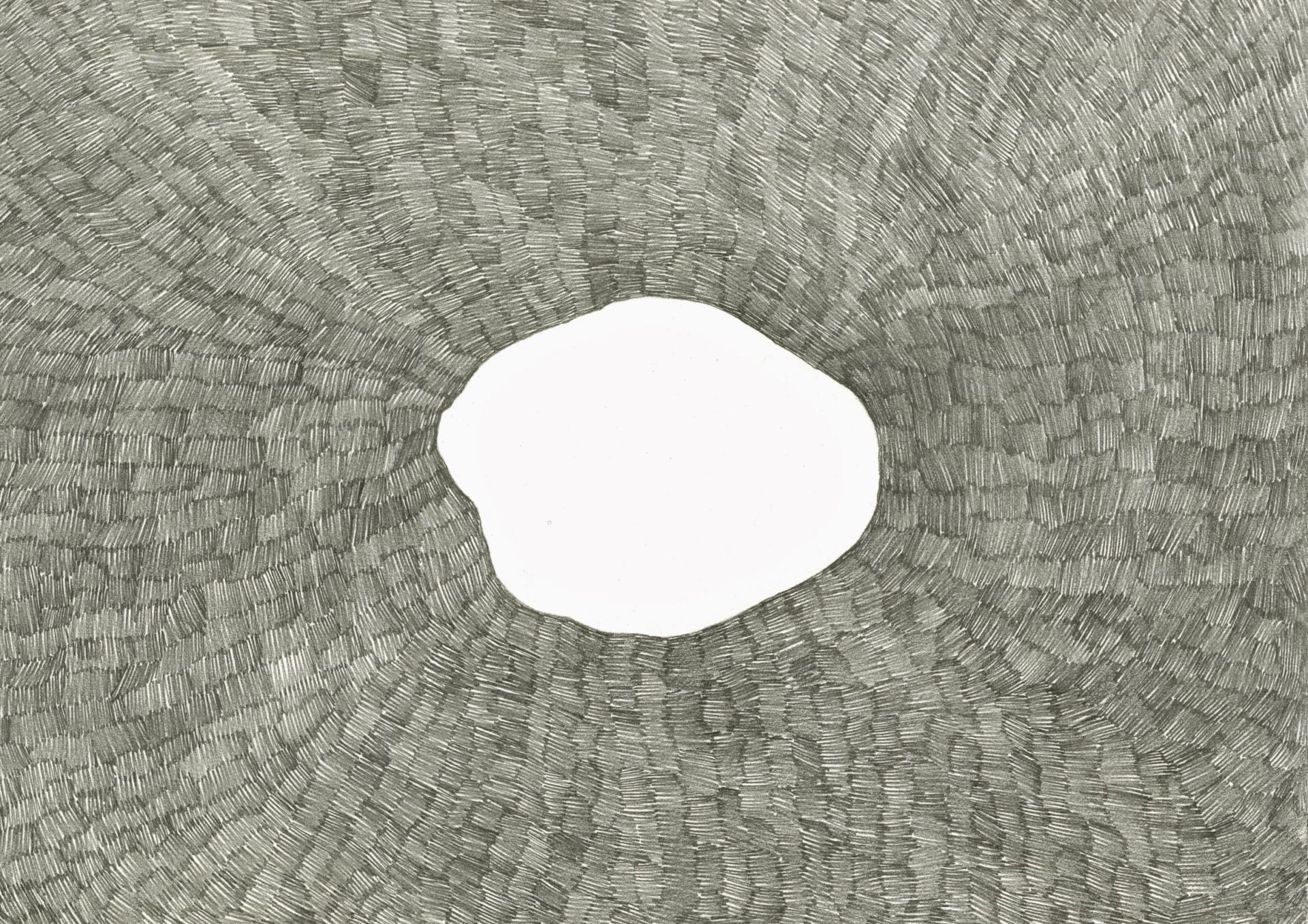
A series of recent works has developed from some quick sketches I did exploring ideas of negative space, moving between two and three dimensions:

These sketches were a random assortment of objects I had to hand at the time, but they still capture this idea of capturing the space that an object exists in, capturing their very matter. This ties in with themes that have been developing in my work for some time, ideas of mass and flow, the physical presence of a body in space. Whereas before I have concentrated more on neat flow lines around an object, or using methods of concealment to somehow box off, or highlight in some way, the mass which I am trying to draw attention to, this perhaps is a more explicit rendering of its physical material presence. This creates a certain push and pull between concealing and revealing in my work – where this piece leans towards a more overt explaining of this internal/external dialogue, other works running parallel to this are working explicitly to conceal and to provoke the imagination in this way. I feel the mark-making in the pieces seen below links to the line pieces I did last year, but shifted towards a more organic way of exploring flow, a little less controlled yet a little more subtle and authentic.
From these sketches I made several iterations of the work (created in order from top left, top right, bottom left, bottom right):


Reflecting on these works I can see the influence of many of the artists I have looked at recently coming into play:
- Katie Paterson’s work often expresses vast cosmic events on a human scale, drawing parallels between the two, making comparisons. To me this highlights an underlying uniformity to it all, reminding us of a basic elemental existence that we all share, an atomic materiality that spans the breadth of the universe. I feel this idea of presence and mass, an elemental materiality, is explored/hinted at, through these drawings.
- Antony Gormley’s work also explores a similar physical presence in space, often in terms of the human body, which he explores through his cast sculptures. In a way I see these drawings as almost 2D casts, taking the outline from an object and inverting what is filled and what is not. This also creates an interesting conversation between two and three dimensions, moving between the two.
- Rachel Whiteread’s work, too, explores a similar theme through her own use of casting, simplifying spaces down into a nondescript block of matter.
- I also see Vija Celmins’ influence in these pieces, albeit a little more tenuously. There is a certain allover interaction with the surface of the image that is important to Celmins that I feel is present here in the mark-making covering the whole space. The piece with a drawn edge links a little more explicitly to Celmins as the edge is something important to her, something that she likes to have on display to highlight the status of the artwork as its own object, not simply a reproduction of an image. In my piece I consider the edge as perhaps more of a direct referent to this idea of casting, it becomes the edge of this 2D mold. It is an interesting device in and of itself but I think the piece without a drawn edge is perhaps more successful as the importance is placed more wholly on the central void, which is the general aim of the drawings.
- Cornelia Parker’s War Room (as pictured below) is a room made out of the negatives of annual remembrance poppies. Parker used this idea of a physical negative space/void to create this vast installation about loss – not a subject matter I am intentionally working with but is important to recognise the connotations with (as spoken about more within the dust and debris provocation).

The feedback I have received from the work (particularly bottom left) is that the eye is drawn to the central void and there’s a strong sense of a space that once contained a structure, a relationship with solid stone forms and the mark that they’re leaving. There’s a sense of absence and presence, spaces between and nothingness – the idea of a void. It was also suggested that I could consider the work on a larger scale, even an uncomfortable scale, really pushing the idea to its limits. I like that the mark-making around where the stone once was imbues a sense of importance, as though the marks show the far-reaching effects of the stone’s presence. A larger scale would certainly emphasise this and dramatise it further, and I could see it linking well to War Room, a piece on such a grand scale. Taking this work into an installation-like space, too, would release the work from the confines of the edges of the paper which so far have been the predominant limiting feature.
As well as these drawings exploring negative space/voids, I have created another drawing recently which I feel sets up an interesting dialogue with this series:

The piece has strong links to Celmins’ work in terms of its realism, its use of the whole surface area, and also a its quietude. As is something I’ve encountered with several works, in creating this one I found myself spending a lot of time with the rock, exploring it thoroughly with the aim that it can withstand a lot of investigation from the viewer (which links to a lot of the themes I spoke about in relation to my rock map), something that I know is present in Celmins’ work too. I do feel it fits well with the more abstract void pieces however, particularly these three in combination (especially as they are all taken from the same rock):
Compositionally I question whether the ‘still life’ could do with being from an angle that mimics the other two more exactly, drawn from above looking down. I may leave them as they are for now, as I like the feeling that the current composition invokes, but will continue to come back and reconsider, making further iterations down the line if and when I feel the need arises.

 Anna Harris