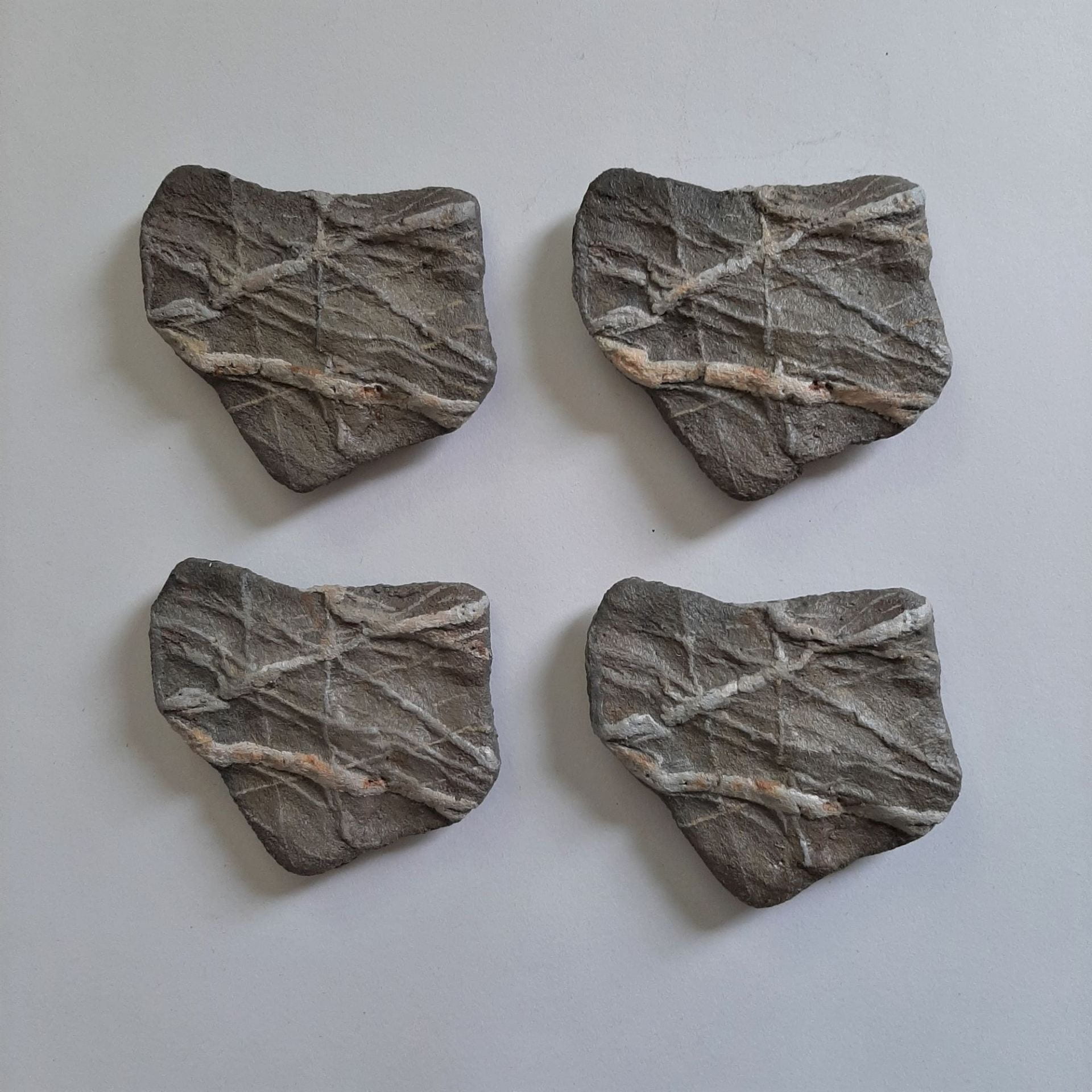
A lot of the work I have been creating this study block has been as a result of reflection on, and hopefully refining of, work from last year. Looking back, one of the most successful pieces I made last year were my fake rocks. At the time they were made with the intention of critically investigating the materiality of an object, drawing attention to the processes behind its creation and the timescales associated with this. This year I feel I have more clearly outlined a focus on specifically deep time, which these pieces link to well, and I have also had a chance to discuss this work in a research seminar. In the seminar we spoke about the process of encounter with the objects, and the uncanny experience of seeing an unexpected double.
When I first created the fake rocks last year I had intended for the new rock to be the artwork in itself, simply displaying the one supposed ‘rock’. However through discussing the work I have begun to realise the effect of having the rock photographed alongside its original in creating this slightly shock encounter and the uncanny effect. As a result of this I have created a series of fake rocks, all based on the same rock, in order to try and emphasise this effect and push it a little further.
Whereas before I’d either used a clay mold or an alginate mold, this time I used silicon. This had the double advantage of making a more accurate mold, capturing more of the fine details in the rock’s surface, but also that the mold could be reused to create these multiples. I also had used plaster to make the casts before whereas this time I used concrete. I had hoped it would create a more ‘rock-like’ end result, which to an extent it has, but I’m not sure the concrete has picked up the same details that the plaster previously did, thus perhaps undoing the improvements that may have arisen from the silicon mold. Nonetheless I do enjoy how concrete has to be combined with an aggregate, which is made up of sand, and thus in part shares a same material origin with rock itself.
Practically speaking the rocks were really hard to make to the standard I would have liked. The cement had more bubbles in it than perhaps plaster would have done, and these were harder to fill in without loosing some surface texture. As it was I was able to fill in the bubbles with a thick first layer of paint, but again I fear I may have compromised the surface texture a little in doing so. I found dry-brushing the paint onto the surface to be a good way to highlight the rock texture, but simultaneously struggled to get the exact tone of the rock to match exactly the original. Variations in light conditions cause the actual rock’s colours to vary differently to the painted ones so it has been quite a struggle to create as uniform a tone in as many lighting conditions as possible. The end results are perhaps a little cooler in tone than I would have liked, but every time I made it warmer it got a little too light so given the time constraints I had to settle for this slight mismatch.


Given this mismatch I actually wonder if the end result would be better presented without the real rock. Even though having the original rock alongside the replica was where this idea developed from, it is perhaps more the idea of the uncanny double that is important, rather than the need for the real to be alongside the hand-made. The uncanny double effect is even more emphasised when the real rock is not present as the replicas look more similar to each other than they do the original, thus furthering the illusion/confusion.


I can see the influences of several artists within this work, as well as ties to their own work:
- Several of Antony Gormley’s pieces revolve around an idea of a ‘field’, often created by a number of usually similar objects placed nearby each other in the same space. In Gormley’s case he considers a ‘bodily field’ – the body as a multitudinous object that is home of the individual yet also something we all share. These rocks, although not quite as numerous as Gormley’s fields, do instill a similar quality in the space they inhabit, creating a strange connection between themselves to create a strange field of identical rocks.

Field, Antony Gormley – Image from https://www.antonygormley.com/projects/item-view/id/245 
Lost Horizon, Antony Gormley – Image from https://www.antonygormley.com/show/item-view/id/2247
- The repetitive casting process is somewhat similar to the process used by Rachel Whiteread in her 100 Spaces, although arguably this is a tenuous link as hers is almost more of an iterative process/creating separate sculptures whereas the aim with mine is that they are all identical.

- Vija Celmins’ To Fix the Image in Memory I-XI has long been obviously similar to these fake rock pieces, although incidentally I didn’t come across it until after I had already started my own. I’m not sure Celmins and I share the same intentions, despite the works’ similarities. Celmins describes all her work (all hyper-realistic but this being one of her only sculptural pieces, the rest being paintings or drawings) as ‘redescription’, notably different from a simple copying of imagery, and uses this towards perhaps more of a critique, analysis or questioning of art itself; she makes replicas of an original but with the intention of creating a new object in and of itself, highlighting that the artistic is not simply a replica of real life. My pieces perhaps aim more towards a questioning of materiality, process and deep time, as well as this uncanny encounter with the double. Celmins’ piece is also a little more subtle than mine, the viewer having to search for a small while to realise and find all the pairs, whereas the duplication is the most prominent factor in my own. What our work does share, however, is this sense of quietude and spending a long period of time with our subject matter, aiming to create an object that can ‘withstand a lot of inspection’.

Going forwards I could make more of the same rock, as I still have the mold, as I feel the more duplications there are the more striking and effective the piece becomes in its ridiculous excess. However, I feel these fake rocks have perhaps reached the end of their studio life and could instead be taken back (?) out into the world, provoking something a little more performative and dynamic. There’s a certain playfulness to replacing something natural with a directly imitative man-made copy and I feel there would be a lot to unpick and reflect on around such a performance. I have had the idea of doing this slowly growing in the background for a long while so have thought through several iterations and possibilities surrounding this idea. I could simply substitute a rock out for a replica one at a time, perhaps collecting the real rocks as a sort of memento, and could even try find the rock on the beach at a later date (an almost comically impossible task). I have even thought about buying trackers to put in the fake rocks just to maintain an element of connection with them, or a way of tracing their journey if and when they move on from where I left them. There is equally something quite poetic to be said for not tracking them, instead just letting them loose into the world and likely never seeing them again. If I were to try this I would need to consider practicalities such as what materials to use; I know concrete isn’t particularly sustainable, and acrylics (that I have been using to paint the rocks thus far) are plastic-based, so releasing these onto the beach wouldn’t be ideal.
In all, I feel these rocks in themselves do create quite a striking piece, invoking ideas of the vast and the singular, material and process, but I can’t help but feel they have the potential to develop into something further.

 Anna Harris