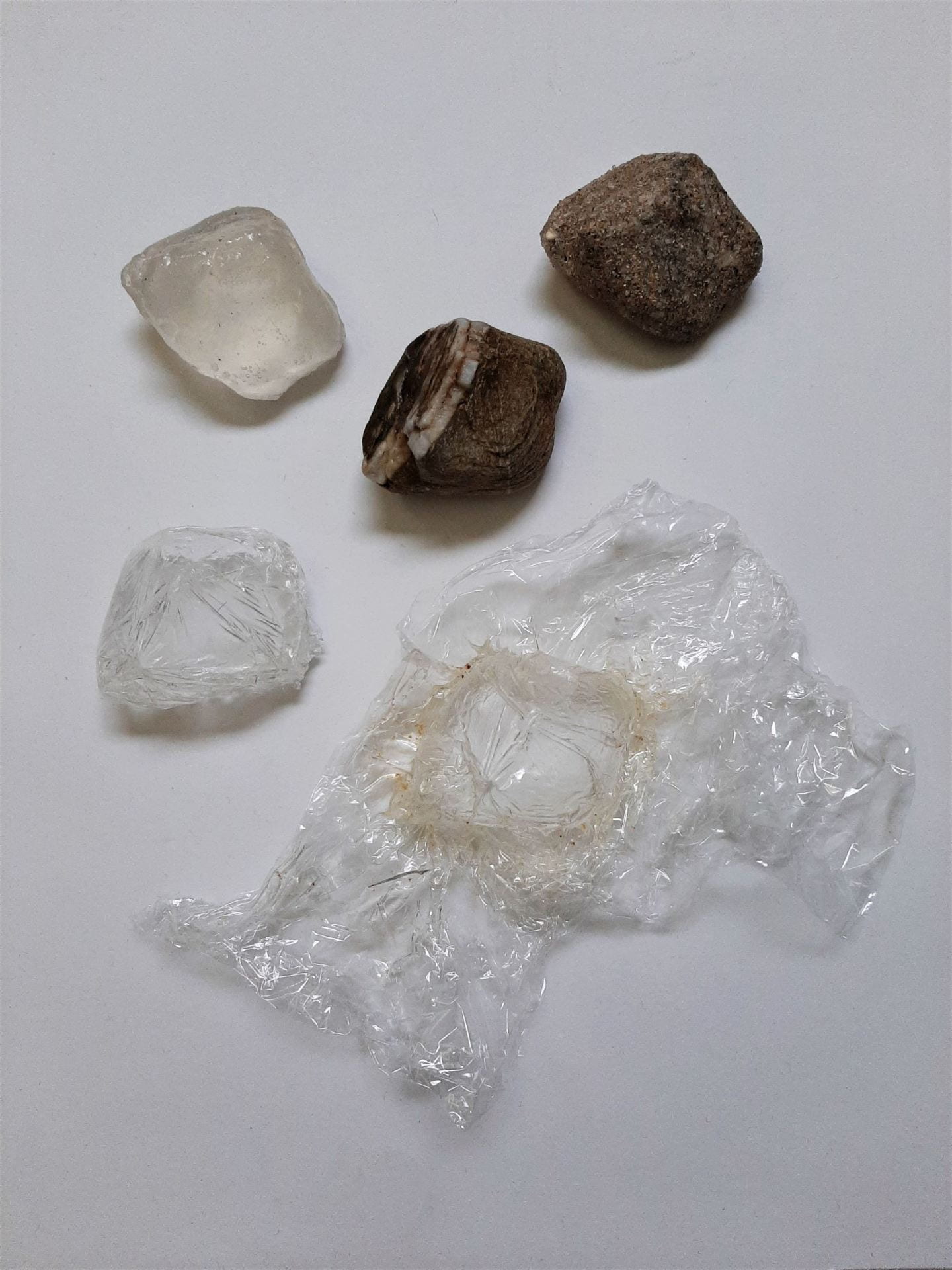
As I wrote about extensively in my Drawing Presence post, a theme I have found myself working around this term has been visualising presence/negative space/an elemental materiality. This can be tracked back through my work quite extensively, perhaps the first time it was consciously explored being when I started casting, and then this year continued through the exploration of cling film and paper rock shells. The shells began to express a certain encapsulation of a particular space, presence of matter, or even a moment that intrigued me, and out of this has developed a trail of experimental pieces working around these ideas.
I started, as mentioned, with shells made of paper and cling film and although these were a good starting point I could never quite get particularly the cling film to hold its form as would have liked. I preferred the cling film’s translucency to the paper, providing a bit more of an ephemeral quality, so it was this that I chose to pursue further. I started using resin to solidify the forms more than just using PVA layers which was far more successful in creating forms that would hold their shape. I am still having some problems in terms of making an all-encompassing shell from resin, and as such have only made more half-shells so far. These have been created by laying cling film over a rock and pouring the resin over this so the resin can be removed from the rock, but has the downside of creating quite a thick base, as opposed to a thin shell itself (due to lots of the resin running down and off) which then becomes difficult to extract and pair with the other half of the rock shell.
Another method I attempted was painting the resin on to the inside of an alginate mold but again I have been having issues with the alginate and the resin interacting – the resin seems to in some way re-activate the alginate, making it become wet again so the surface of the cast is not as clean. The resin I have been using is also pretty runny, whereas perhaps I could do with researching a thicker resin that wouldn’t run off the sides of the shell casts so easily. As it is I have been trying to get round this by doing multiple coats, each one left to dry at a different angle so the resin settles in a different area of the shell.


These works, as mentioned, link well to my previous drawings that explore the same idea but through a drawn, two dimensional form as opposed to the three dimensional form here. There are also links to Katie Paterson‘s work in the sense that she distills vast cosmic ideas down to a subtle, unifying elemental view of the universe, and there is something about this concentration on a basic materiality, the existence of matter, that I feel these pieces also explore.
I also encountered an unexpected link to an artist’s work I have not explicitly studied as of yet in the Siluetas series by Ana Mendieta. It was mentioned in a lecture how these pieces explore an idea of an absence/presence that are encapsulated in a trace of something, and again I feel this is something that resonates with these pieces. This is also a theme heavily present in Rachel Whiteread‘s work, as I have touched on many times throughout this term.
As well as the resin shells I have also experimented with making some resin casts to further explore this idea of an encapsulated space. I like the ephemeral, almost ghost-like quality that the resin cast possesses, the way it catches the light and becomes a dynamic object in this way. I played around a little with the idea of materiality by adding sand into one of the casts but this has not turned out particularly successfully with the resin loosing its shine and the sand sinking to the bottom to create a bit of a lackluster result.


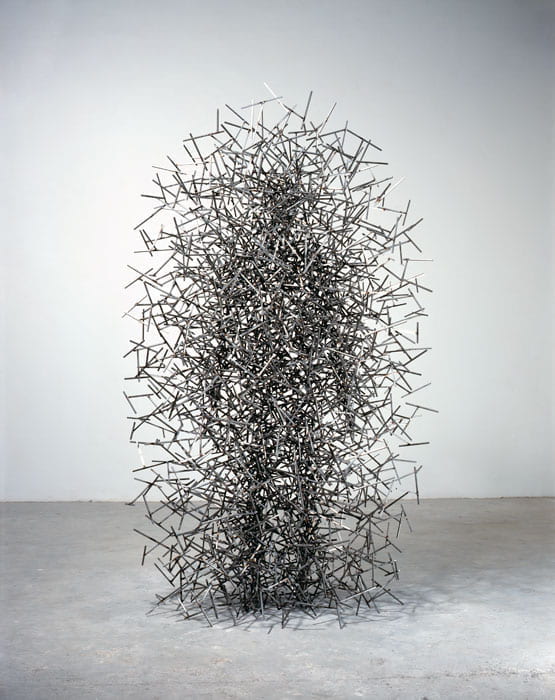
The idea of materiality when using resin, however, is interesting to me as the plasticity of resin is something I find hard to ignore, both in terms of it arguably not being particularly relevant to what I’m looking at, and in it being not a eco-friendly material. The plasticity could be tied into a larger anthropocentric narrative, a comment on the human impact in geological terms, but even with this in mind I feel it is important to consider the ecological ramifications of the work itself. It could be that I decide that the resin pieces I have made so far are sufficient to express the idea and that I therefore don’t need to make any more. It could also be that I feel the drawings are a more successful way of exploring the idea, and one that doesn’t come with such a heavy ecological price, so it is in this vein that I choose to continue exploring it. In a recent lecture we were exploring some works by Antony Gormley, who is also exploring similar ideas of presence, and it was highlighted that some of his works broke the usual pattern of an implicit exploration of this and moved instead to a more explicit exploration (as seen below). Perhaps I could try something similar to the more explicit investigation, and in the process move to a less ecologically damaging material.
So in all, going forwards with these works I am unsure as to if and how I would want to develop them further. I will certainly continue to pursue the themes they explore but whether I will continue to use resin remains to be seen, particularly as I’m inclined to think the drawings were a slightly more successful exploration of the same ideas. If a more environmentally-friendly material with similar qualities were to become available to me, or if I do later feel as though the use of resin is vital to the expression of an idea, then perhaps I will return to this series but for now this may well be where this gets left.

 Anna Harris