Notes from artist talk:
Visiting Lecturer (Donal Moloney):
- Showing work from art school – finding one thing you like and then just approaching it from different angles from the rest of your career
- Making the objects to be painted rather than relying on direct observation/photos
- Key artists, texts and research then figured out through the work
- Painting the rain – the landscape taking part in its own painting
- Relying on black and white – didn’t know how to use colour
- Between abstraction and figuration
- Etching into wet rabbit skin glue
- Finding lots of new marks – throwing into waterfalls
- Reading artist interviews (not reading a lot of critical theory at the time)
- Morris Louis – colour field artist – stained with acrylic paint – ingrained within the canvas/embedding in/a compression – not sitting on top of a primed canvas – new gesture and mark – letting the paint make its own marks
- Small collages, biro drawings as contrasted to the large paintings
- Importance of materiality – the alchemy of a gesso ground as opposed to others etc
- Stretched outdoor canvases and they seemed very aged and weathered/worn – layering, scraping back
- Bringing different narratives in
- Not planning out but instead about the process and reactional
- Start with a problematic thing that you try to solve (e.g. a giant ear made into a mountain, breaking up a space and building from this – getting lost in the story, allowing images to come in and out of the painting)
- Simon English – subtle and suggestive, alluding to a story
- Colin Crotty – taking images from photos and painting them the exact same scale – a lot of this semi-abstract, process-led work at the time in Ireland (mid 2000s)
- After degree show, started looking at the stuff he enjoyed most – the detailed sections
- Compressing these collected images together, building up until resolved
- Also playing around with collage, photoshop, breaking down initial meanings – not wanting to be too kitsch or twee
- Working a colour at a time
- Then realised he could make his own images using Plasticine – not having to rely on found imagery
- Making ‘maquettes for sculpture’
- Ellen Altfest Green Gourd – primarily paints from life, male figures or natural forms – ‘an intense scrutiny and myopic focus’

- Sometimes work that you like comes in unconsciously, you don’t have to select something and intentionally bring it in
- Going over the top with photoshop – bringing a digital effect to painting – liquify tool ‘makes an image look like paint’
- Allowing humour into the work
- Changing the model kind of allows you to reach right into the photo and change it
- The process of painting led him to weaving
- Two year MA – first year messing about
- Diagrammatic woven paintings – painting out woven images and scrunching into a form to then be painted
- Projecting digital imagery onto sculptures (then build up paintings from this I think)
- Untitled = you’re not really sure what the work is about (and that’s ok)
- (has he ever thought to exhibit the sculptures? Why mediate through painting?) – subject and object getting confused, answer and question simultaneously – they’re only good from one angle – they often become fragments, falling apart and used again
- Jeff Dennis

- Animations projected on sculptures – vibrant and psychedelic
- Slow down and work on one painting for 6 months and see how dense and claustrophobic it can get – still procedural, also a sense of gestation?
- A narrative of a figure having just left, an assembled mass of stuff
- Trompe l’oeil paintings with a flat/shallow picture plane
- (missed the name of the painter but someone painting cellophane – incredibly narrow picture space)
- Clement Greenberg’s Modernist Painting – painting should be flat
- Leo Steinberg The Flatbed Picture Plane – letting culture back in, a dumping ground for information – throwing things in, editing them out
- Norman Bryson essays on still life painting
- Also dutch art, Svetlana Alpers’ book
- Didi-Huberman Confronting Images – a detailed element that acts as an interruption – e.g. white specks of highlights (links to Simon’s lecture and the Ingres text)
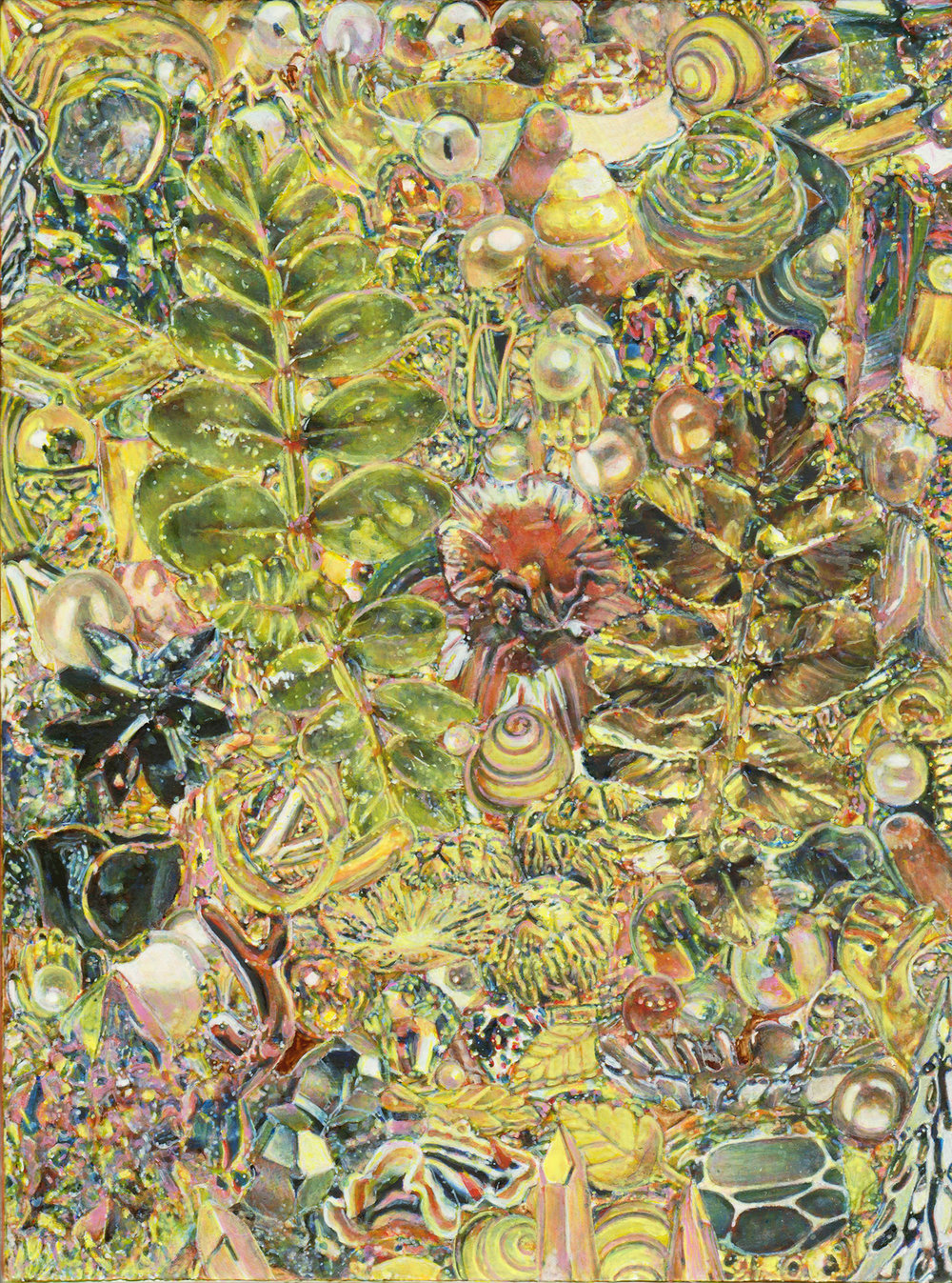
- Reliquary – from inside a cave looking out
- Cave Floor – a density of information with narratives coming out

Cave Floor 
Reliquary
- Can’t take it all in at once
- Idea of narratives continuing outside the edge of the painting as the image is filled edge to edge
- Painting paintings on top of each other and sanding back through them !! – bring in an element of surprise/rediscovery – collaborating with yourself almost
- Book called the uncertainty principle
- Don’t think of your degree show as a full stop! (maybe more of a comma)
- Reflective surfaces to create space outside the picture plane

 Anna Harris