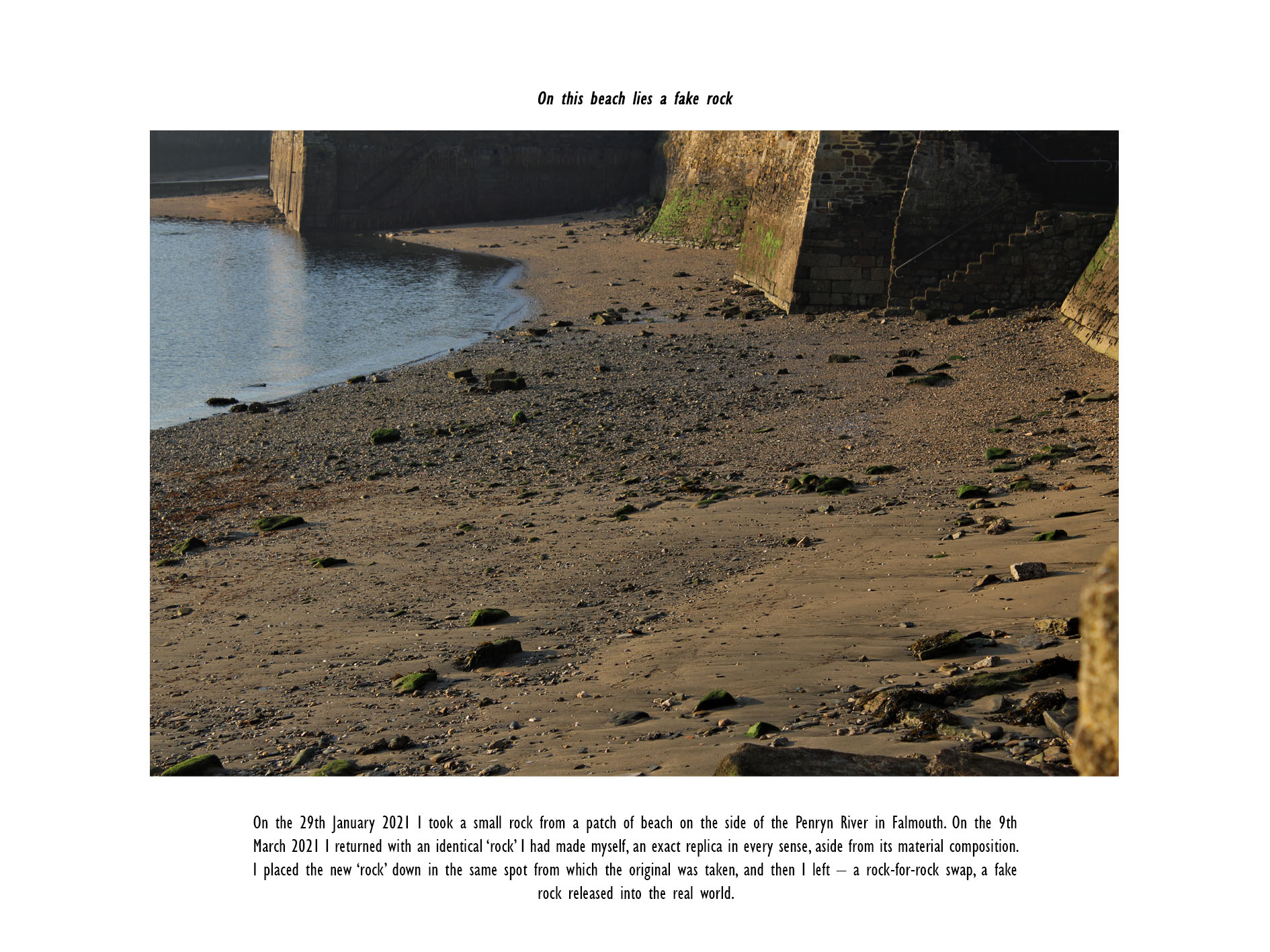
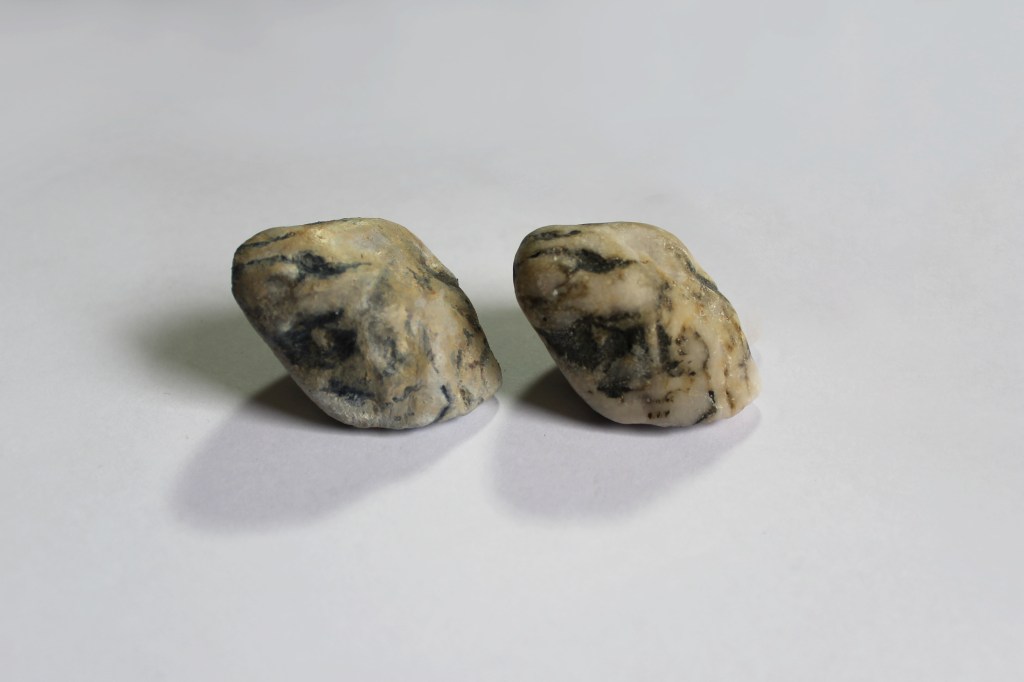
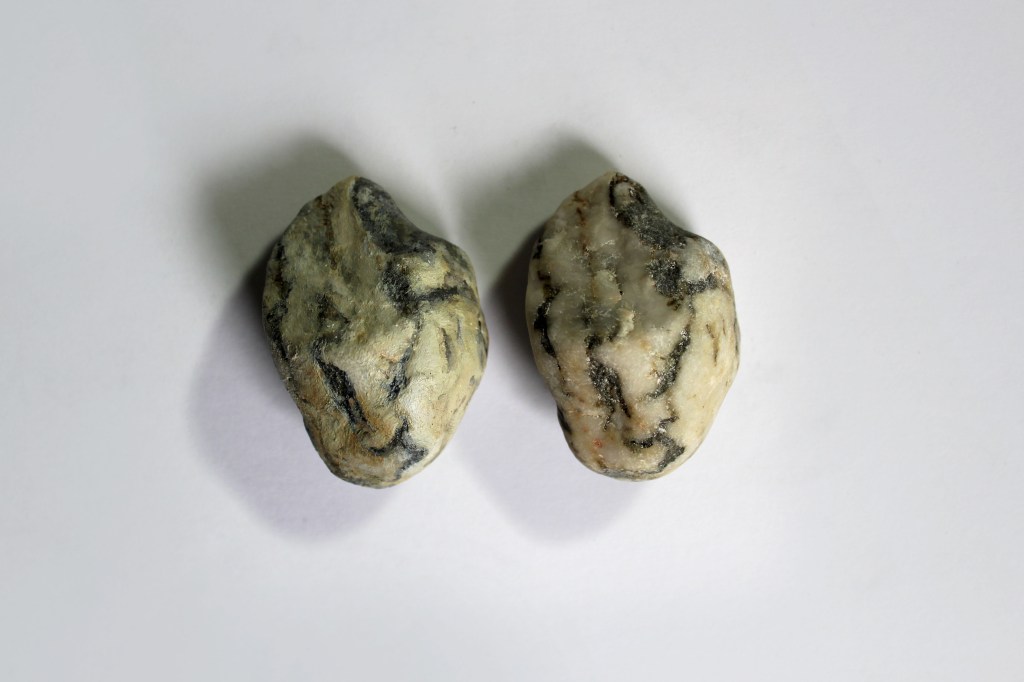
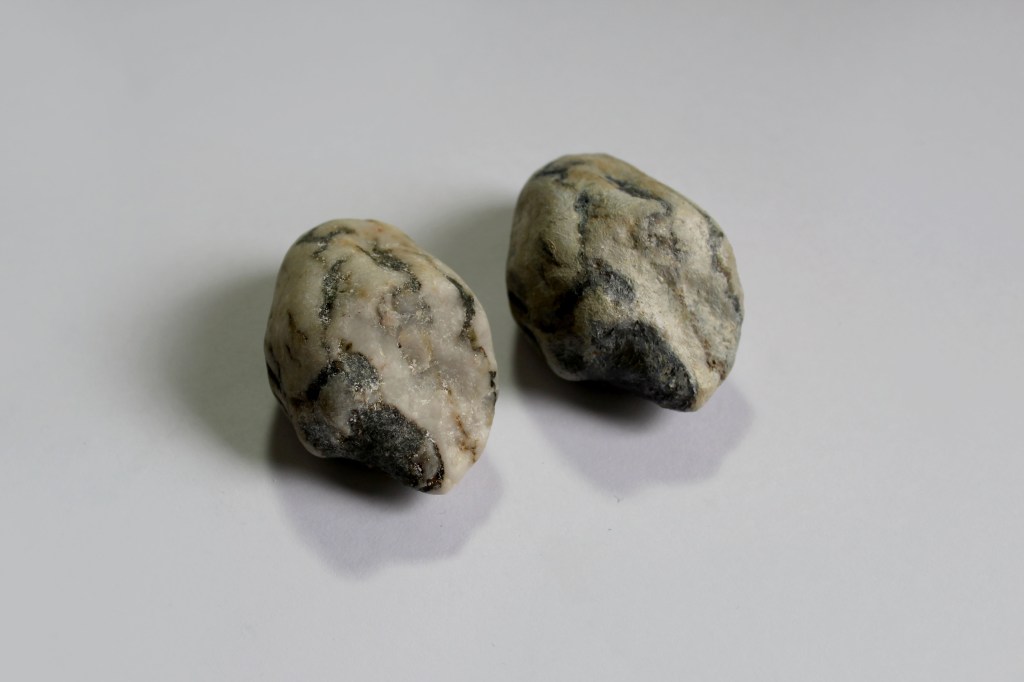
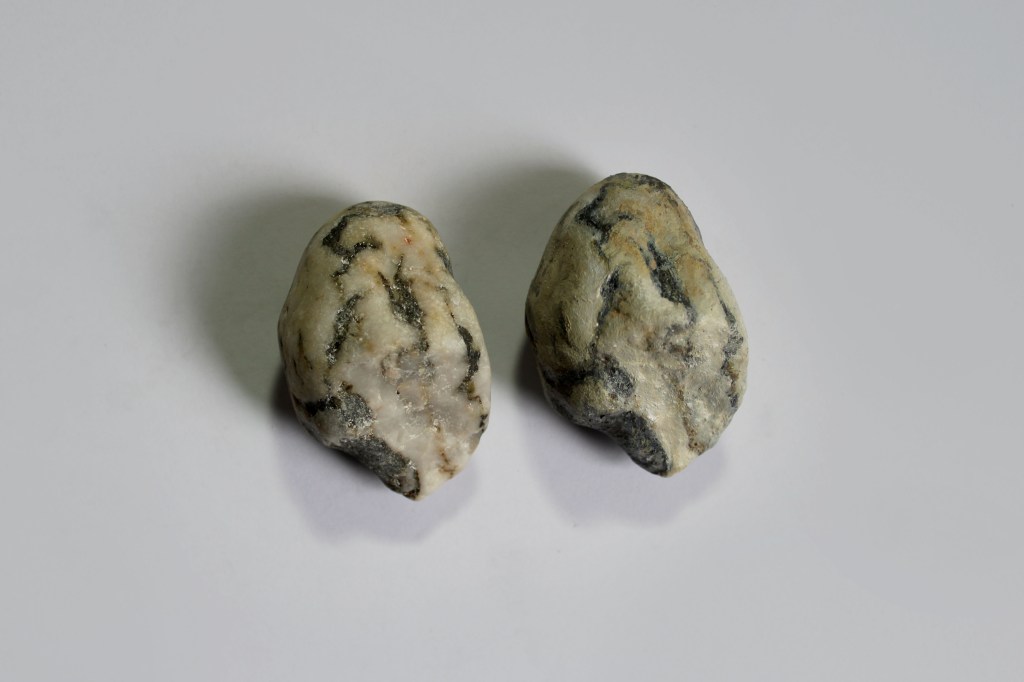
For a while now I have had the idea of pushing my fake rocks beyond the studio, taking them out into the world and ‘activating’ them in some way. Various iterations of ideas have formed and reformed, most of which have revolved around ‘returning’ the rocks to the beach in one way or another, creating an encounter between the ‘real’ and ‘fake’ that is largely out of my control.
Just how much I chose to relinquish control, alongside how I documented the work, was where the majority of the decision making lay with this piece. Initially I liked the idea of placing tracking devices in the rocks so I could map their journeys beyond my releasing them onto the beach. However, the practicalities of achieving this on a student budget proved quite difficult, not to mention the moral implications of inadvertently tracking someone should they chose to pick up a rock and take it home. There also seemed to me to be a certain clinicality to this method that jarred with the more ephemeral and poetic feel that the work had the potential to produce.
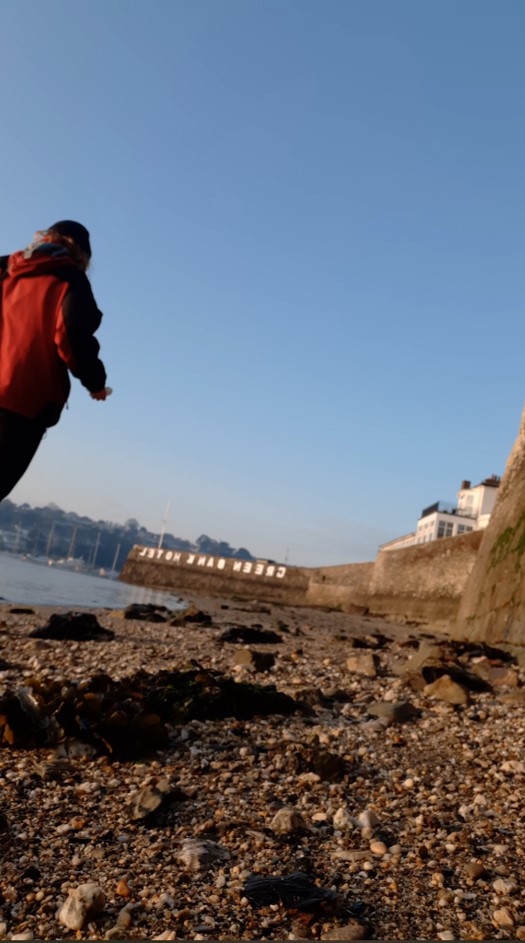
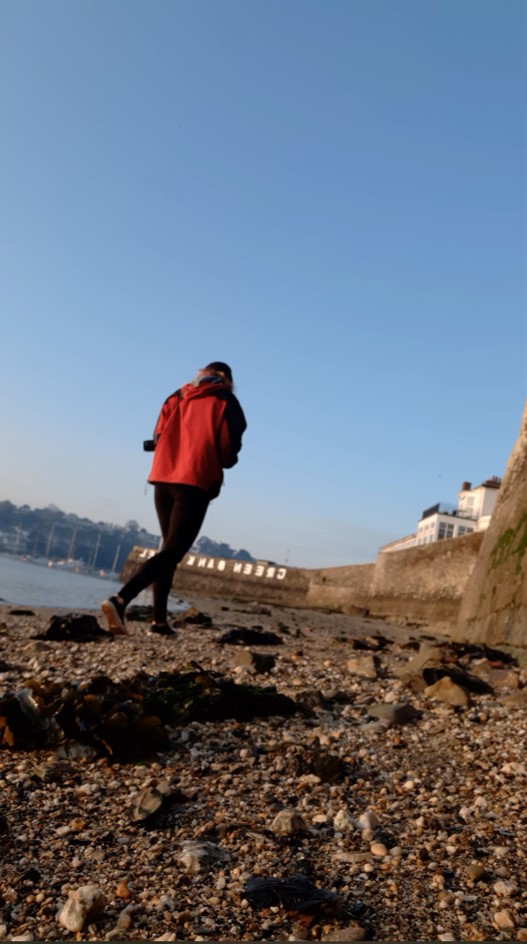
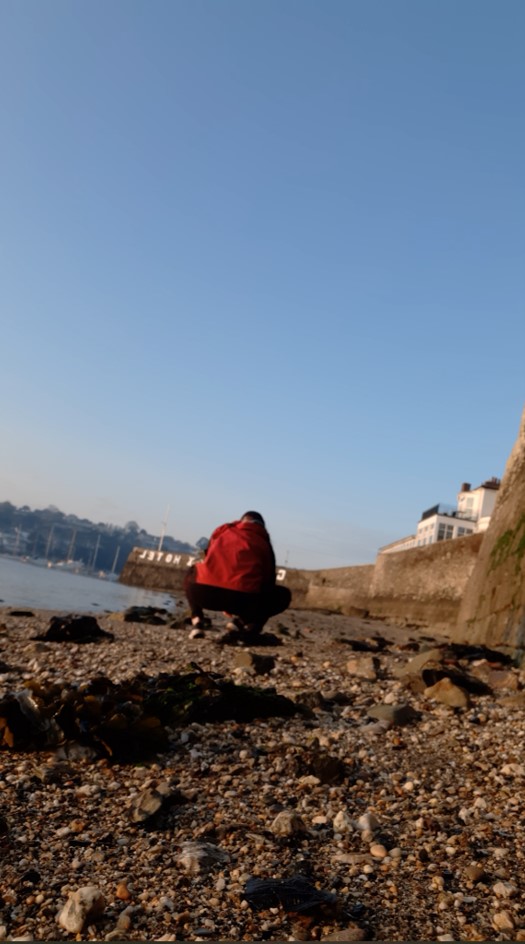
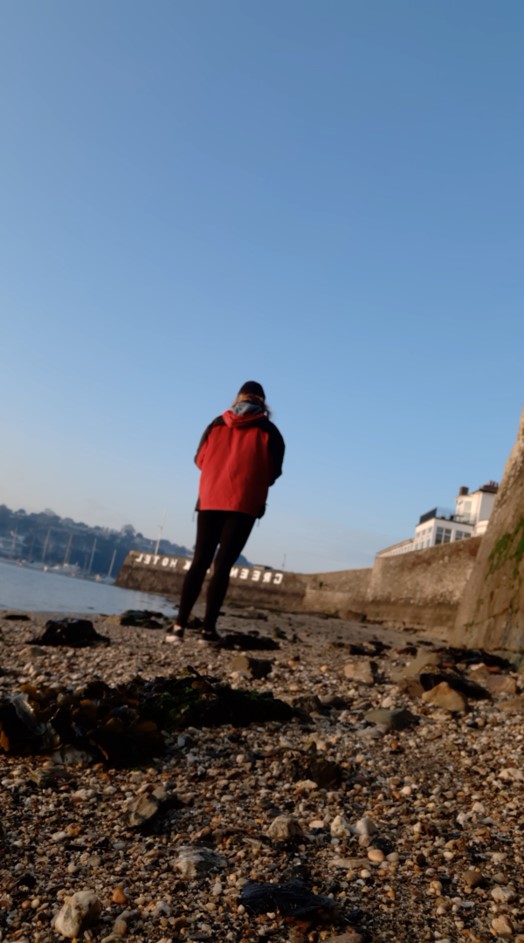
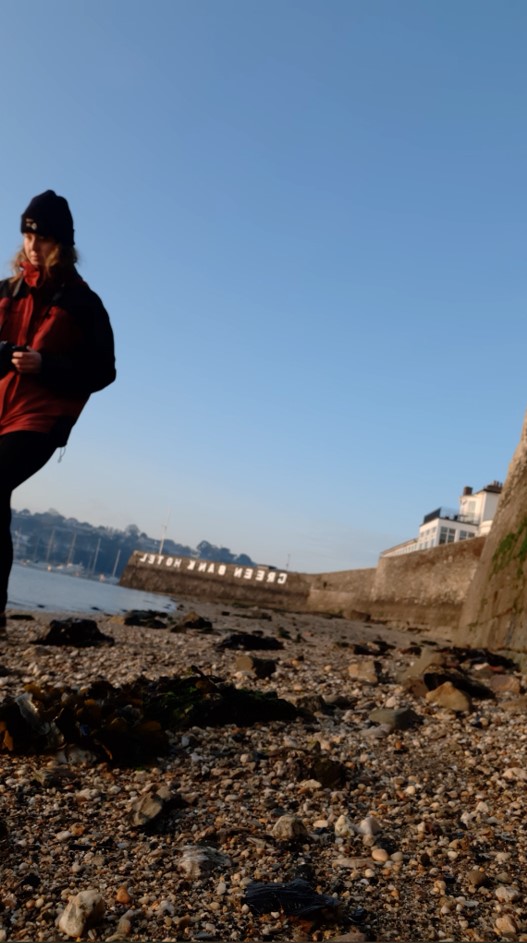
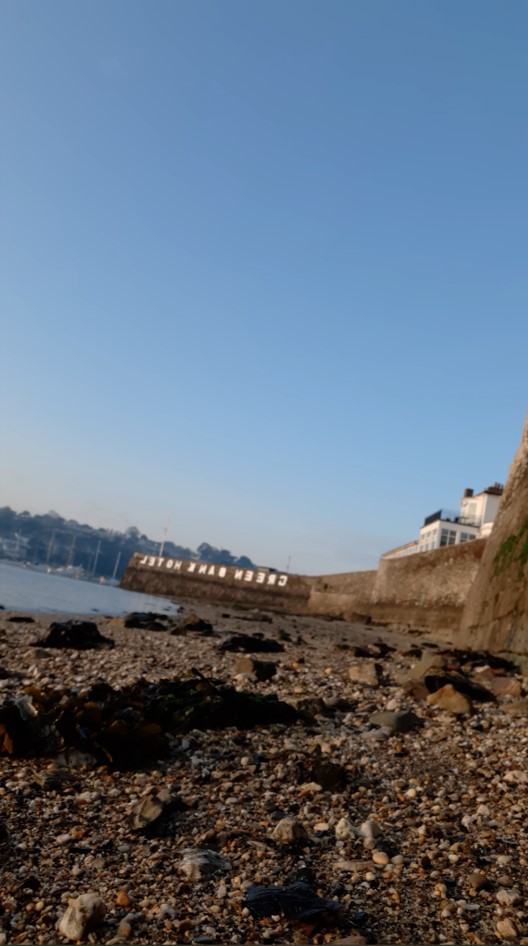
Instead, I chose to simply release the rock onto the same beach I had found the original, in as close to the same spot as possible – as close to a rock-for-rock swap as I could manage. The placement itself was carried out in the early hours of the morning, while the beach was empty but for some seagulls and one sole workman taking a phone call. This timing was dictated partly by the tides (the beach is only uncovered at low tide), yet also the early hours felt most apt in their quietude, their hopeful secrecy.
Documenting the event was in some ways the most experimental, or improvised, part of the whole piece. I took photos of the spot where I first located the original rock, and tried to replicate both the location and the photos when re-placing the ‘fake’ rock, although obviously in between times the surrounding rocks, sand, and debris had shifted significantly, creating a wholly different landscape. I also filmed myself placing the rock down but in doing so captured the whole process of my photographing the occasion, stopping multiple times to do so rather than simply placing the rock and walking away, a visual that perhaps might have been a little more poetic. There is a certain snagging here, a tangling, between the act itself and the documenting of the act: the tip of the iceberg, perhaps, of the larger entanglement between an ephemerality and an anthropocentric need to monumentalise.
Perhaps in future I might attempt another of these works and focus on separating the act from the documenting, even if this is simply to film myself placing the rock and walking away, taking the photos after the video has ended. I am still intrigued by the idea of somehow tracking the rocks as a way of making tangible unnoticed, knotty material journeys that might not otherwise come to our attention. I wonder if tracking them short-range (following their movements simply around one small beach rather than more widely), and for a short time (the battery on the tracker running out after a few days, in doing so also eliminating the possibility of my inadvertently tracking anyone who picks up the device), might still allow for a similar transience as they disappear into the world eventually all the same.
The only other implication with this, as with the piece as a whole, is my releasing potentially polluting materials out into circulation. Even without any kind of tracking device it does still concern me that in doing this work I have taken a ‘natural’ material into my own possession and replaced it with a human-processed material. I have no exact justification for this other than I have endeavoured to keep my interference small-scale and with the least damaging material currently in my control; I used plaster for the rock (as opposed to concrete which is significantly more ecologically harmful), and as I did not have access to technical facilities due to the pandemic have been unable to experiment with, or enquire about, more suitable materials. However, going forwards I will be sure to continually review and refine my techniques and materials, and will keep in mind the accumulative ecological effects of my interventions.



 Anna Harris