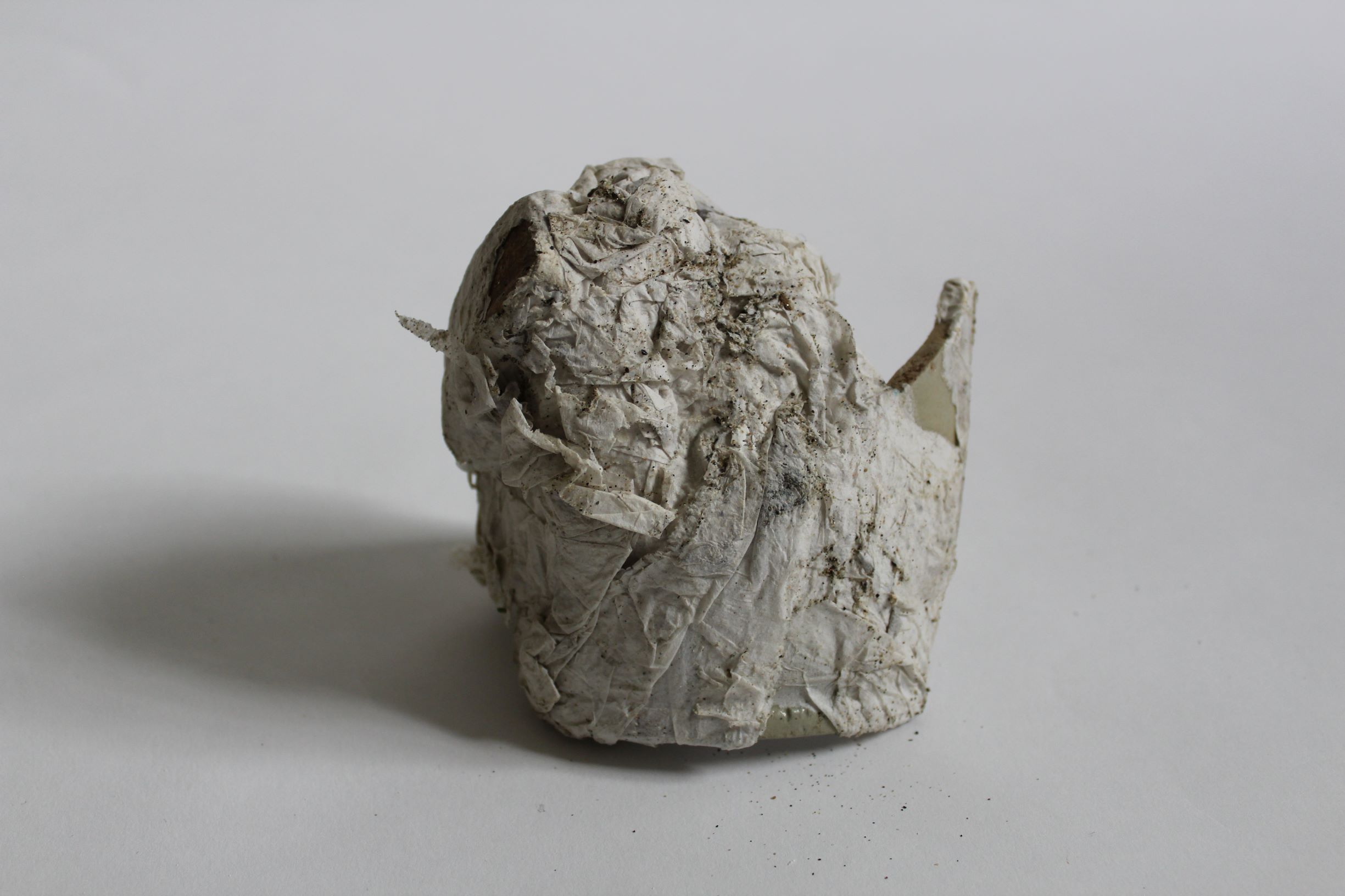
As with most of my work lately, these pieces emerged by playing around with different ways to assemble and amalgamate collected materials/objects. I was trying to obscure individual constituent elements and create a confusing, amorphous whole to in some way provoke a sense of intrigue into the new object’s identity (however that may be defined). Paper mache sprung to mind as a fairly playful, accessible medium, useful for conglomerating individual parts to a whole without being particularly environmentally harmful. The following is the first piece I made in this way:

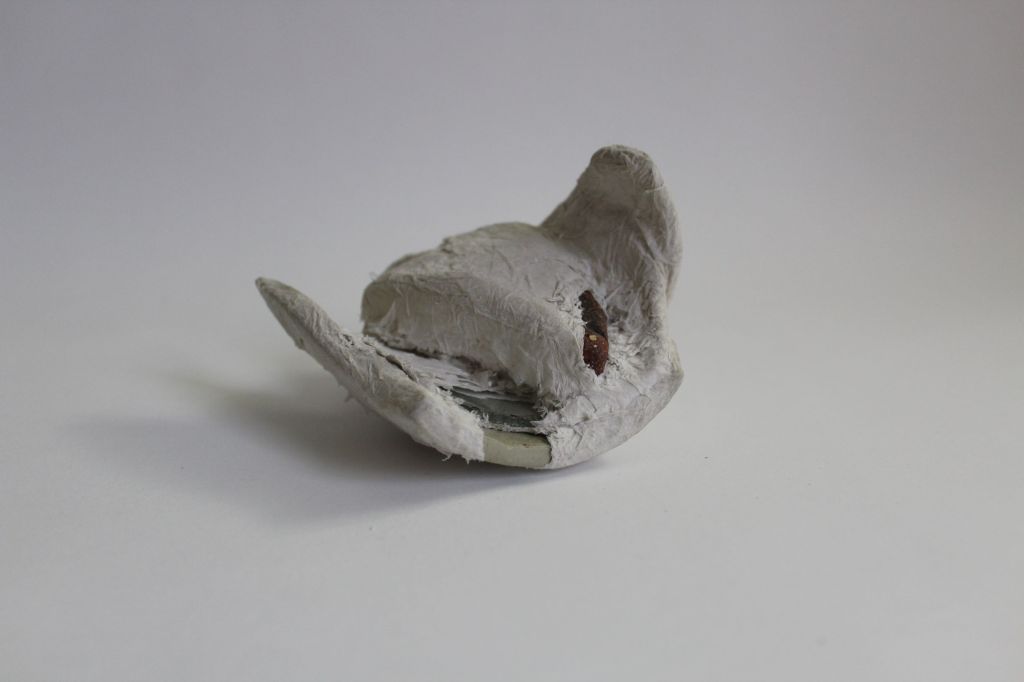

As can be seen in the photos I have sanded away certain areas of the paper mache once dry to reveal areas of the initial surface. This was done fairly experimentally as I didn’t particularly like the shape of the piece and the uniform surface essentially meant this was the primary element to look at. By revealing small areas of surface I hoped to draw attention to what was beneath the paper mache coating – a similar technique to one I have used previously here. Although I still don’t really enjoy the strangely spaceship-like shape of this piece, I did enjoy the process of sanding back the surface, finding something nicely archaeological in the process. The small revealed sections also become abstracted in their cropping and nicely draw attention in this way. As mentioned here there is something Boyle Family-esque about this random cropping and focus on surface.


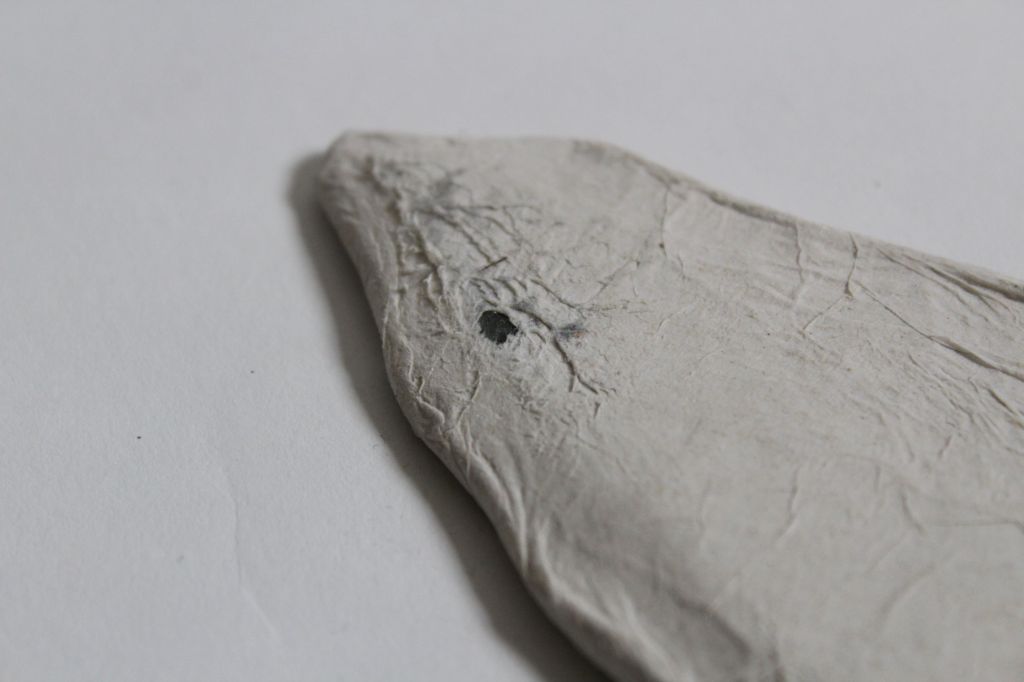
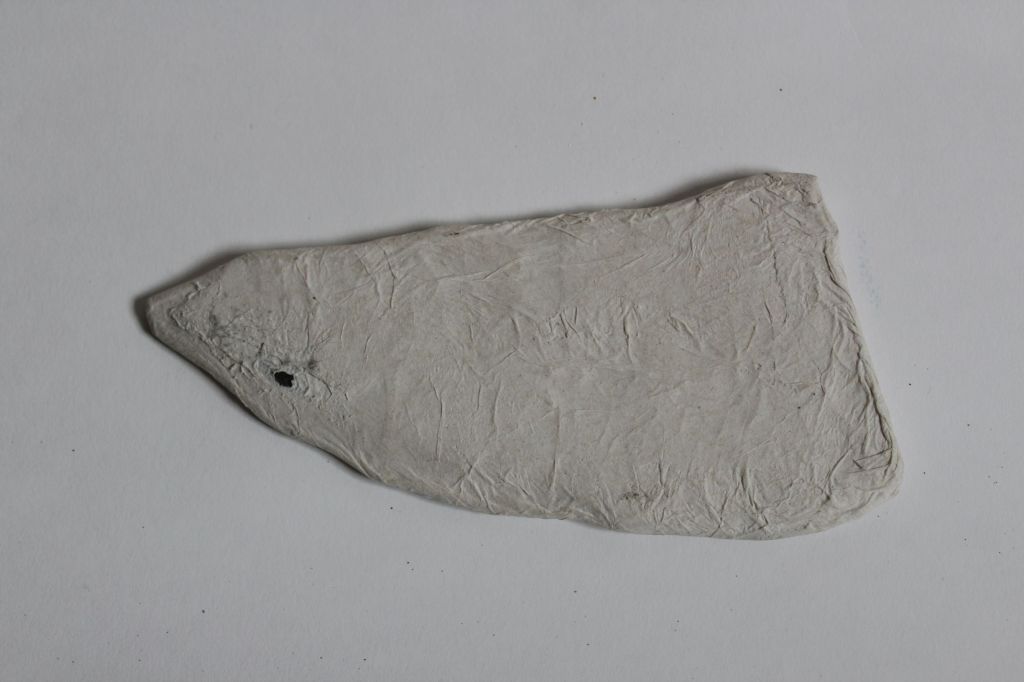
The above piece is a fairly simple experiment just to continue to explore the archaeological process of sanding back the paper mache. While this piece is in itself fairly uneventful I do still feel there is potential in this method to be pursued in the future, perhaps carving back clay instead of paper mache to reveal a surface.
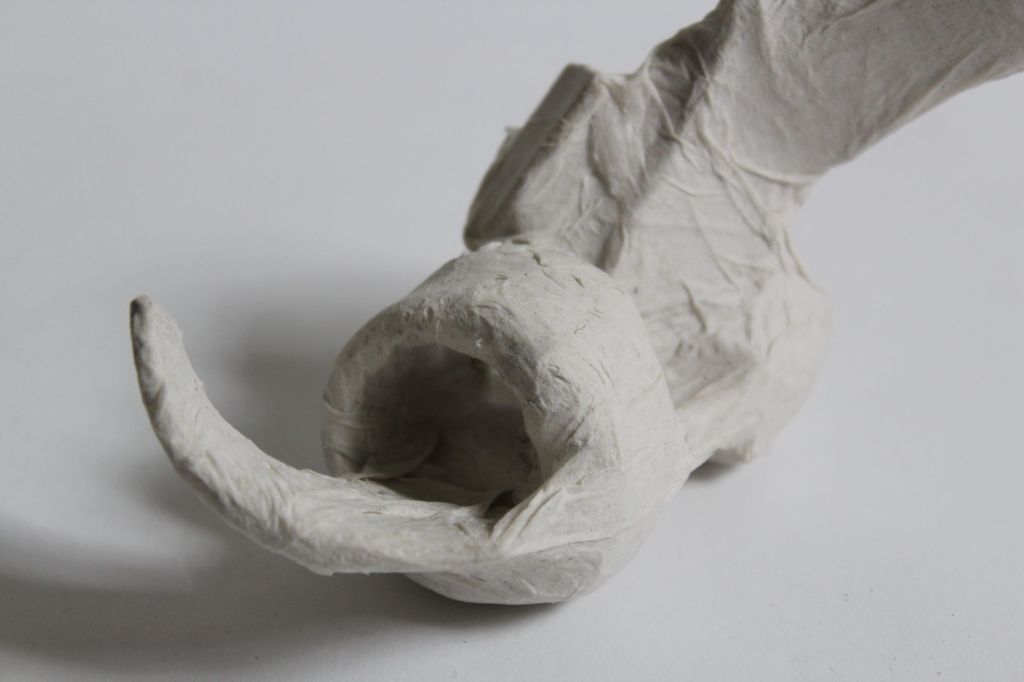

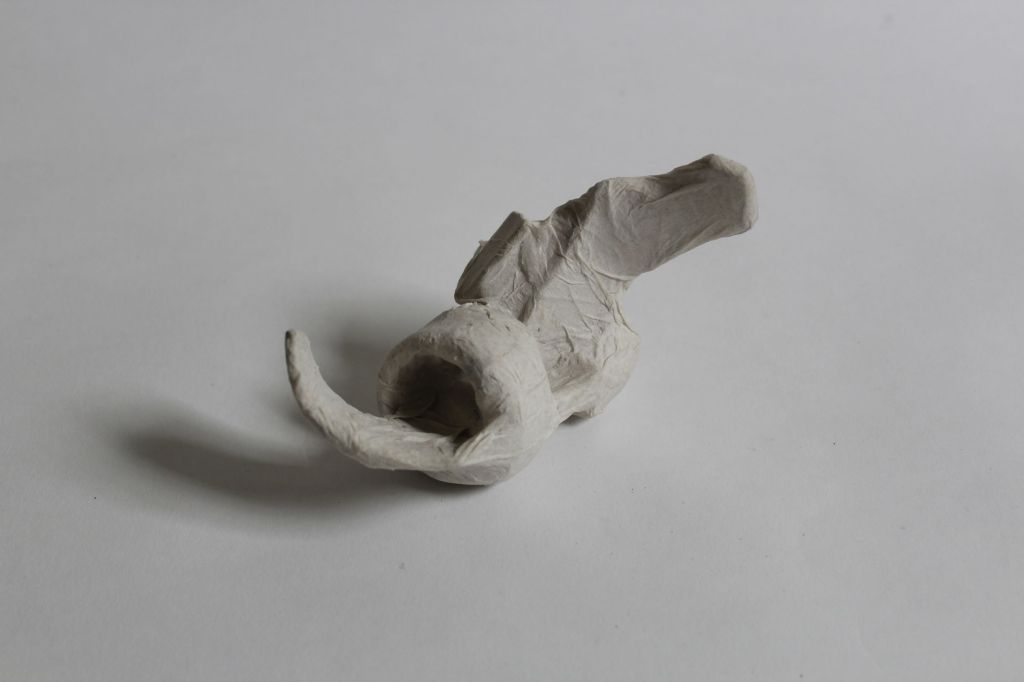
One of the problems I found with the initial sculpture was that using paper mache alone to hold together different objects was somewhat limiting: they would have to be positioned together, almost flat against one another, and would then still require a lot of layers to stay in place. Therefore, although I initially chose paper mache due to its mainly non-synthetic roots, I introduced the use of a glue gun to make the above piece, creating the form first and then coating in paper mache. The role of the paper mache therefore changes here, suddenly no longer being structural but instead aesthetic. Aesthetically, then, it unifies what was several different objects/materials into a cohesive whole, but in doing so still hints at these original individual components. Psychologically when something is obscured, especially when tantalisingly so, intrigue into what lies beneath is heightened. Again, I don’t think this sculpture in and of itself necessarily proves the best example of this but as a concept it would be interesting to bear in mind for future work.
One of the key concepts underpinning my work lately has been Jane Bennett’s ‘vital materiality’: a theory which highlights the lively, entangled, animated nature of nonhuman matter. In creating intrigue into these puzzling material forms I was aiming to express this in some way but I soon realised that the static sculptures might be more effective at doing so if they could, themselves, be in some way animated. I therefore took them back to the beach where I collected the initial material and experimented with using one of the most lively nonhuman bodies to animate it: the sea.
The first day I attempted this was ironically when the sea was at its calmest and so barely even disturbed the sculpture. Nonetheless I filmed the outcome anyway:
I appreciate this video may well be better as a time-lapse to get the true experience of the tide gently rising around the sculpture, but equally there is something quite nice about viewing the process in real time, slowing down for a moment and existing alongside the process/interaction taking place. This is one of my first times working in any way with video in my practice so there is much I have yet to learn here. For one I realise this video may be better aesthetically were it landscape as opposed to portrait. In the future it would also be nice to play around with editing more, either something as simple as making this into a time-lapse, or something more advanced – there was a nice moment where the sculpture was rolled over by the sea and it might be interesting to isolate this and play with it to heighten the emphasis on a nonhuman agency/liveliness.
On a slightly rougher day I went back and collected the following footage:
The way the paper mache slowly unravels and swirls around, getting tangled with seaweed, I feel far better embodies this lively, entangled materiality that Bennett describes than the static sculptures do on their own. Again, I do think these videos on their own could be in some way taken further through either editing or re-shooting at slightly higher quality, or perhaps even on a stormier day so as the sculptures are moved and altered even more drastically.
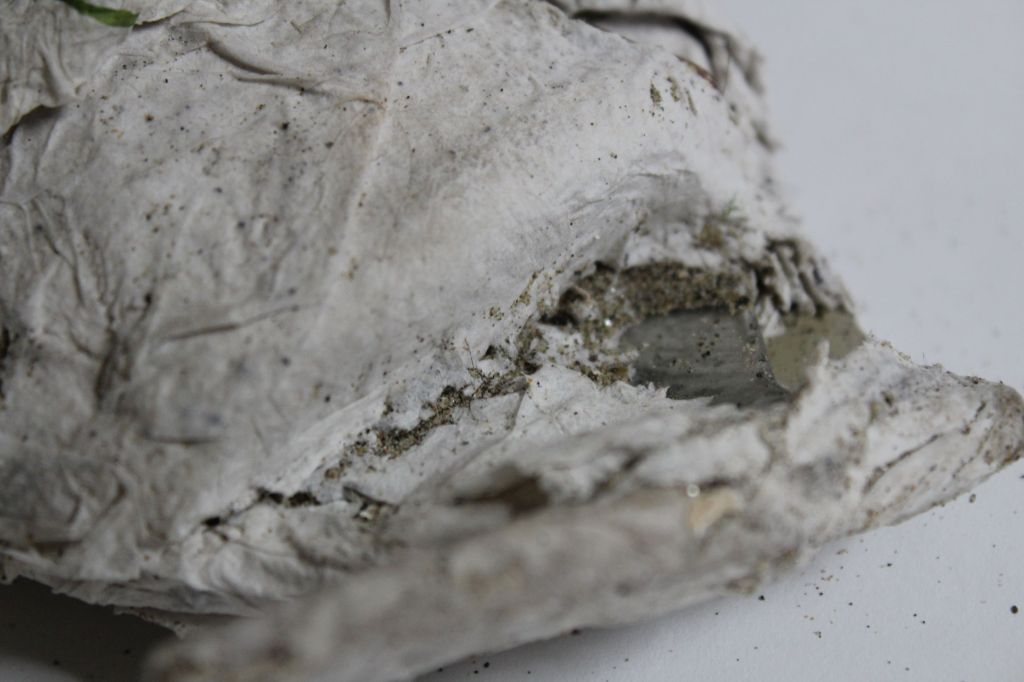
Exhibition/outcome-wise, as well as the videos, I have some stills and photos of the process that could be displayed, or alternatively the altered sculpture itself hints well at the process it has been through as can be seen below. Displaying sculptures that have been through some kind of journey or process, as I touched on briefly when considering my ‘ghost sculptures’, do require some extra thought as to how this backstory will be explained. I feel the videos do this job quite nicely here and I can imagine having the final altered sculpture next to a video of its creation being an effective way of conveying this without relying on any lengthy descriptive text. This is something I touched on in my research on Simon Starling too.




 Anna Harris