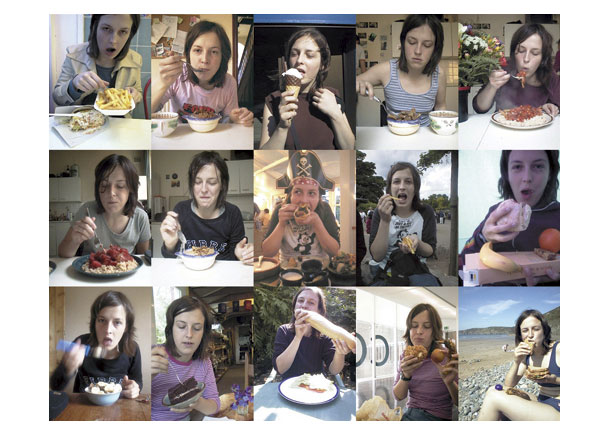
For one year – from her 22nd birthday to her 23rd – Ellie Harrison documented everything she ate. The processing and displaying of this vast quantity of amassed images is something I wish to look at in reference to my own rock tracking data. Harrison’s project seems relevant not only in its methods of data collection, but also in how these are then displayed and in how the playful tone of the project is assimilated into the final presentation.
The project has its own website – eat22.ellieharrison.com . I had not considered a virtual mode of presentation beyond the ‘in-progress’ previous journal post. I’m not sure if logistically I’d have the funds to set up it up a website of its own but it could well be presented in a more final format on my own website/this journal, or be able to view as a compilation of pictures in a Google Drive album or something similar. The virtual mode of presentation, particularly when presented on a website, also allows for accompanying information to contextualize the work, and would allow me to separate out different points of view/categories of data, as well as including other fragments that don’t go in a series such as maps/line drawings of the journey. I could also present the work in other digital formats such as video/GIF etc, as Harrison has done here.
Harrison’s website has a rules tab – quite formal/official – laid out clearly for the viewer. Do I want people to make their own way to the conclusion of what is happening in the piece or do I want to tell them? Writing might be a good touch to nail the tone of the piece, particularly in terms of writing something mimicking a very scientific tone?
She has a log for any broken rules – could incorporate this kind of thing for missing photographs? Might be good to explain this a little at the beginning as Harrison has done?
Images are shown (on the website at least) in groups, each group being a full week of photos. Photos are captioned with key information: image, date, time, food, location. Should I include dates on my images, or just let them speak for themselves? Including dates perhaps isolates each individual image, whereas leaving each uncaptioned focuses attention more on the progression/the images en-masse? Or I could include dates separately, in a list at the start/end? If so, this would allow me to include explanations for some groups’ mismatching dates/why there are missing dates at all at the same point. This may be a good middle-ground in terms of having the dates available if needed, but keeps the focus on the pictures elsewhere.
After looking at some of her other data collection projects, it would appear that most of Harrison’s data collection work is documented online/digitally: in her tea blog the viewer can scroll through her hot-drink-thoughts (each with their own blog page); she has an online swear box in which the viewer can sort through all the times she swore in a year; she also has a space in which the viewer can scroll through her thoughts while swimming lengths of her local pool. It is notable that most of these projects occurred before many social medias had been invented, and she soon gave up data collection once they had. Some of her data collecting projects can be found here, and critiques/reflections on social media here (New Forms of Collectivity essay) and here (‘instantaneous ego broadcasting’ tag).
I had presumed that I would create a physical display/document of my rock tracking images, but Harrison’s work has shown me that perhaps methods of digital presentation might work better for presenting large quantities of information, particularly visual information. Equally, perhaps it should be noted that Harrison’s work often includes considerably more data than my own project has, at least so far, amassed. I think I need to consider further what aspect of the piece I’d most like to accentuate, and how different modes of display may bring these out. Digital may be best for including all possible information, and for allowing flexibility when viewing, whereas perhaps physical display may be a bit more curated. I could also do a mix of both, creating a physical document (a book/zine?) which then links to a more in-depth catalogue online?

 Anna Harris