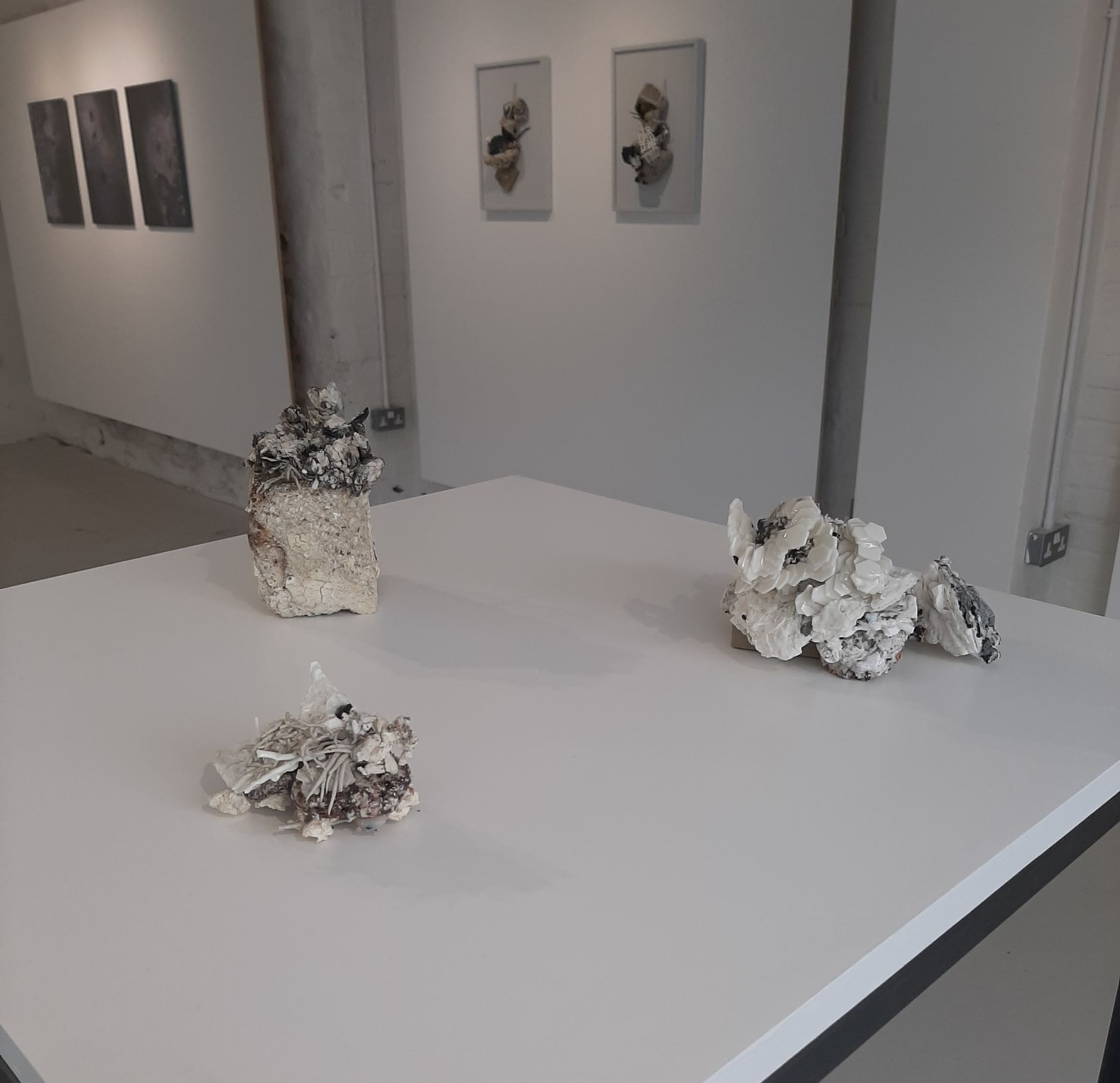
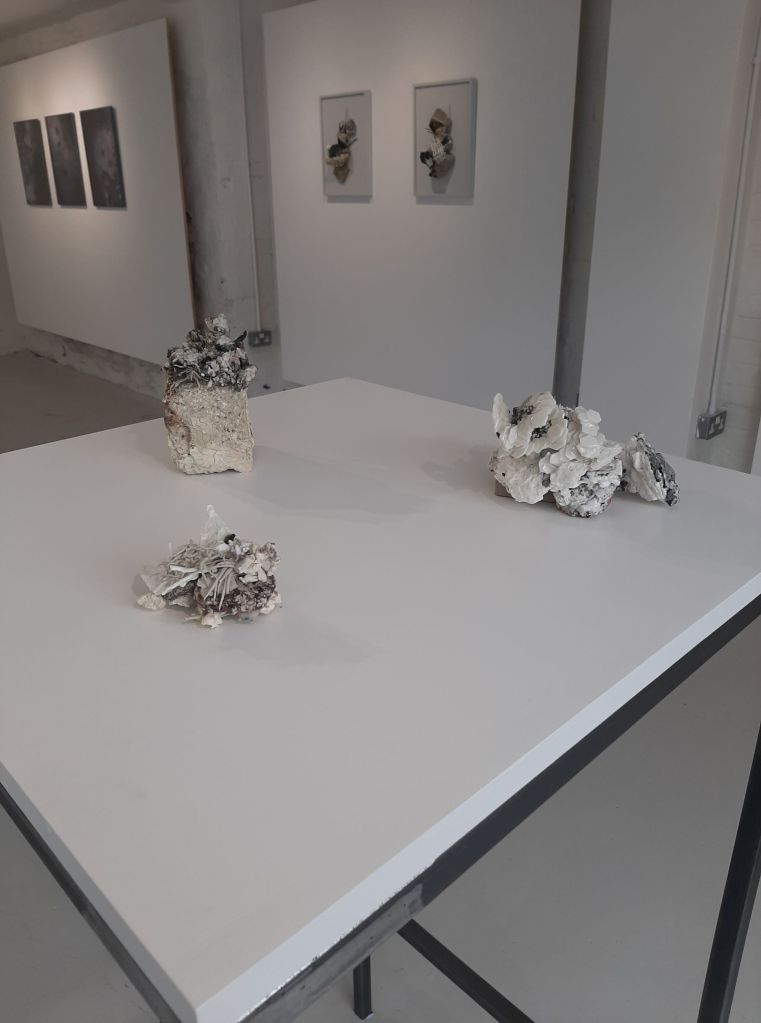
Martin’s work has very similar intentions to my own – a desire to explore ‘grey areas, of unknown materials, unseen places, and our desire to categorise the world‘. (see my previous post on this) This was the first time I’d seen her work in person, however, providing me with a much more critical look at the work. My thoughts and reflections can be found below the pictures.


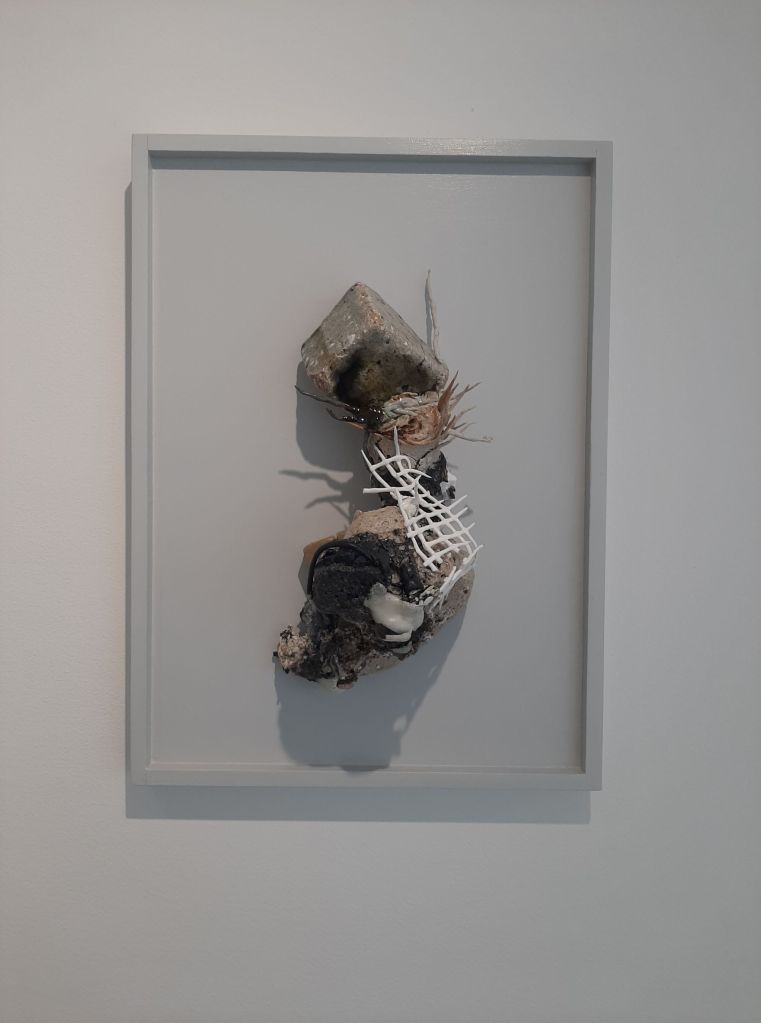

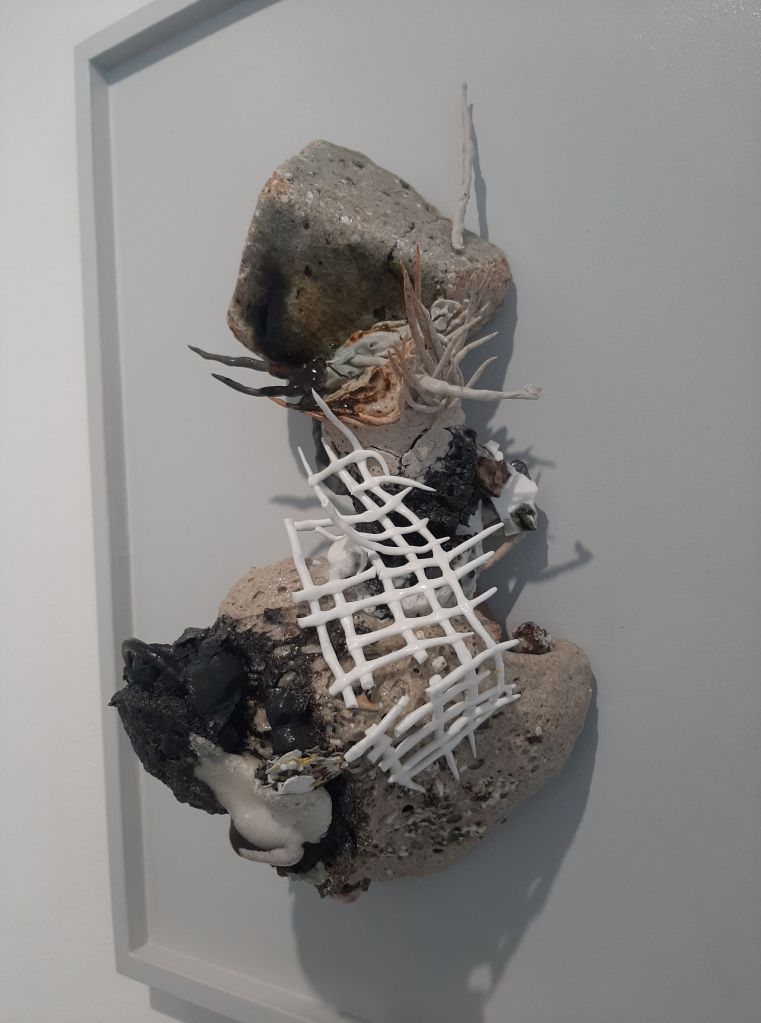




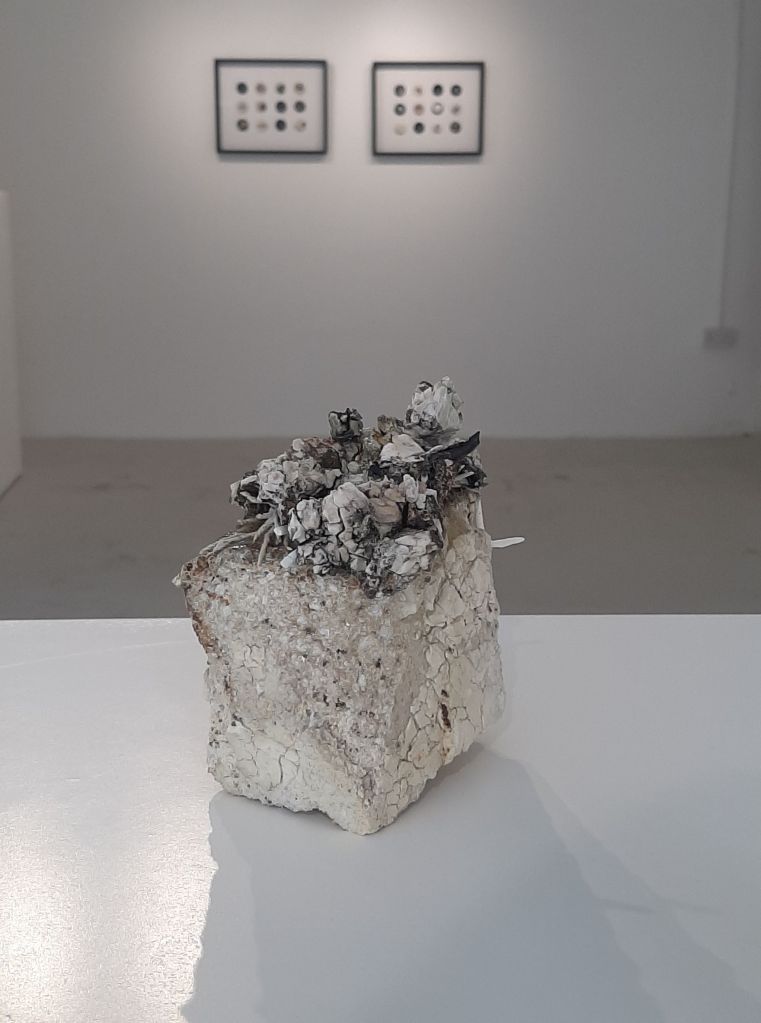


- the method of assembling a set of conditions – an amalgamation of materials such as clays, porcelains etc – and then firing them is exactly what David Paton was speaking to me about in its geologic-ness: the firing providing heat and fusion, reminiscent of rock formation.
- this set-up really embodies the sense of being a collaboration between human and material, a shared process. the half where the material is allowed to take over, exhibit a sense of agency, is something that i still feel i am lacking in particularly my sculptural work. in some senses i have perhaps separated the two, with the sculptural work being the more human-led investigation of ‘thingness’, and the rock tracking being the material-led section. could i consider a way to fuse these two more coherently, as in Martin’s work?
- i liked that there were echoes of imposed forms within the scultpures, as well as there being plenty of areas where the works became more amorphous, oozing – pure material moving away from the human. this created a nice tension between the two, again echoing this idea of the pieces being a material-human collaboration
- the imposed structures that seemed to me either the most notable, or that were repeated were the delicate fungi-like tentacles, the grid formations and the hexagonal patterns
- i like how the tentacles offered a sense that something was growing, bringing a more organic feeling to the pieces
- the grid formation was intriguing in how out of place it could feel if it hadn’t cracked and warped in the firing process. as it had though, it really accentuated the material’s agency – the human had shaped it to be rigid and uniform and then the material had taken over, drawing it into an entirely different shape. again, how could i consider bringing this into my own work?
- the hexagonal patterns seemed quite jarring initially, quite overtly speaking of the hand of the human in the object’s creation, particularly when compared with the more fluid, organic tone of the rest of the sculptures. however, as with the grid, they soon began to ooze and blend back in with the rest of the sculpture, providing a nice sense of tension and relief that perhaps wouldn’t have been achieved had it just been the softer materials alone. the hexagonal pattern is also nicely reminiscent of the microscopic structures of materials, echoed in the large microscopic prints elsewhere in the exhibition
- the different layers of texture and material that the above provides is again something that would be good to bring into my own work so i don’t end up being too conservative in my use of materials – it is also in places nicely reminiscent of layers in rock, with different sediments and times being cemented one above another
- something that is interesting to consider in relation to my own work is the scale of Martin’s work. I have always been drawn to work relatively small-scale, at much the same scale of Martin’s sculptural pieces, and yet have felt that this may be merely to avoid having to cross practical boundaries rather than actually being an artistic choice. However I noticed with Martin’s works that I was most drawn to her smaller sculptural pieces and that the pieces I found least effective were her two larger photographic prints. I enjoy the concept of them – printing microscopic images at almost human-scale, potentially becoming immersive landscapes (something I have looked at before through my miniature, my rock landscapes and maps etc) – and yet they seemed a little too blurry to achieve this, instead leaving me with the impression that they were large scale simply for the sake of it. With this in mind I think it would be good for me to try working on a larger scale for the sake of comparison, but also bear in mind that smaller scale works aren’t necessarily unfinished or unresolved. Testing my smaller works out in a more ‘finished’ setting would also help me reflect on this (i.e. getting plinths, making space for them outside of the clutter of the studio)

 Anna Harris