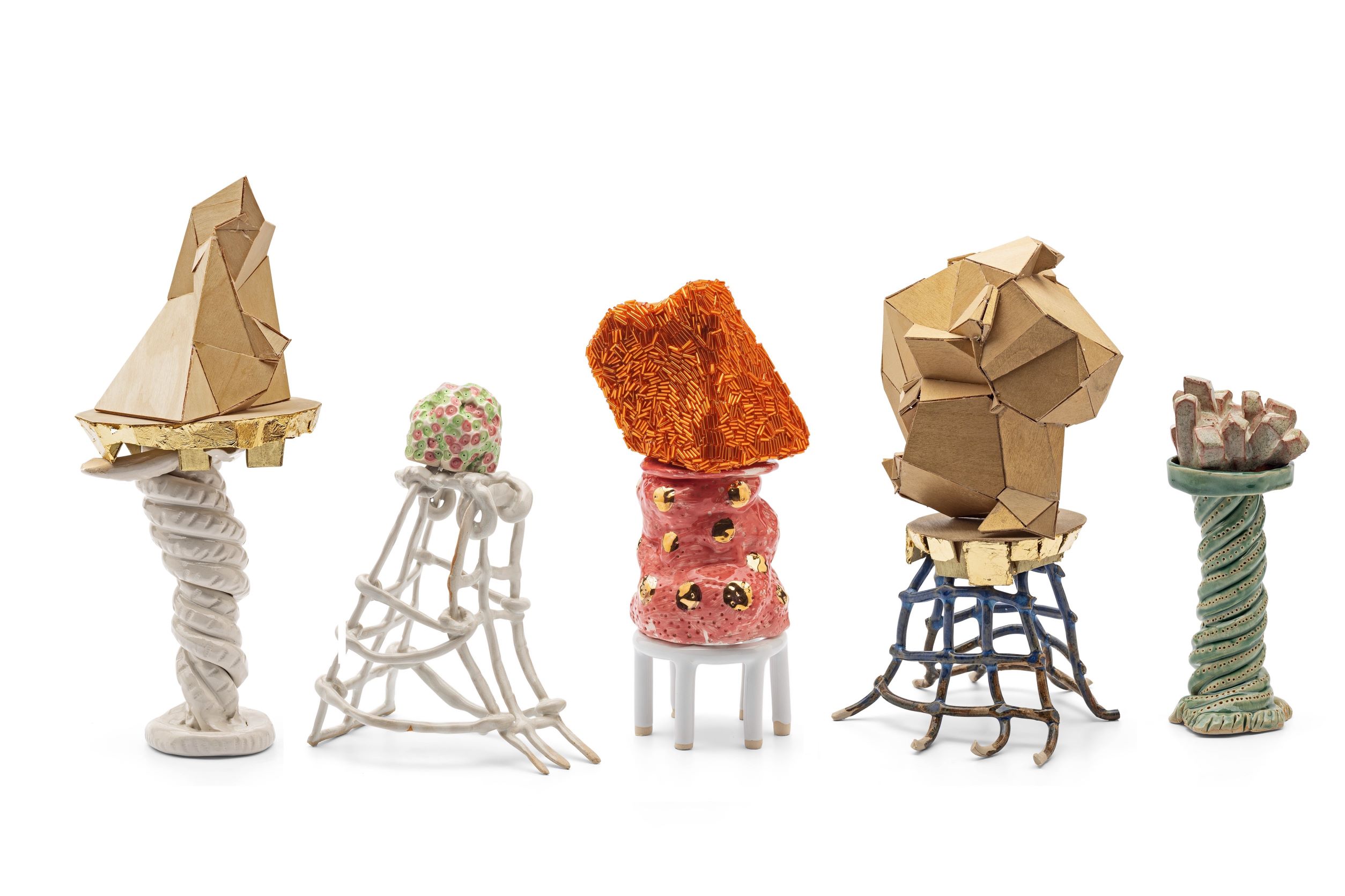
http://bridgetteashton.co.uk/portfolio/plan-for-fake-minerals-and-fancy-plinths/
Bridgette Ashton’s ‘Plan for Seventy Fake Minerals & Fancy Plinths On Presentation Stands’ encouraged plans during lockdown 2019 for future making and display, through the process of drawing and redrawing an array of handmade objects. The sculptures depicted were modelled predominantly from ceramics incorporating cardboard or plywood rectifications and embellishment.
The accompanying letterpress and linocut publication with its ceramic illustrations, presentation case and display stand directly reference an 1871 mineralogical handbook in which the author methodically describes and lists a lexicon of rocks and minerals found in Cornwall & Devon. (from above website)
- reminiscent of Rosanna Martin‘s exhibition catalogue which was produced to ‘directly reference’/mimic the style of a geological document
- captures nicely the idea of geology without feeling the need to be a direct replica, a direct copy of the science – similar to Paul Nash’s approach to Avebury:
- ‘Nash wanted to champion the possibility of artists finding their own accommodation with the past, rather than being subservient to archaeological understanding.’
- ‘Nash felt that Keiller’s restoration work at Avebury in the later 1930s had robbed the site of its presence and its power. The controlled experience of prehistory offered by Keiller’s restoration (megalithic landscape gardening, as Stuart Piggott later described it), seemed to Nash wrong-headed in its attempt to retrieve what time had eroded. Keiller wanted clarity where Nash wanted mystery.’
- ‘Nash’s insistence on the vitality of the past is, ultimately, a plea for another sort of knowing, an alternative, even a resistance to empirical data and orthodox methodology. In their place Nash proposes a mode of engagement with prehistory that works with what cannot be known, what must be intuited.’
- ^this captures a very similar encounter with the past/the object, rather than what is known and labelled, as Bennett’s vital materiality does, and as Brown’s thing theory does
http://bridgetteashton.co.uk/portfolio/coxside-cartographies/
Coxside Cartographies is a creative history mapping project developed with Joanna Brinton and Coxside communities. The mapping took place predominantly during the first lockdown of 2020 but came into fruition in 2021 once we could hold public workshops. Coxside Cartographies reflects on Plymouth’s past, present, and its connections to the wider world through migration, work and trade taking the sites of Coxside’s historical porcelain factory and sugar refinery as starting points for considering the area’s history*. Incorporating walks and talks, remote activities and in person tea-reading sessions and clay workshops, we worked with local and regional communities including: Coxside Neighbourhood Group, Prince Rock Primary School, Plymouth and Devon Racial Equality Council, Plymouth City Council’s Natural Infrastructure team, and Plymouth Community Homes.
The accompanying publication brings together maps produced by project participants, and photographs taken on their daily ‘lockdown walks’ as an invitation and a guide for others to explore Coxside. In tracing the resident’s’ journeys and delving into the buildings, landscapes and horticulture they recorded, we can engage in a type of ‘local escapism’ that incorporates place, people and memory. In a series of walks, workshops and conversations that were held over the course of the project we hoped to also address the colonial legacies that emerged, from evidence of trade and travel, wealth and production but also via botany.
- the phrase ‘local escapism’ also contributes to this idea of the unfamiliar being found in what is usually the familiar, removing normalcy from the mundane and encountering surroundings anew
http://bridgetteashton.co.uk/portfolio/2003/
^this upcoming exhibition is how I came across Ashton’s work – it should be exhibited soon at Newlyn Art Gallery so hopefully I can see the work in person, learning more about it in the process

 Anna Harris