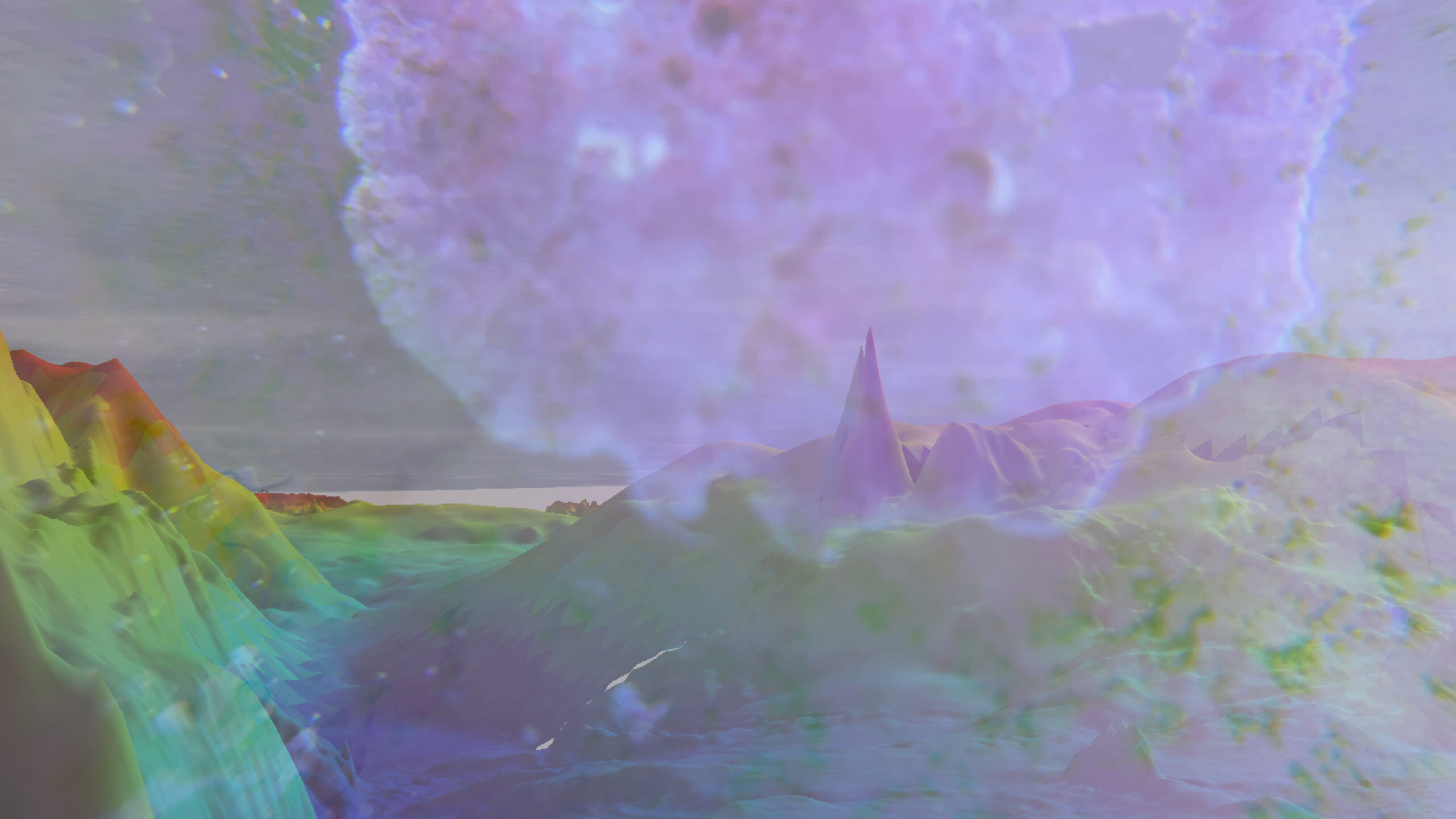
From the John Hansard Gallery website:
John Hansard Gallery is proud to present Hydromancy, a new commission by Matterlurgy.
Filmed on location at the University of Southampton’s National Oceanography Centre, a globally renowned centre for developing technologies that investigate the world’s oceans, earth systems and biosphere, Hydromancy blends documentary with artistic intervention, considering the ocean as both a sensory environment and scientific object. As viewers, we visit a coral lab bathed in blue light, an engineering workshop, and enter a room bubbling with algae and phytoplankton.
Hydromancy puts into focus the spaces and technologies involved in ocean sensing and modelling: autonomous vehicles, remote sensor and tools that measure temperate and composition. The film shifts in and out of scale and perspective, water acts as a portal to span time and space. Haunting the film is the sound of the Hydromancer, an utterance between voice, song, breath and atmosphere.
Hydromancy was co-commissioned by John Hansard Gallery and Onassis Stegi, and premieres at John Hansard Gallery from 1–26 November 2021 and online from 1 November 2021–31 January 2022. The film then forms part of the exhibition Weather Engines at Onassis Stegi in Spring 2022, curated by Daphne Dragona and Jussi Parikka.
Matterlurgy is a collaborative practice between London-based artists Helena Hunter and Mark Peter Wright. They investigate the critical ecologies of environmental change, across disciplines and media, combining the production of artworks with co-constructed events, exhibitions and live performance.
My own responses to the film:
- sound waves as water waves – sound as matter
- ephermeral, unsure
- shimmering blue but artificial
- (the voice, echoing: what more can we know? not resolution/conclusion)
- faint/panning/many voices
- lab set-up, bubbling matter
- spinning
- ‘magnetic stirrer’
- deep resonant humming – machine and unearthly
- water vortex – menacing, a presence, felt
- shimmering but urgent
- filtration
- high electric fizzing, whirring, pale noise
- manufacture
- monitoring. learning?
- bathymetry/metric
- roaming deep sea surfaces
- unseen landscapes
- layers of information
- breakdown of words
- tentacles
- fronds – drifting, flowing
- tumbling sediment or creatures? itchy like ants, static-sounding
- corn seeds? fields? yellowing, yellows
- earth colours and sea colours
- swarms, swarming
- disorienting repetition
- microscopic but alive and urgent, tumbling, disorienting, unresolving scenery flashing by
- a sea but not as we know it. not as we experience it
- clouds
- pulled violently away from immersion in tumbling microscopic at the end – just staring out at a more conventionally human look at the ocean – a provocation
- encountering unknowns, both through and because of the eye of science
There’s a wonderful part towards the end where the camera seemingly enters the swirling, swirling water. The footage tumbles, bubbles, froths, turns – it’s evident you’re in the water but it is not evident even whether you’re in the lab, the sea, some other body of water. There is never an opportunity to catch your footing, to pause, regain ‘sense’, to understand – it becomes merely experiential, rooted only in material tossing and turning. This is very much something I’d like to include more in my own work – a sense of an experience, a provocation – as opposed to simply just an illustration of material ideas that interest me.
There are also strong links between this exhibition and the content of my dissertation, particularly Rona Lee’s work. I’d like to look further at the John Hansard Gallery as it seems to have strong links with NOCS, creating a fascinating blend of art, science and water. Matterlurgy as a collective would also be interesting to research further.

 Anna Harris