https://www.upress.umn.edu/book-division/books/alien-phenomenology-or-what-itas-like-to-be-a/
https://www.penguinrandomhouse.com/books/319/the-spell-of-the-sensuous-by-david-abram/
https://olafureliasson.net/researchmap/
Doreen Massey For Space – available through library online
In this book, Doreen Massey makes an impassioned argument for revitalising our imagination of space. She takes on some well-established assumptions from philosophy, and some familiar ways of characterising the 21st century world, and shows how they restrain our understanding of both the challenge and the potential of space. The way we think about space matters. It inflects our understandings of the world, our attitudes to others, our politics. It affects, for instance, the way we understand globalisation, the way we approach cities, the way we develop, and practice, a sense of place. If time is the dimension of change then space is the dimension of the social: the contemporaneous co-existence of others. That is its challenge, and one that has been persistently evaded. For Space pursues its argument through philosophical and theoretical engagement, and through telling personal and political reflection.
^ how would this intersect with my own exploration of deep time?? It perhaps links more to the idea of here-and-now that I spoke of in my dissertation? Might help to pull together the close attention of my sculptures (space) and the wider reaching implications (time)
In Vibrant Matter the political theorist Jane Bennett, renowned for her work on nature, ethics, and affect, shifts her focus from the human experience of things to things themselves. Bennett argues that political theory needs to do a better job of recognising the active participation of nonhuman forces in events. Toward that end, she theorises a “vital materiality” that runs through and across bodies, both human and nonhuman. Bennett explores how political analyses of public events might change were we to acknowledge that agency always emerges as the effect of ad hoc configurations of human and nonhuman forces. She suggests that recognising that agency is distributed this way, and is not solely the province of humans, might spur the cultivation of a more responsible, ecologically sound politics: a politics less devoted to blaming and condemning individuals than to discerning the web of forces affecting situations and events. – nice summary of vibrant matter
Current thoughts on my practice (somewhat in response to research, somewhat just a wandering mind):
- currently my practice feels a bit fragmented as the sculptural element has been slowed significantly as ceramics is a much more involved process – it’s important for me not to lose a quick 3d way of making, even if that does mean using glue/materials that aren’t quite ideal
- clay/ceramic will be an important next/more final step but don’t lose the thinking step in between – drawing scratches this itch to an extent but it’s not quite the same on its own
- exploring the idea of underground – from my miniatures piece and Robert Macfarlane’s Underland – as a similar realm of nonhumaness as the sea/water (as covered in diss)
- could try burying things? drawings?
- could grow artwork? https://zenaholloway.com/root
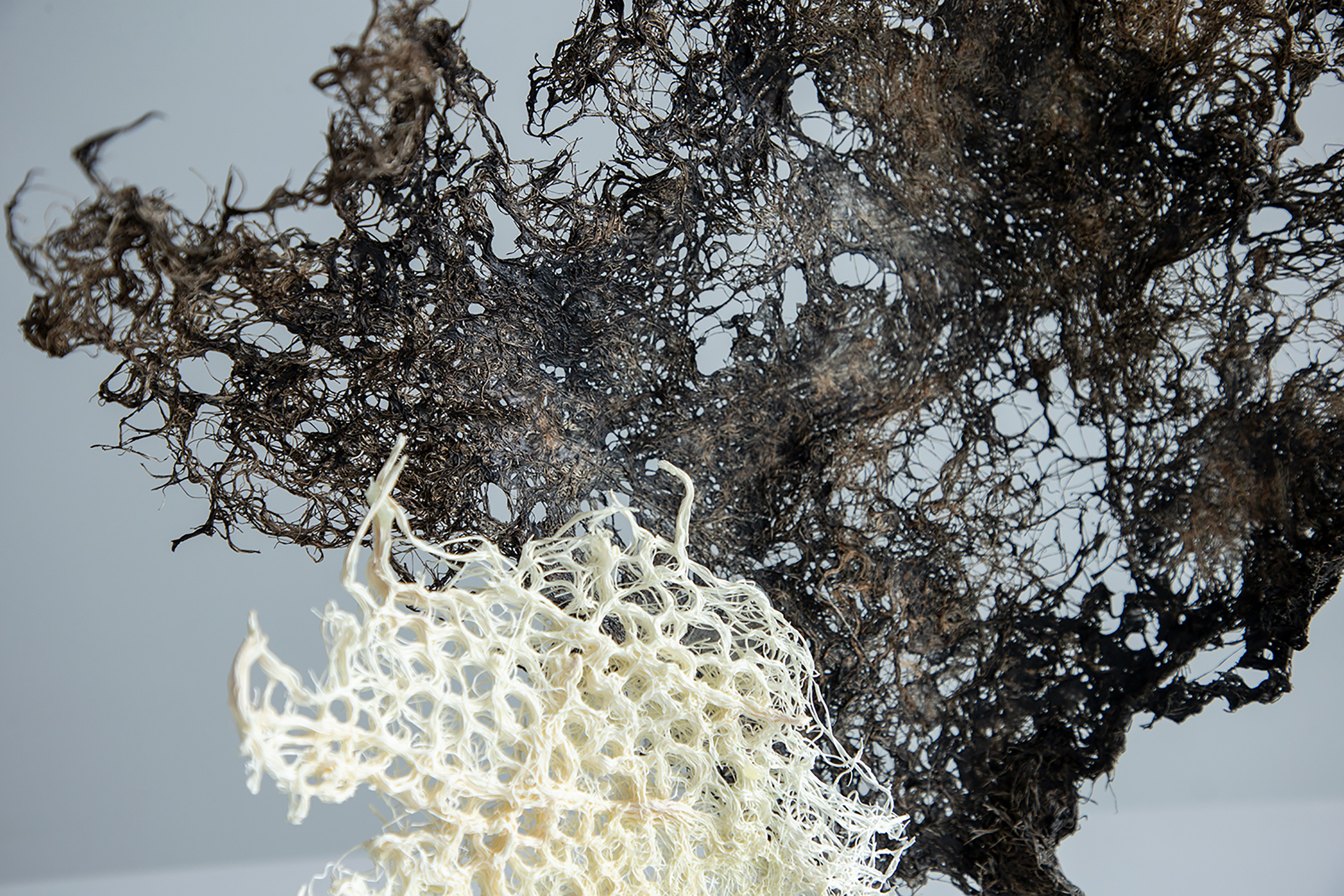
- seaweed? (glue)
- the importance of tidal zone in relation to this – a space of change and in-betweeness
- could document one bit of space, observing the changes that happen in it every day?
- could put a camera on a rock?!
- Interventions in the world? What would this object say to you? Inscribing phrases into objects (similar to pebble for your thoughts) and leaving them in the world – one on every beach in Cornwall?!
- Changing the means through which we usually interact with nonhuman objects – usually via sight

 Anna Harris