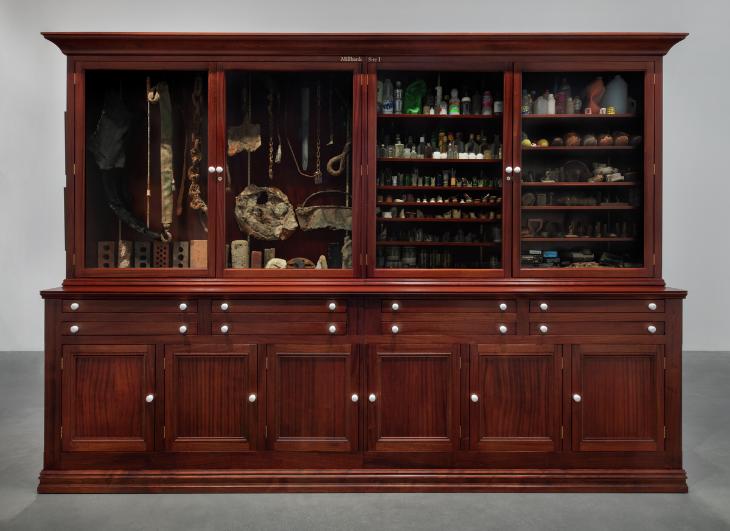
As part of preparing my work for a recent crit I experimented with the way I choose to present it. One arrangement was identified as slightly more successful than the others, and was the one in a taxonomical arrangement. As such I felt it would be relevant to familiarise myself with the work of Mark Dion, and thus the critical implications and historical associations of this method of display. (The ‘curiosity cabinet’ approach has also been used in Bridgette Ashton‘s Artificialia).
Mark Dion:
‘Mark Dion (born August 28, 1961) is an American conceptual artist best known for his use of scientific presentations in his installations. His work examines the manner in which prevalent ideologies and institutions influence our understanding of history, knowledge and the natural world. The job of the artist, according to him, is to “go against the grain of dominant culture, to challenge perception and convention.” By locating the roots of environmental politics and public policy in the construction of knowledge about nature, Dion questions the objectivity and authoritative role of the scientific voice in contemporary society, tracking how pseudo-science, social agendas and ideology creep into public discourse and knowledge production.’ (Tate website)
Dion’s Tate Thames Dig is in many ways reminiscent of my own gathering of artefacts from the side of Penryn River:
During the summer of 1999, U.S. artist Mark Dion and a team of volunteers drawn from local groups combed the foreshore of the Thames at low tide along two stretches of beach at Millbank and Bankside, near the Tate Gallery (now Tate Britain) and Bankside Power Station, which would become Tate Modern the following year. As with Yard of Jungle 1992 (Museo Arte Moderna, Rio de Janeiro), where he literally removed and examined a yard of jungle floor, Dion focused on a natural, historical constant. In this case, he turned to the banks of the River Thames, looking for fragments of individual and ephemeral histories. London’s location, its growth and its fortunes can be attributed to the Thames. The two sites yielded a wide variety of artefacts and tokens of life as lined Millbank on the north shore of the Thames and Bankside on the south. Working over a number of days, Dion’s team collected large quantities of items, including clay pipes, vividly decorated shards of delftware, oyster shells and plastic toys. The finds were then meticulously cleaned and classified in ‘archaeologists’ tents’ on the Tate Gallery’s lawn at Millbank during the summer of 1999.
‘Antique items sit alongside contemporary items, ephemera and detritus are next to objects of value. Each is a material witness, performing the same function as a historical proof. This lack of distinction is an important aspect of Dion’s approach and he resists the reading of history as a necessarily linear progression. The only differentiation is a geographical one, the two sites retaining their individual identities. The lack of historical categorisation suggests a subversion of standard museological practice. Viewers are free to create their own associations, to trace histories across time, not necessarily in a linear direction.’
(more info can be found here)
Could it be interesting to try and find out more about these artefacts as Dion has done here? And to learn more about the history of Penryn River? But is there more of a distinction here between my work and Dion’s – whereas Dion is looking at ‘individual and ephemeral histories’, am I not looking at it from a more material perspective?
Also important to remember the problematic histories associated with taxonomic displays – ‘By re-enacting the processes of scientific research, Dion questions the premises upon which these activities are based.’
How am I changing the display by adding my own made objects to it?
- emphasis on slowing viewers down, making them look carefully – ‘i make work to reward careful viewers’
- not getting too hung up on the idea of what is art, more just what is interesting
- ‘obsessive collecting that creates a sense of wonder when you’re in the exhibitions’
- collecting from shops as well as the beach – brings a more human element to it? and then considering these artist materials, creating installations with them rather than physically using them to make sculpture with etc

 Anna Harris