The main highlights from this week:
- the last Cultivator workshop
- another Tate Emerging Artist session – we experimented and played around with materials in response to Thai Nguyen Phan’s exhibition
- I started volunteering at the CAST Saturday Club sessions – we made St Piran’s day lanterns from willow and tissue paper (really interesting materials to work with – would love to experiment more with this at some point in the future)
- I was approached by a publication called Tour de Moon and asked if they could publish some of my work in their next issue. I gave them work I had already created but wrote some new text to go alongside it which was a really thought-provoking way of working, and something that may be good to consider for the degree show.
- open studios (will reflect more on this below)
- I collected my bronze-cast seaweed – this still isn’t finished but so far looks to have turned out well!
- I made another paper sculpture for the open studios (again, reflection below)
- I made some more clay pieces, exploring paper and glass, but these need to be fired – hopefully next week. I also bought some glazes so again hopefully these can be applied and fired next week.
- also some water-logged (and in places cyanotyped) paper cups
In terms of where I’m at with my art, I seem to have reached a bit of a pause. I’m realising that I am naturally drawn to a way of working wherein I’m constantly experimenting – trying new iterations and variations on a theme, always relatively small-scale, which then over time accumulate to strange clusters of ‘things’. I’m currently unsure whether this is something I should challenge – should I be pushing myself to pick a small number of experimental outcomes and start to push them to a bigger scale in preparation for the degree show? Or should I lean into this way of working, and move towards a degree show where a lot of emphasis is in the curation, arranging lots of smaller pieces into curious piles and collections? I know I am certainly leaning towards the latter currently but I want to be sure this is for the right, critical reasons and not simply because it seems a more familiar and comfortable way of working. I feel as though were I to push something to be larger, this is the time to start – perhaps I could see if I can start something larger but also keep experimenting alongside?
I feel this is also a good time to start, very speculatively, considering what I might need for the degree show in terms of presentation. If I am leaning towards wanting to exhibit lots of smaller pieces, the first thing that comes to mind would be either large plinths/tables, or even curiosity-cabinets. I need to start looking into where and how would be best for me to acquire these if so. I also want to ensure, however, that I don’t just pick one of these options as they seem default options – is there anything I could do to be a little more creative? Could I let people interact with (some of?) the work, allowing the curation and display to change over the course of the exhibition? This could even involve allowing fragile pieces to breakdown as people handle them? If I am doing anything Mark Dion-esque, I would need to more consciously assess the associations with that style of presentation – the histories and intentions of museums as opposed to art spaces. Hopefully I might be able to use my tutorial this week to run through some of these options.
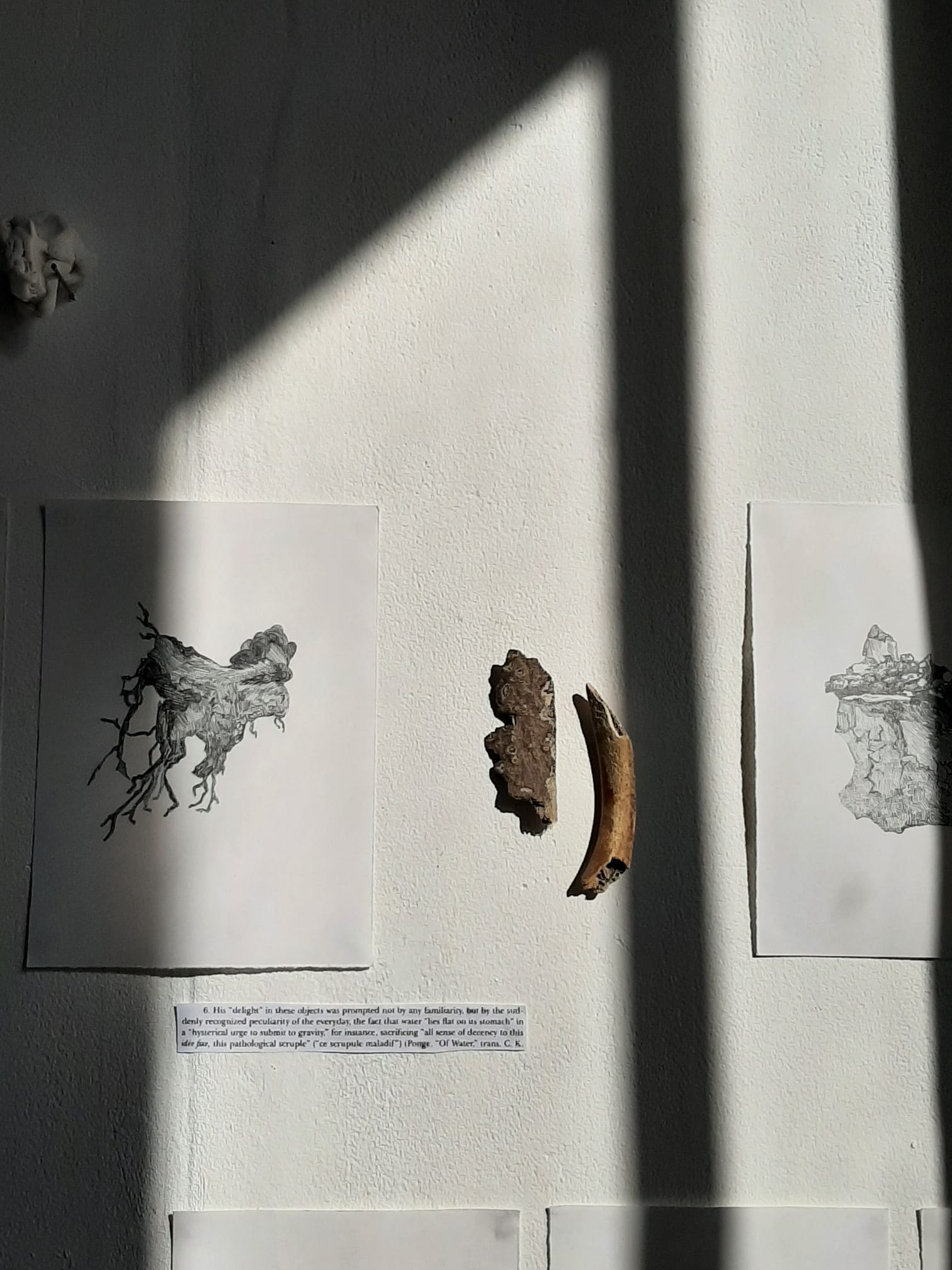
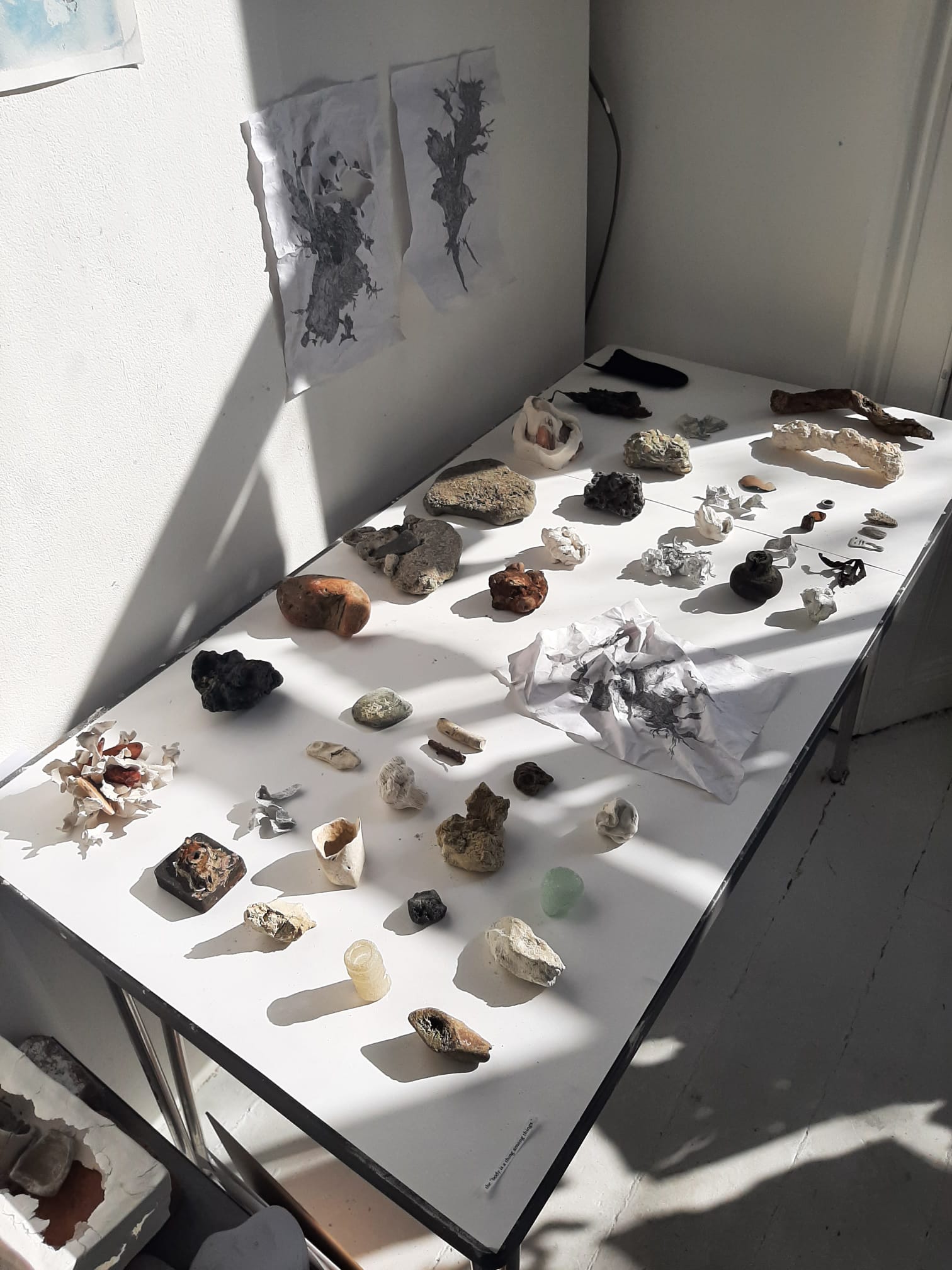
For the open studios this week I tried to curate my space in response to the crit feedback I received last week. Instead of having a pile of materials on the table, I moved it all to be in a taxonomy-esque arrangement. I’m not sure if it was quite as effective – the uniformity of the arrangement seemed, to me, to dampen some of the liveliness between the objects. However, it may be that if I were to make a slightly wider array of pieces (e.g. once I have more ceramics, bronze-cast seaweed etc), this might make the display a little more vibrant and interesting. I did receive a couple of comments from people asking me what was ‘real’ and what I had made which I enjoyed – I like this idea of people questioning what they’re seeing. I think this comes from the fake rocks that I made, quite awhile ago now, which raises the question of if I should make some more ‘fake’ things? To some extent this might satisfy the urge to make something a little more established – although it wouldn’t necessarily be bigger, they do take significantly more time, and I have already been through a long experimentation process with these. Or is this unnecessarily going back to something I’ve already done? Perhaps next time I’m in the studio I could look through my collection and see if there’s anything that lends itself particularly to casting?
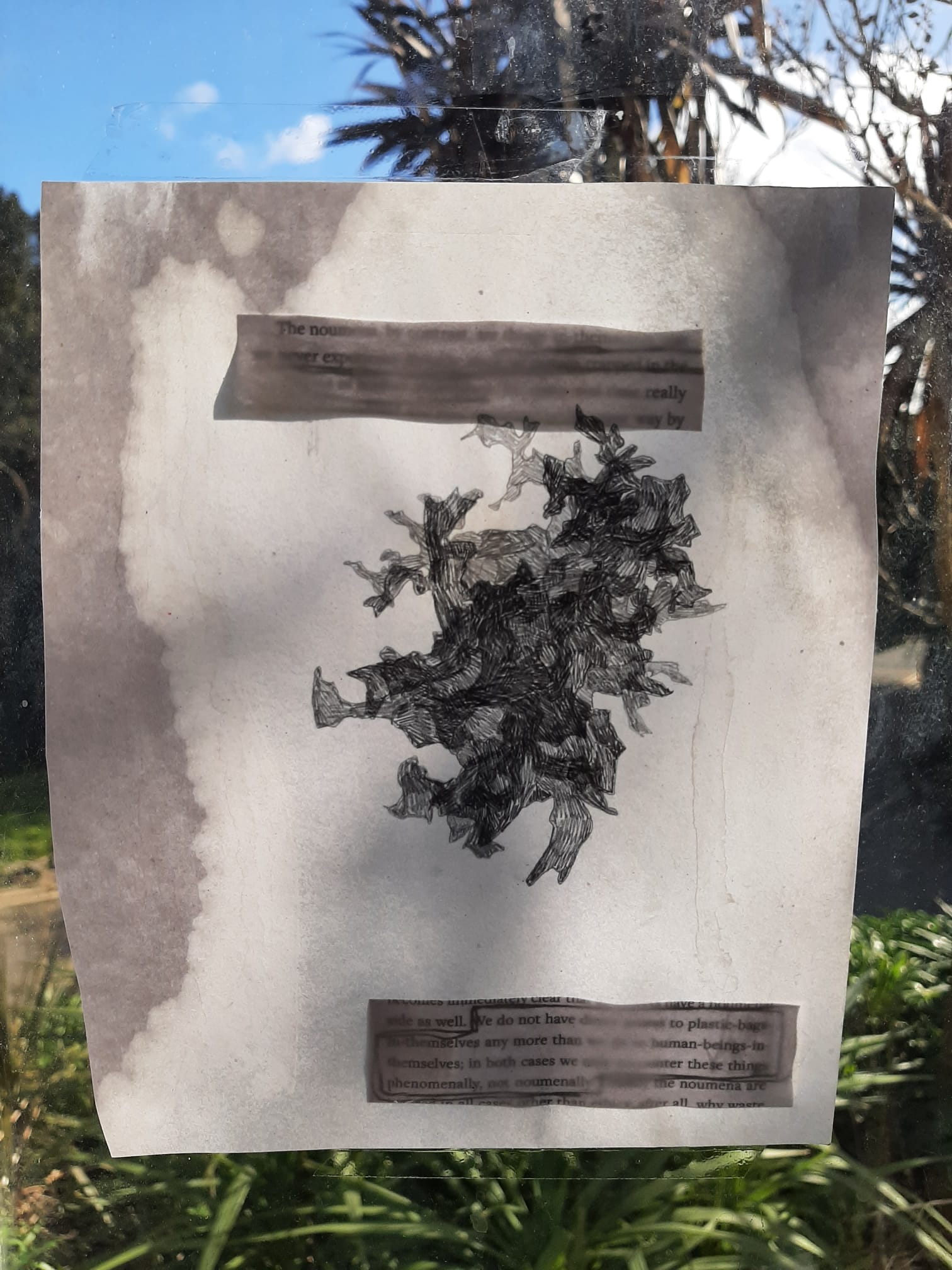
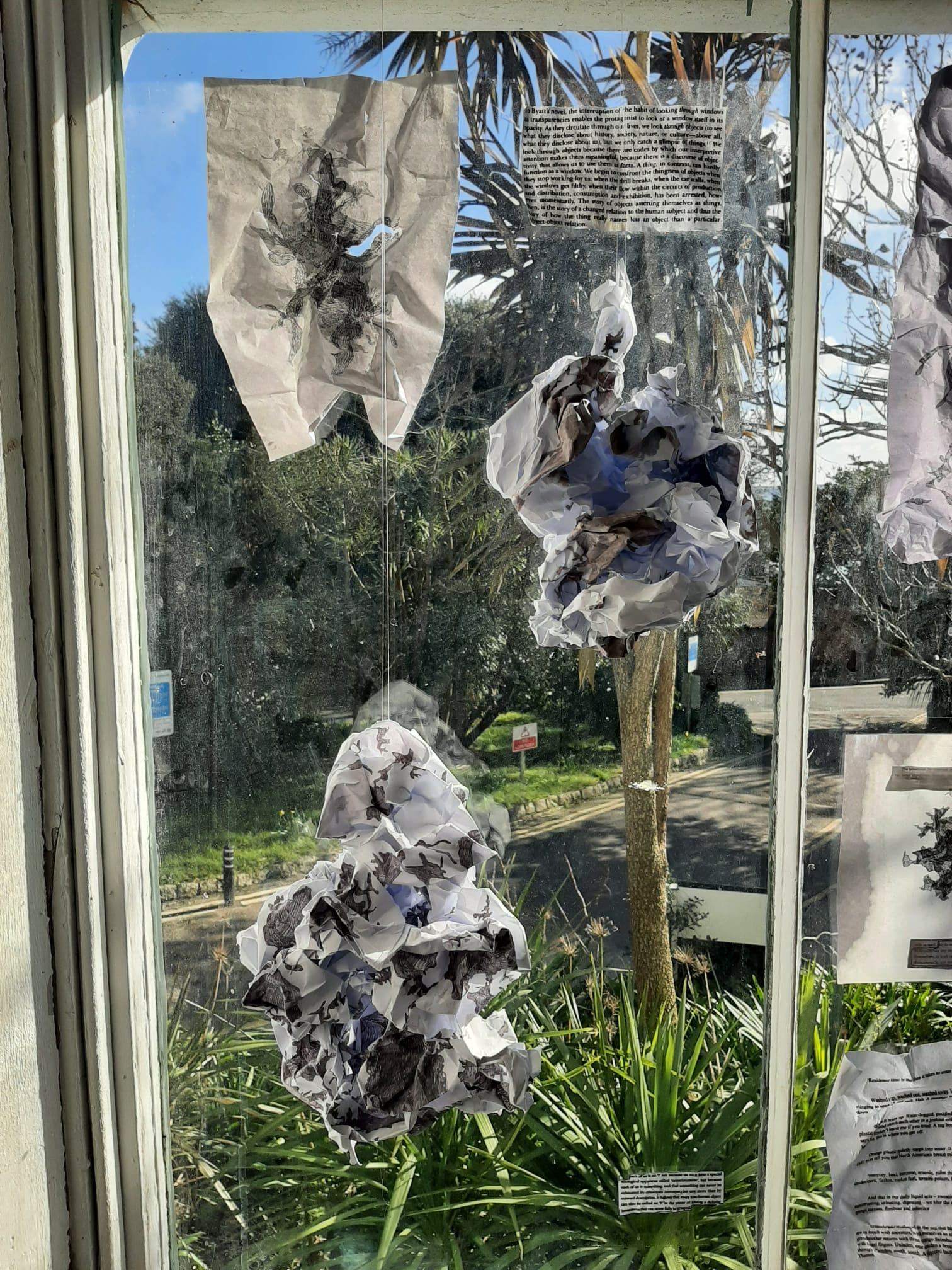
I had multiple zones to my open studio, which worked quite nicely: table, wall, window and then a couple of bits on the floor (and things on the radiator?). The window display I feel holds potential, but didn’t maybe feel quite right, although it’s hard to pinpoint why. I suppose conceptually what I like about the window is the authorship it gives to the outside world, allowing weather conditions etc to affect the work. Maybe what didn’t feel right was the number of things I had on the window, which didn’t quite feel cohesive? Perhaps if I had more consciously curated the space, rather than putting up a collection of drawings, paper sculptures and text this might have helped? I could try doing a piece that exactly fits the window and see if this simplifies things in any way, even incorporating text to the pieces (on the back)?
As for the paper sculptures (which I made this week with the open studios in mind), I’m not sure if they’re working as I intended. Previous feedback I received was that the paper sculptures felt a bit more limitless than the drawings, which felt contained by the edges of the rectangular paper. However, I can’t help but feel that there’s something effective about the subtlety of the flatter paper pieces – they seem a little more recognisable, but with a slight disruption, a bubbling, rather than becoming entirely untethered, unreadable pieces. It’s be good to consider experimenting with this, rather than writing off this avenue completely, but also good to recognise that this is something I find effective about the flatter pieces too. It also may be to do with the way I’m displaying them that isn’t quite right – hanging them makes them seem quite decorative, rather than growing out from somewhere. I displayed a few paper pieces on the floor, sat alongside some rocks, which actually struck me as doing something that the ones hung in the window weren’t; they established a dialogue with an ‘object’, in doing so pulling attention to the various forms and folds and processes of creation, as well as the weight of the pieces. This idea of invoking something’s weight – a physical sensation – without needing any touch is again something I find quite unexpectedly exciting.
Another strand, also in paper, that has started to develop has been small receptacles. The idea was to make these small receptacles to hold water, and then over time the water would soak out, distorting the form. However, I’ve found that the water tends to soak out quicker than it takes for the form to change, so I have been experimenting instead with just soaking them, and also adding cyanotype to the mix which makes tidelines around the edges. I like how the form of a cup is something a little more tangible than anything else I am currently working with, and echoes the forms that a lot of my gathered bits of ceramic etc would have come from. These currently feel very much like a sub-strand of my practice, not currently hugely important, but may develop into something more notable at some point.
The last section I curated was the wall space. This actually felt like the most successful area, perhaps because I am more familiar with curating a wall than e.g. a window. I particularly enjoyed having a mixture of completely flat drawings, somewhat water-shaped drawings, as well as found pieces on the wall; I felt this created a liminal space, things moving between dimensions and forms, nicely in dialogue with the window and table spaces. I’m still unsure what the cyanotype is bringing conceptually – I need to ensure I’m not just using it for purely aesthetic reasons, but because it brings another ‘thingness’ (as well as process) to the collection.








So, in all, things to do this week/going forwards include:
- tutorial – run through whether to take the approach of smaller things, or do I need to start working bigger?
- ^start considering what I might need display-wise for the degree show (kind of depends on the space I’m allocated too)
- potentially start something larger – maybe a window-sized drawing (with (window?) text on the back?)
- finish bronze seaweed
- go to Poly – get new pieces fired and glaze first batch
- maybe make a ‘fake’ object – assess items in studio and see if there’s anything suitable
- continue with paper sculptures? how could they be made more effective? not hung?
- (soak paper cups for longer?)

 Anna Harris