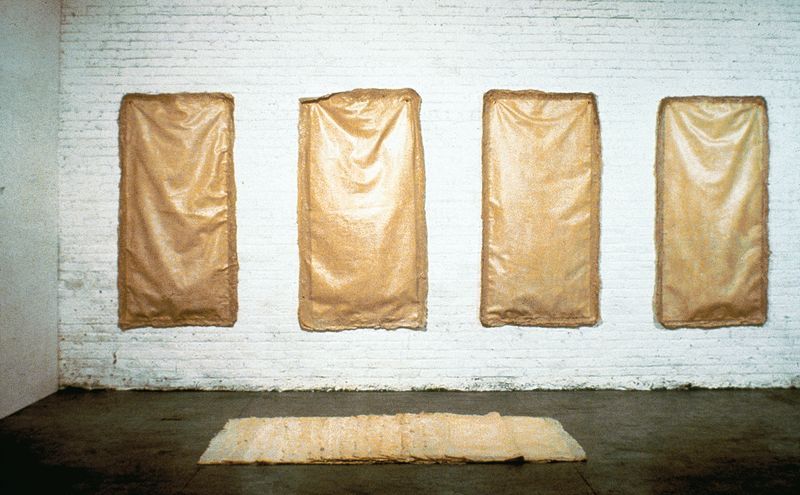
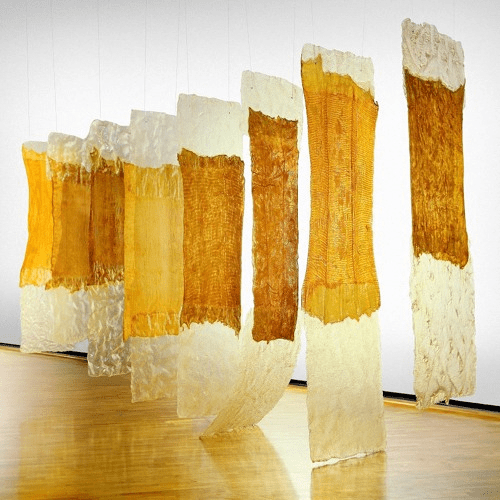
‘Her eight suspended sheets of resin and latex-soaked muslin are about as opposite as is possible to the predatory forged iron object. Suspended from fixtures overhead, the fragile sheets are openly vulnerable. Their armatureless bodies refute sculptural language, instead behaving more as painterly surfaces. But they are as sculptural as Modulation of Space I. And both pieces represent the physical and material manipulation of space, time and gravity which sculpture can exert. They are not concerned with pictorial images in three-dimensional form, but with sculpture which is rooted in actions applied to materials and processes to evidence – what? Perhaps these actions transform themselves into emotions, and that is what we are left to fathom.‘
From https://www.tate.org.uk/tate-etc/issue-23-autumn-2011/heat-moment
- reminiscent of my own soaked paper pieces – could display like this? would need to be double-sided?
- hovering between sculpture and drawing
- bold text i feel particularly relates to my work/summarises where I feel the water-soaked drawings might sit
‘Extensive research has been carried out into the conservation of Hesse’s works in latex and fibreglass, including exploring ethical options for conserving these often seriously compromised sculptures. The material degradation of her latex, rubber and fibreglass artworks has rendered many unable to be exhibited or with a distinctly changed appearance. The condition of Hesse’s sculptures, how to approach their display, and when to conserve or even remake them have all been contentious topics, with key figures from Hesse’s life, her artistic practice and the wider art community endeavouring to glean her intentions for her legacy, including her views on the degradation and physical changes to the materials she was so passionate about.’
From https://www.tate.org.uk/research/tate-papers/33/eva-hesse-working-practice-technical-study-addendum
- interesting unintentional (?) agency of material showing in the artwork – having to draw a line between what can be classed as part of the art and at what point this becomes ‘degradation’, i.e. the material processes that were harnessed as part of the creation of the work have gone too far/taken over
‘Around this time, Bochner gave Hesse a thesaurus, which became an inspirational tool for devising her artwork titles.’
Also from https://www.tate.org.uk/research/tate-papers/33/eva-hesse-working-practice-technical-study-addendum
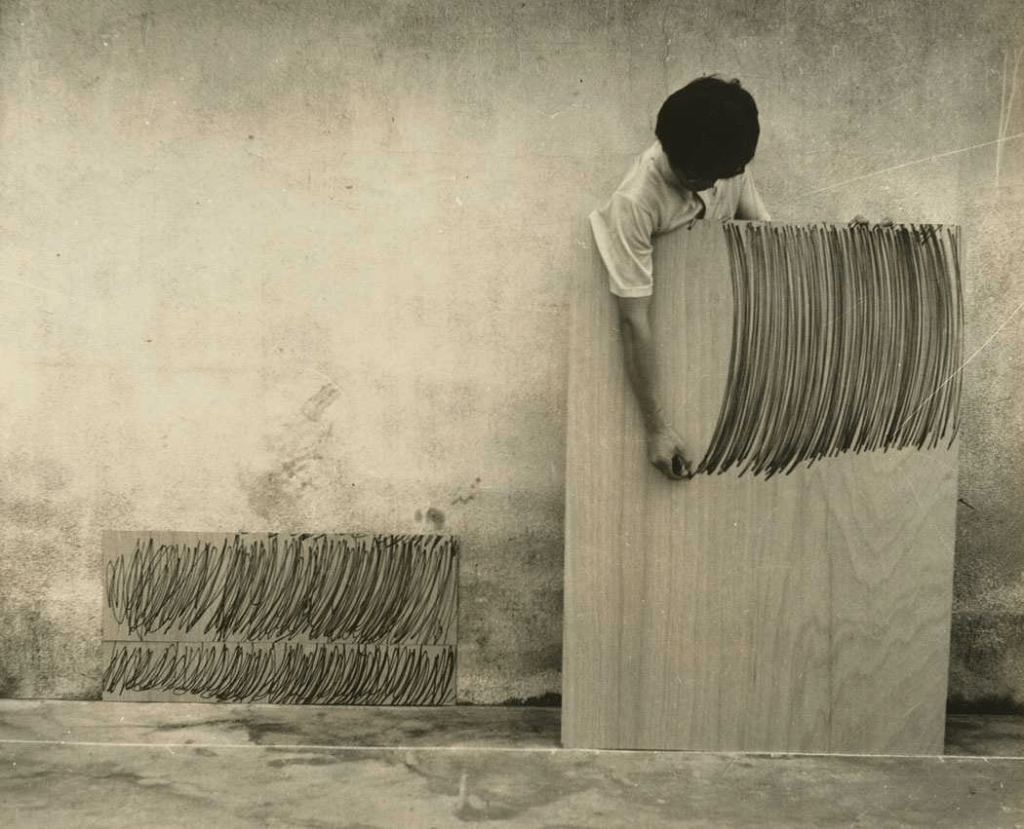
^similar to my own mark-making – what does the mark do/mean? different contexts – Kun-yong is looking at the way in which the mark reflects the movement of the body, whereas I am looking at how the mark reflects the movement of the water on paper’s surface?
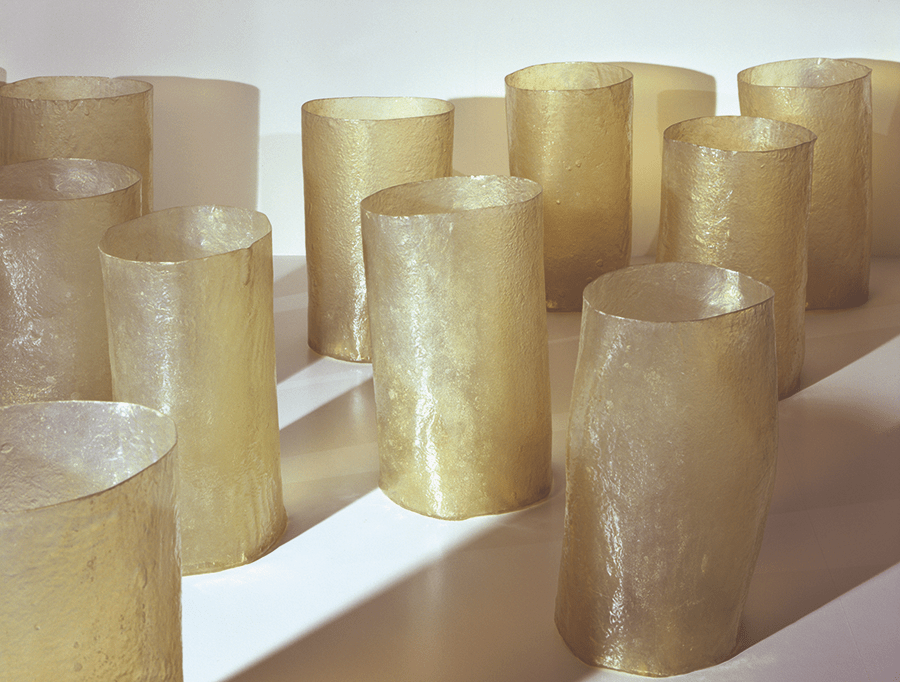
- minimalistic on the surface, but in many ways the subtlety of the repeated forms emphasises the minute differences between them
- opens up the question of material agency, with the variations arguably being caused by just that?
- the resulting impermanence of the works – relates to the idea of material being ongoing, my sculptures just being a snapshot of their lives
- especially relates to the dilemmas I was having in terms of glue etc – it seemed to be wanting to impose itself and unnecessarily hold them stationary, when really what I am interested in is their ongoingness and the vibrancy
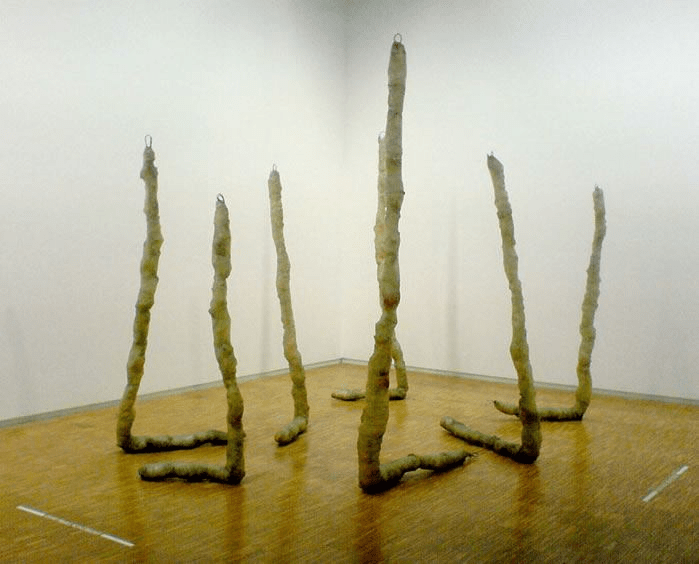
- the work varies in transparency, again like my drawings – Hesse’s seems more skeletal perhaps, opening up/allowing an internal view, whereas mine more encourages a questioning of looking through/at
- vertical forms – become humanoid
- the presence of the hand of the artist
- broken/misaligned forms – imperfection

 Anna Harris