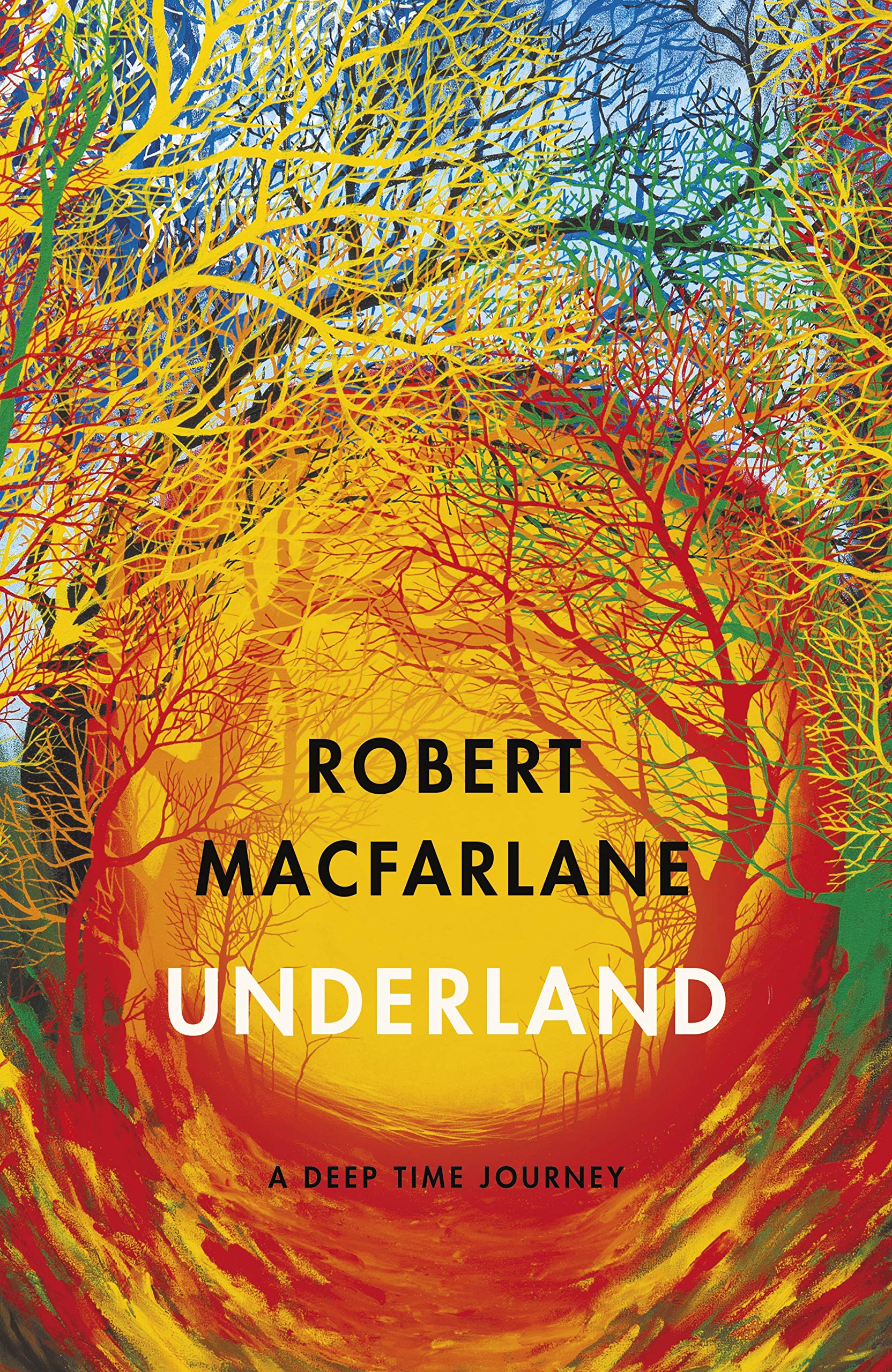
13: ‘An aversion to the underland is buried in language. In many of the metaphors we live by, height is celebrated but depth is despised. To be ‘uplifted’ is preferable to being ‘depressed’ or ‘pulled down’. ‘Catastrophe’ literally means a ‘downward turn’, ‘cataclysm’ a ‘downwards violence’.’
15-16: ‘When viewed in deep time, things come alive that seemed inert. New responsibilities declare themselves. A conviviality of being leaps to mind and eye. The world becomes eerily various and vibrant again. Ice breathes. Rock has tides. Mountains ebb and flow. Stone pulses. We live on a restless Earth.’
32: ‘In this way limestone can be seen as merely one phase in a dynamic earth cycle, whereby mineral becomes animal becomes rock; rock that will in time – in deep time – eventually supply the calcium carbonate out of which new organisms will build their bodies, thereby re-nourishing the same cycle into being again. // This dance of death and life that goes into limestone’s creation is what makes it without doubt the liveliest, queerest rock I know’
33: ‘Her body was placed in the grave, curled against the northern side of the oval. Two stone martens, their brown and cream fur sleek in the low light, were draped over her: one across her upper body, one across her lower. The fore-leg of a wild boar was laid on her shoulder. A human foot was placed between her feet. The blackened shells of eighty-six tortoises were scattered over her. The tail of an aurochs was put near the base of her spine. The wing of a golden eagle was opened over her. She had become a wonderous hybrid – a being of many beings.’
37: ‘We tend to imagine stone as inert matter, obdurate in its fixity. But here in the rift it feels instead like a liquid briefly paused in its flow. Seen in deep time, stone folds as strata, gouts as lava, floats as plates, shifts as shingle. Over aeons, rock absorbs, transforms, levitates from seabed to summit. Down here, too, the boundaries between life and not-life are less clear. I think of the discovery of the bones in Aveline’s, shining with calcite, lying promiscuously, almost converted into stone… I slip out the whalebone owl, feel the Braille of its back, the arcs of its wings, thinking of how it had taken flight from a whale’s beached ribs. We are part mineral beings too – our teeth are reefs, our bones are stones – and there is a geology of the body as well as of the land. It is mineralisation – the ability to convert calcium into bone – that allows us to walk upright, to be vertebrate, to fashion the skulls that shield our brains.’ (emphasis original)
38: ‘Flowstone is the name given to the calcite deposits that precipitate out of minerally saturated water as it runs over the slopes of limestone caves. You might imagine flowstone as a kind of white candle wax, gradually hardened as it runs, though it is built up over spans of time rather than by brief incandesce. Because of the gradual nature of its formation, flowstone sets in elaborate ruches and folds – elephant-skin gathers of texture, wrinkled stockings. Flowstone is very beautiful to look at and very hard to grip.’
39: ‘Up the gorge, up the notch, through the squeeze, the smell of green growing up the nose, up into the belly of the elder-filled dip of land, and up to the levels of the fields, the horses, the swooping swallows, out of the Carboniferous and into the Anthropocene.’
46: ‘Kites turn above us, and above the kites turn buzzards. A telecoms mast relays signals through the air, through our bodies.’
51-52: ‘Sean tells me a story. Modern archaeologists excavating a Bronze Age barrow in a Mendips wood find the remains of a woman placed in a funerary urn. The barrow had already been ruptured by deep ploughing when the cemetery was planted with trees early in the twentieth century, but the urn somehow survived. The archaeologists disinter the urn, and study the remains of the woman that it holds. Once their work is done, one evening while white moths flit in the shadows of the trees, they rebury the woman’s remains in a replica urn. As they do so one of them speaks a blessing at the graveside – reburial ritual performed across the space of several thousand years, spoken out of respect and also, perhaps, out of apology.’
58: ‘Dark matter physicists work at the boundary of the measurable and the imaginable. They seek the traces that dark matter leaves in the perceptible world. Theirs is hard, philosophical work, requiring patience and something like faith: ‘As if’ – in the analogy of the poet and dark-matter physicist Rebecca Elson – ‘all there were, were fireflies / And from them you could infer the meadow.’’
58: ‘WIMPs – like neutrinos, nicknamed ghost particles – have scant regard for the world of baryonic matter. WIMPs traverse our livers, skulls and guts in their trillions each second. Neutrinos fly through the Earth’s crust, mantle and solid iron-nickel core without touching a single atom as they go. To these subatomic particles, we are the ghosts and ours the shadow-world, made at most of a diaphanous webwork.’
68-69: discussion with a particle physicist about how similar searching for these elusive particles is to religion: ‘’I grew up as a very serious Christian,’ Christopher says. ‘Then I lost my faith almost entirely when I found physics. Now that faith has returned, but in a much-changed form. It’s true that we dark matter researchers have less proof than other scientists in terms of what we seek to discover and what we believe we know. As to God? Well, if there were a divinity then it would be utterly separate from both scientific enquiry and human longing.’ […] ‘No divinity in which I would wish to believe would declare itself by means of what we would recognise as evidence.’ […] ‘If there is a god, we should not be able to find it. If I detected proof of a deity, I would distrust that deity on the grounds that a god should be smarter than that.’
74: ‘The strains of the work are intense, the lifespan of the machines short. ‘When one of them reaches the end of its useful days,’, says Neil, ‘it’s not cost-effective to bring it back up. It’d take the place of ore in the upshaft, and that’s too expensive. So instead the machine gets driven into a worked-out tunnel of rock salt, and abandoned there. The halite will flow around it as the tunnel naturally closes up.’ // It is an astonishing image: the translucent halite melting around this cybernetic dragon – the fossilisation of this machine-relic in its burial shroud of salt.’
75: ‘I am briefly filled with a longing to step into a side tunnel myself, lie down and let the halite slowly seal me in for five years or 10,000 – to wait out the Anthropocene in that translucent cocoon.’
77: ‘Philip Larkin famously proposed that what will survive of us is love. Wrong. What will survive of us is plastic, swine bones and lead-207, the stable isotope at the end of the uranium-235 decay chain.’
77: ‘There are many reasons to be suspicious of the idea of the Anthropocene. It generalises the blame for what is a situation of vastly uneven making and suffering. The rhetorical ‘we’ of Anthropocene discourse smooths over severe inequalities, and universalises the site-specific consequences of environmental damage. The designation of this epoch as the ‘age of man’ also seems like our crowning act of self-mythologisation – and as such only to embed the technocratic narcissism that has produced the current crisis.’ (nice lil summary of my diss lol)
77-78: (cont straight on from above) ‘But the Anthropocene, for all its faults, also issues a powerful shock and challenge to our self-perception as a species. It exposes both the limits of our control over the long-term processes of the planet, and the magnitude of the consequences of our activities. It lays bare some of the cross-weaves of vulnerability and culpability that exist between us and other beings now, as well as between humans and more-than-humans still to come. Perhaps above all the Anthropocene compels us to think forwards in deep time, and to weigh what we will leave behind, as the landscapes we are making now will sink into strata, becoming underlands. What is the history of things to come? What will be our future fossils? As we have amplified our ability to shape the world, so we become more responsible for the long afterlives of that shaping. The Anthropocene asks of us the question memorably posed by the immunologist Jonas Salk: ‘Are we being good ancestors?’ // But to think ahead in deep time runs against the mind’s grain. Try it yourself, now. Imagine forwards a year. Now ten. Now a century. Imagination falters, details thin out. Try a thousand years. Mist descends. Beyond a hundred years even generating a basic scenario for individual life or society becomes difficult, let alone extending compassion across much greater reaches of time towards the unborn inhabitants of worlds-to-be. As a species, we have proved to be good historians but poor futurologists. While we have devised abbreviations for marking out deep time in the past – BP for ‘before present’; MYA for ‘million years ago’ – we have no equivalent abbreviations for marking out deep time in the future. No one speaks of AP for ‘after present’, or MYA for ‘million years ahead’. // The Anthropocene requires us to undertake a retrospective reading of the current moment, however – a ‘palaeontology of the present’ in which we ourselves have become sediments, strata and ghosts.’
(he goes on to refer to this future geologist with default pronouns of ‘she’ as seen below – yes Robert)
78-79: ‘Down at the chaos of the mine’s production face, I think of the puzzles we are creating for our future geologist. I wonder how, millions of years on, she will interpret the fossil presence of the lizard-like mining machines of Boulby, manufactured in the Anthropocene and embedded in the strata of a 250-million-year-old seabed. How will she distinguish them as machines rather than as organisms? And what of the drift itself – the faint impress that this 600-mile maze will leave in the layers of halite and sylvite? // Geologists and palaeobiologists speak of ‘trace fossils’. A trace fossil is the sign left in the rock record by the impress of life rather than life itself. A dinosaur footprint is a trace fossil. The enigmatic doughnut-shaped flints called ‘paramoudra’ are thought to be the trace fossils of a burrowing worm-like creature that lived vertically in the seabed during the Cretaceous, its breathing organs just above the level of the silt. Boreholes, funnels, pipes, slithers and tracks are all trace fossils – stone memories where the mark-maker has disappeared but the mark remains. A trace fossil is a bracing of space by a vanished body, in which the absence serves as a sign. // We all carry trace fossils within us – the marks that the dead and the missed leave behind. Handwriting on an envelope; the wear on a wooden step left by footfall; the memory of a familiar gesture by someone gone, repeated so often it has worn its own groove in both air and mind: these are trace fossils too. Sometimes, in fact, all that is left behind by loss is trace – and sometimes empty volume can be easier to hold in the heart than presence itself.’
80: ‘Out through the door and into burning white day, blue billowing sky, sun glinting off windscreen and chain-link, tarmac and grass blade, dark matter nowhere and everywhere around me – and surfacing into this blinding light seems like stepping into ignorance.’
81: ‘Somewhere to my east, men are at work a mile below the moors, half a mile under the sea, cutting tunnels through the salt-ghost of an ocean to harvest its energy for crops as yet ungrown.’
82: ‘The sky is salted with stars.’
89: ‘[Suzanne Simard] also discovered that the hyphae made connections between species: joining not only paper birch to paper birch and Douglas fir to Douglas fir, but also fir to birch and far beyond – forming a non-hierarchical network between numerous kinds of plants.’
90: ‘In a research plot thirty metres square, every single tree was connected to the fungal system, and some trees – the oldest – were connected to as many as forty-seven others.’
Merlin Sheldrake
92: ‘Living wood, left long enough, behaves as a slow-moving fluid. Like the halite down in the darkness of Boulby mine, like the calcite I had seen beneath the Mendips, like glacial ice drawing itself on over topsoil and bedrock, living wood seems to flow, given time.’
92 – the word ‘inosculation’ from the Latin osculare meaning ‘to kiss’ – means to ‘en-kiss’, when trees grow into one another
94: ‘’My childhood superheroes weren’t Marvel characters,’ Merlin once said to me, ‘they were lichens and fungi. Fungi and lichen annihilate our categories of gender. They reshape our ideas of community and cooperation. They screw up our hereditary model of evolutionary descent. They utterly liquidate our notions of time. Lichens can crumble rocks into dust with terrifying acids. Fungi can exude massively powerful enzymes outside their bodies that dissolve soil. They’re the biggest organisms in the world and among the oldest. They’re world-makers and world-breakers. What’s more superhero than that?’’
98: ‘Our growing comprehension of the forest network asks profound questions: about where species begin and end, about whether a forest might best be imagined as a super-organism, and about what ‘trading’, ‘sharing’ or even ‘friendship’ might mean between plants and, indeed, between humans.’
**Anna Tsing essay called Arts of Inclusion, or How to Love a Mushroom**
100: ‘I think of good love as something that roots, not rots, over time’
100: ‘Rivers of sap flow in the trees around us. If we were right now to lay a stethoscope to the bark of a birch or beech, we would hear the sap bubbling and crackling as it moves through the trunk.’
Roiling – fun word – ‘it’s roiling with life’
101: ‘What’s the haunting phrase I’ve heard used to describe the realm of fungi? The kingdom of the grey. It speaks to fungi’s utter otherness – the challenges they issue to our usual models of time, space and species.’
*draw fungi*
102: ‘The blue whale is to this honey fungus as an ant is to us.’ Idea of living deep time
Honey fungus is between 1,900 and 8,650 years old
Rhizomorphs
Ethnobiologist
103-104: ‘Nature, too, seems increasingly better understood in fungal terms: not as a single gleaming snow-peak or tumbling river in which we might find redemption, nor as a diorama that we deplore or adore from a distance – but rather as an assemblage of entanglements of which we are messily part. We are coming to understand our bodies as habitats for hundreds of species of which Homo sapiens is only one, our guts as jungles of bacterial flora, our skins as blooming fantastically with fungi.’
104: ‘’holobionts’ – collaborative compound organisms, ecological units ‘consisting of trillions of bacteria, viruses and fungi that coordinate the task of living together and sharing a common life’, in the philosopher Glenn Albrecht’s phrase.’
104: ‘The fungal forest that science had revealed to Merlin and that Merlin was revealing to me – a forest of arborescent connections and profuse intercommunication – seemed merely to provide a materialist evidence-base for what the cultures of forest-dwelling peoples have known for thousands of years.’
104: ‘In such a vibrant environment, loneliness is placed in solitary confinement.’
105: ‘So I use my phone to summon the satellite network, and pull up a hybrid map of the forest. Sixty-three distinct chemical elements including rare earth metals and minerals mined mostly in China interact within the casing of my device. A blue lanthium dot pulses our location. I pinch and splay the screen to get the right scale.’ Thingness – making the familiar unfamiliar
108-109: ‘Science is full of this stuff: full of happenstance and stumbles and getting knackered and crazy in the field or the lab. It’s so weird to me how science always presents its knowledge as clean. […] ‘I have this plan,’ Merlin says, ‘that for each scientific paper I ever publish I will also write its dark twin, its underground mirror-piece – the true story of how the data for that cool, tidy hypothesis-evidence-proof paper actually got acquired. I want to write about the happenstance and the shaved bumblebees and the pissing monkeys and the drunken conversations and the fuck-ups that actually bring science into being. This is the frothy, mad network that underlies and interconnects all scientific knowledge – but about which we so rarely say anything.’
110-111: ‘Maybe, then, what we need to understand the forest’s underland,’ I say, ‘is a new language altogether – one that doesn’t automatically convert it to our own use values. Our present grammar militates against animacy; our metaphors by habit and reflex subordinate and anthropomorphise the more-than-human world. Perhaps we need an entirely new language system to talk about fungi … We need to speak in spores.’// ‘Yes,’ says Merlin with an urgency that surprises me, smacking his fist into the palm of his hand. ‘That’s exactly what we need to be doing – and that’s your job,’ he says. ‘That’s the job of writers and artists and poets and all the rest of you.’
112: ‘In Potawatomi, not only humans, animals and trees are alive, but so too are mountains, boulders, winds and fire. Stories, songs and rhythms are also all animate, they are, they be. Potawatomi is a language abundant with verbs: 70 per cent of its words are verbs, compared to 30 per cent in English. Wiikwegamaa, for instance, means ‘to be a bay’. ‘A bay is a noun only if water is dead, writes Kimmerer: ‘trapped between its shores and contained by the word. But the verb… releases the water from bondage and lets it live. ‘To be a bay’ holds the wonder that, for this moment, the living water has decided to shelter itself between these shores, conversing with cedar roots and a flock of baby mergansers.’’ – really links to Bennett, Haraway etc
112-113: ‘The real underland of language is not the roots of single words, but rather the soil of grammar and syntax, where habits of speech and therefore also habits of thought settle and interact over long periods of time. Grammar and syntax exert powerful influence on the proceedings of language and its users. They shape the ways we relate to each other and to the living world. Words are world-makers – and language is one of the great geological forces of the Anthropocene.’
113 – ‘species loneliness’ and ‘symbiocene’
115: ‘Drums, songs, stories. The trees shifting, speaking, busy making meaning that I cannot hear. Fungi writhing in the birch logs, in the soil.’
(116 – linking sinking into unconsciousness as going below ground, the imperceptible)

 Anna Harris