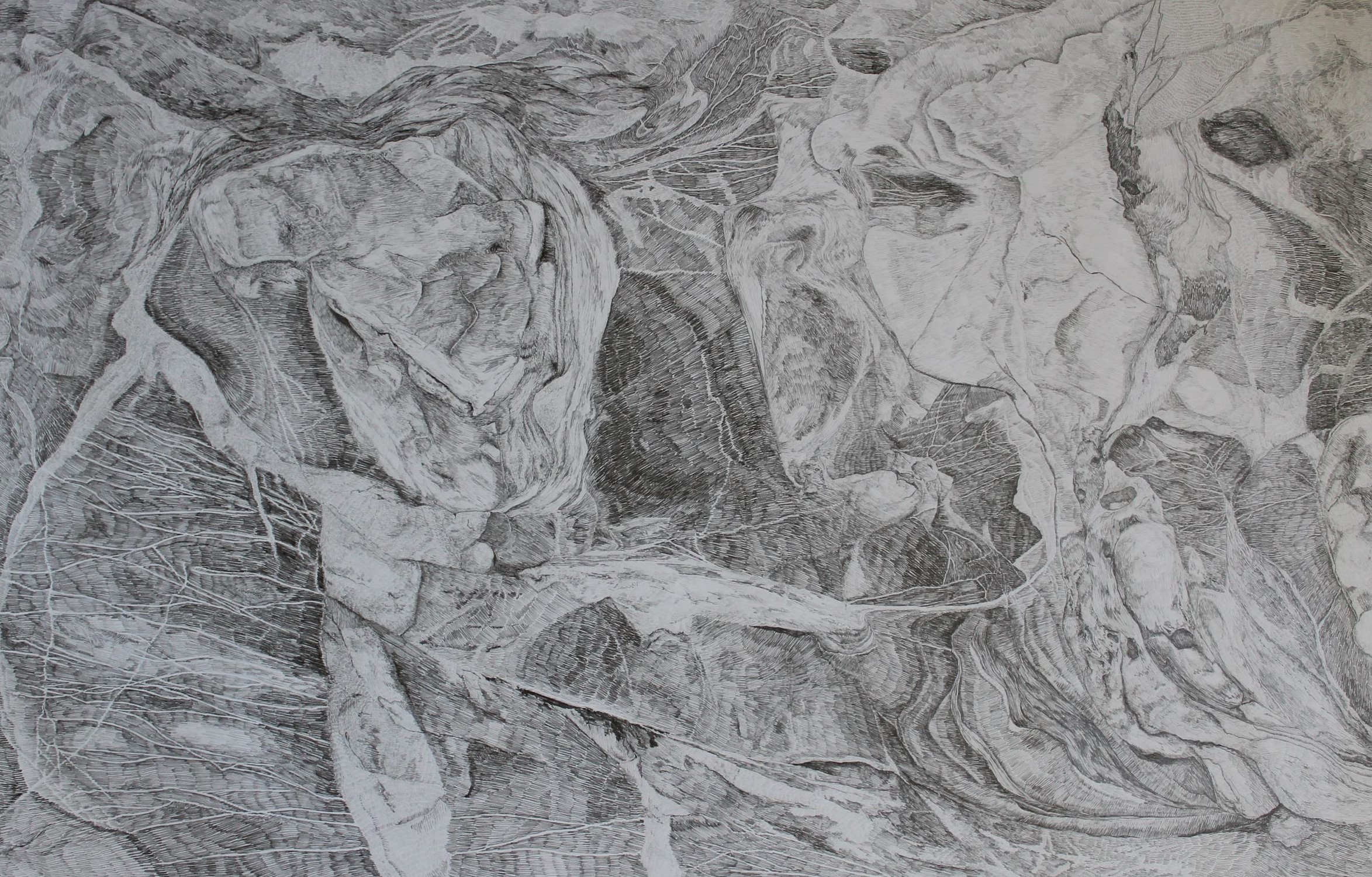
Earlier in the month I was contacted by the arts publication Tour de Moon (Moon Press). They asked me if I’d be happy to send them some artwork for their upcoming publication, in response to the following brief:
A travel guide to the moon. This publication will explore ideas of travel and its impact on the climate. We all dream of going on holiday, escaping the mundane and every-day life to go somewhere new and exciting. People dream of the moon and it’s often seen as a futuristic place of adventure and exploration. But how might this travel impact on the environments closer to home, and how can we create an experience of escapism in a more sustainable way? Other ways we travel to the moon and space, through the internet/transmissions of data and global communications technology, also impacts upon the Earth. How might this travel guide to the moon subvert longings for space travel, bringing us back down to Earth?
In response to the brief I chose to submit an older artwork – one of my rock landscape drawings, made by drawing a tiny section of the surface of a rock on a much larger, map-like scale (see image above). I felt this responded to the ideas of everyday escapism that the brief alluded to, finding adventure and unfamiliarity in something as small as a rock that can fit in the palm of the hand.
As the drawing was one I did a couple of years ago, I wanted to add something to bring it up-to-date, to explore how the ideas I had around it when I made it might differ to what I am looking at now. To do this, I wrote a piece of text to go alongside it:
Some say the Moon was borne of the Earth – rocky flesh ripped and sent spinning, spinning. A new satellite, a sibling.
You stand on a beach, awash with rubble and deep time. Rocks tumble and clink, pushed by the waves, scurrying, sinking, lapping up, up, up, pulled by the Moon above. Gently, the Moon pulls at you, too.
Pick up a rock, turn it in your hand. Look at it – really look, closer, closer. Can you see them? The Moon-people? Roaming the surface, settling in scuffs and craters, dancing over dusty plains. You hold their world with your earthly body, feet rooted in Moon rock.
The Moon is an earthly body. The Moon is here with you.
Although I have noted the benefits of writing about my work before, and considered the possibility of incorporating text more explicitly into my practice, this is I feel the first time I have intentionally set out to write something that steps over the line from the conventional ‘artist statement’ type text, and into the realm of artwork itself. The writing process was surprisingly sensitive and revealing, and I really enjoyed working and thinking in this slightly different way. I intentionally started quite fluidly, with some timed stream-of-consciousness writing, and then started to select and refine from here, which felt a good balance between working creatively and critically.
The text and artwork can be found in the online publication here.
Following on from this, I wanted to introduce this into my current work in some way. With the degree show coming up, I feel text could be a really effective way of exploring similar ideas as my ceramic and paper works, but from a slightly different angle, which could also be useful in giving the viewer a different way in to the work.
Rosanna Martin’s book Other Interesting Stones presents her ceramic pieces alongside writing about the geologic history of Cornwall. Rachel Carson’s book The Sea Around Us is to all intents and purposes a natural history book, documenting the geologic and biologic history of the sea. What I found to be unusual about it, however, is the tone in which it is written – rather than cold and scientific, simply transferring information from one mind to another – Carson writes poetically, as if telling a mythic story of the birth of the ocean. Both of these books, then, directly conflate art and science to create a murky, speculative middle-ground wherein facts seem like flights of fancy, and fiction resembles the truth. I want my work to sit in this middle, liminal space, refusing to quite fall into distinct categories of art or science, human or nonhuman, and thus this is something I want to encapsulate in my text. I also want it to evoke the wild, powerful material forces that simmer in the background of the rest of my work.
As it stands, this is the text I have written:
in the first instant, there was everything
at once.
and then time stretched and yawned and
suddenly there was waiting and aging and time passing,
and so time began to pass.

everything swirled and roared,
spinning, pressing, fusing,
gatheringatheringathering
into bubbling, mushy
clusters
with fires in their bellies.

the floor was liquid.
the air was thick and
heavy with moisture.
after a while, the air began to fall,
and because time existed
it fell and fell and fell.

water pooled and seeped
into dry, cracked rock.
slowly, gently at first,
but it kept coming – flooding,
pushing, wriggling and worming
its way into the surface.

and so began the earth.


the young earth was a geological furnace:
bellows pumping,
magma churning –
a maelstrom of the furious
and the gentle
and the unfeeling.

as the air continued to fall,
water bounced onto popping, fizzing,
crumbling rock,
sending sediments
scurrying in streams
down stony faces.

fresh-faced,
milk-white
pools of porcelain
grew at the feet of
new mountains;

flakes of ashy carbon,
choked from volcanic mouths,
snagged on mica
and quartz crystals;

and microscopic entanglements
tangoed through wetlands,
forming gritty, murky
stoneware mud
that squished between toes.

blood-red iron seeped in
from the cosmos,
thick and ominous –
mud congealing to a
claggy, earthenware mucus;

silica leached out from
the tattered and beaten quartz –
a fine polenta sand,
ready to be melted into submission
and left glassy-eyed, docile.


elsewhere,
an earthworm fell slowly,
lifeless,
landing with the faintest of breaths
on a silty riverbed –
its body a
tiny crease in
a lightly furrowed brow.

sediment churned and sunk and floated and spun,
glittering in suspension.
the time passed,
and brought with it
sediment and bodies,
sediment and bodies –
soft, shimmering flesh compressing to
terra-fied, stony strata.

water pooled and seeped
into the trace-fossil of the earthworm.
slowly, gently at first,
but it kept coming – flooding,
pushing, wriggling
and worming.

and so continued the earth.
I want the text to flow through the space in some way, pulling together the different strands of my practice, hence it is relatively long and falls into three sections in the hope that this will allow me a certain degree of flexibility when displaying.

 Anna Harris