
This week:
- all but finished text to go alongside work (might need one more final edit)
- moved out of my studio
- took down library display
- took all my drawings into the degree show space to assess (thoughts/reflections below)
- made a couple more drawings as a result, including another large piece, some more ‘thing’ drawings, a piece with water-soluble pencils and the quote piece
- sanded and painted all plinths
- secured a cabinet for the exhibition (meaning we likely no longer need a table plinth)
- continued with collaborative book – both making work and working out what more will need doing
- collected last batch of ceramics from the Poly
The main focus of this last week has to been to finish as much artwork as possible, as well as prepping things like exhibition text and plinths etc, so that set-up can start smoothly tomorrow. My drawings have been the focal part of this; laying everything out in the space really helped me assess what it was I had made and why, especially placing them in chronological order and tracing the thought processes and developments throughout. As I’ve written about before, I was a little worried about each piece potentially trying to do too much, incorporating too many different agencies so that the result was a little muddied. I have spent a lot of time mulling this over, trying to pick apart the different elements I was trying to incorporate:
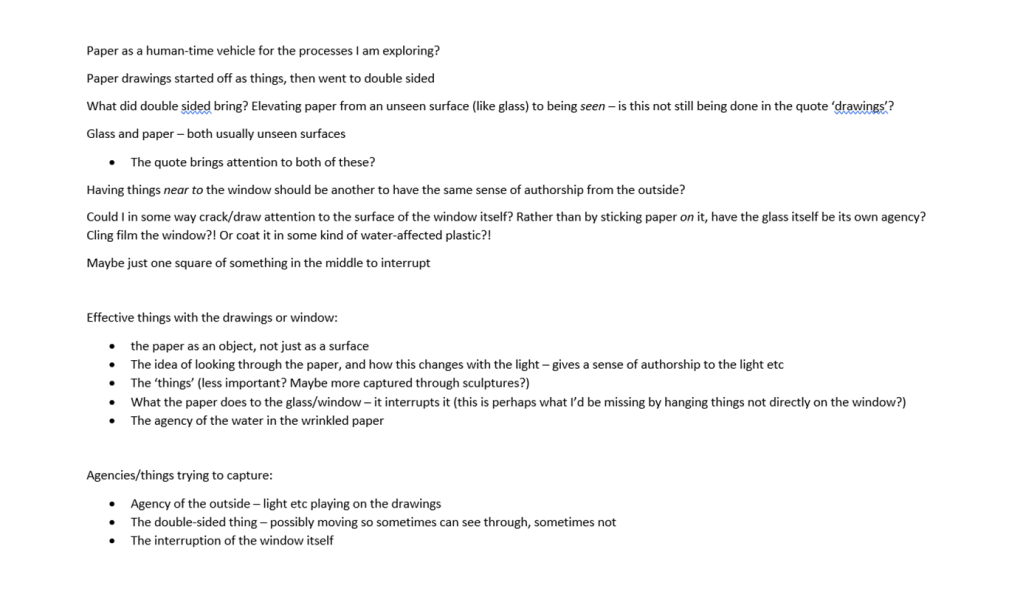
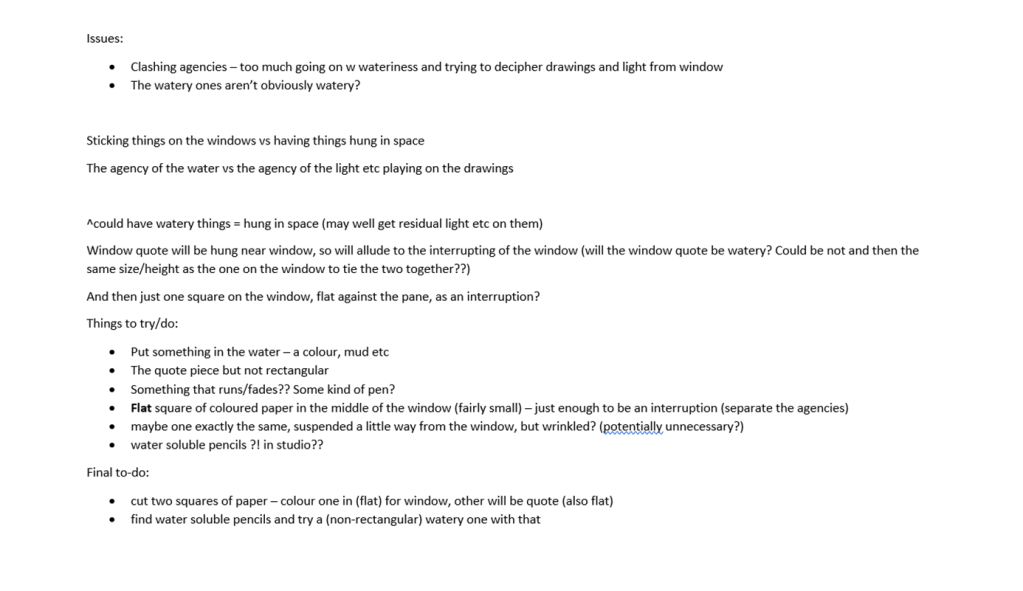
As it stands, I intend to separate the agencies a little by having a small, flat piece on the window, and the water-shaped pieces more on the walls/in the space itself. My plan is to have a small coloured square in the centre of the window, echoed by another square of paper the same size hanging just back from the window with the backwards Thing Theory quote. My thinking is the quote sets the tone effectively for the window piece, highlighting the interruption of the window, and directing attention towards the window/pane of glass itself. Although it is a lot simpler than some of the other iterations I have tried, I think the flatness of the piece interacts well with the flatness of the window itself, and also that to involve the window in the exhibition this may well be all that is needed – I don’t need to curate a whole display on the window. This is not then disrupted by the additional agency/process of water in the same piece, but instead lets the two interact more indirectly/contextually. The quote piece also ensures I can still include the idea of the paper as a double-sided, sculptural medium, again interacting with this whole idea of looking at versus looking through (with both the paper and the glass).
The water drawings can then be distributed through the rest of the space, most likely either on the wall or on plinths/shelves alongside ceramics/found objects, working together to evoking watery/geological processes. I was considering hanging them in space or placing them on the floor, but as it stands I imagine the space may become a little full, what with the plinths and the cabinet and the hanging window drawing, so having them on the wall might be best. I’d like to try them pushed into corners, or spilling out onto the floor, just to give them a little extra dynamism in the face of such a stationary white gallery space.
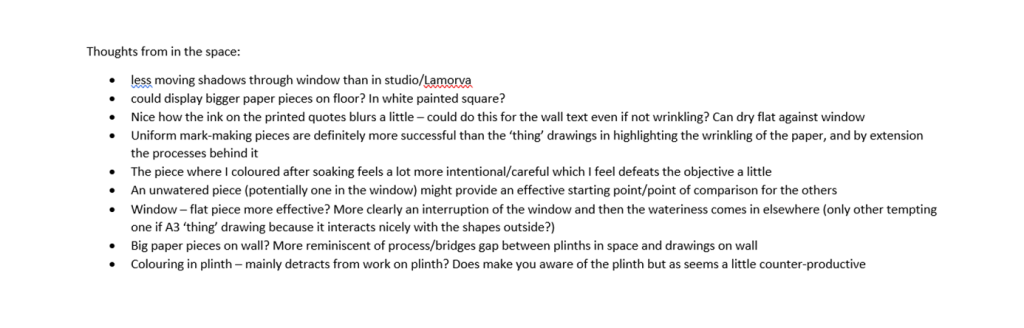
I did try out a few of these ideas in the space this week:


Something else I tried in the space was adding mark-making to the plinths themselves. I just wanted to see how it might impact the space, and if it could incorporate the plinths themselves into the work in any way. However, while it was certainly striking aesthetically, I did feel it detracted a little from the subtler details of the ceramic pieces on the plinths, overshadowing them somewhat. As the surface is so flat and uniform, it also didn’t have the same watery/textured feel as the paper pieces, therein not playing as neatly into the exploration of process as the works themselves. While I imagine, in order to keep the attention on the work itself, I will therefore stick to the white plinth for this show, this is definitely something to bear in mind for future shows; I feel there is a lot of potential, relating to vibrant matter and not overlooking ‘inert’ materials, in the idea of the plinth that is specifically there to support other, more precious, material, and not to be seen in and of itself (as with the glass, the paper etc that I have been looking at).


I also briefly started considering how I might format the text in the space. I can see the text I have written almost flowing around the space, weaving between artworks and found objects, so as such I wanted to try writing directly onto the walls. While it is possible, I’m not sure the effect was quite as I desired, and again I’m not sure if having text quite so close to the artwork, and in as unconventional a format as written straight onto the walls, might detract from the work itself? On reflection, the water-soaked quotes from earlier in the term are quite effective at echoing the processes present in the artworks while simultaneously echoing standard gallery protocol. As such, I think I am potentially leaning towards having the text printed in this way, but again I may finalise this towards the end of setting up the exhibition, in response to how the work feels at that point. I also need to consider if I will be incorporating any other text, as I did in earlier open studios, or sticking with just the drawn window quote piece, and the text I have written. Again, I may reconsider a little further down the line but at this point I am leaning towards just having my text; the piece I have written is relatively long and hopefully covers many of the concepts that the quotes I included earlier were referring to, so I wouldn’t want an overwhelming amount of text, particularly if the content is duplicated anyway.


It was helpful to play around with how I might display my drawings in the space. As mentioned, I think the flatter ones would pair well with the window, and it was good to try the water-soaked ones on the wall, in corners etc. Seeing the impact of the bigger pieces in the space also pushed me to make another larger one in response as I found the variation in size an effective offset to the smaller ceramic pieces. There was almost something bodily about the larger ones, which in turn prompted consideration of the viewing body in relation to the piece. I like the incidental link this has to Bennett’s consideration of the ‘its’ and the ‘mes’ in the human body, reflecting the idea of vital materiality back onto the human form and what we consider human vs nonhuman. The larger pieces also seem to capture a wider variation in both size and shape than the smaller, more strictly rectangular, pieces which I feel better reflects the fragmented nature of the objects I will be displaying alongside. It also opens up the possibility for me to display some of the smaller fragments quite literally alongside these objects on the plinths etc.
The only other drawings I need to consider are the ‘thing’ drawings. These feel important to me as they are where the body of work has grown from – they were the starting point into my exploration of an unplaceable ‘thingness’, prompting both my ceramics and my paper pieces. As such, although they potentially don’t fit as neatly with the wateriness of the rest of the exhibition, I would like to include them, even if they are just on a separate wall as a small additional series. Another possibility is that I could distribute them throughout the display, possibly even curating them like everything else, seeing what chance similarities are sparked by random placements with found objects/ceramics. I also at one point had them just propped against the wall (as can be seen in the pictures above), which was a surprisingly interesting way of displaying them – it almost elevates them from flat drawing to 3D object, which again ties in nicely with the rest of the work. My worry with this mode of display would be that I might begin to run out of floor space if all of my work is either on plinths, propped against a wall, or hung in space, but again this may be something to play around with tomorrow when all my work is in the room.
I will also need to decide whether to include any of my double-sided and water-soaked ‘thing’ drawings. Currently I am leaning towards leaving these out as they mark more of a transitional point, and where the different agencies/techniques start to become a little too much.
The other notable thing I did this week was collect my ceramics from the Poly. A few of them have become fused to the dishes they were fired in, so I will need to find a way to detach these somehow. This may be a bit of a difficult operation as there are some pools of glass/glaze/melted earthenware in the dishes that I’d like to keep attached, and besides, I doubt I’ll be able to remove the bases cleanly anyway; I’ll have to find a way of removing most of the dish, but without going so close to the work that it might become damaged. That aside, I am happy with how they’ve turned out; there as been a lot of movement from paper burning away, glazes pooling, and glass and earthenware melting that they’ve become wonderfully alchemic. It was my first time using a fair few glazes so I was unsure exactly how they’d turn out, but for the most part they are fairly effective, simultaneously echoing the earthy tones of many of my gathered objects, while in parts becoming more glistening and mineral-like. Again, I think this will be really exciting to introduce to the found objects during curation.
In all, I feel in good stead going into installation; I have a good idea of roughly what I’d like to include, and in what format (hung, on the wall, on plinths etc), but equally it is not so fixed so that I can’t be responsive to how I feel as the exhibition develops, and the chance interactions of my work with the found objects unfold.
My to-do list (for the next two weeks) is therefore as follows:
- move all work to the space and decide where it will all be going (will need to wait for technical team to move wall and deliver cabinet)
- possibly sand and paint one last plinth
- remove ceramics from bowls
- position ceramics/found objects/bronze seaweed on plinths/shelves
- decide how to hang/stick both window pieces – stick to pane with water? and then hang other with invisible thread? do I need to weigh it down at all?
- mount paper pieces on wall – paper hinge method? or just nails/magnets?
- anything else on walls – ‘thing’ drawings? found objects/ceramics/bronze seaweed?
- paint and attach shelf for concertina book to wall
- finish concertina book
- book shelf – what books do I want in the space? do I have them all? a label for this?
- (paint floor at end?)
- text – how will I display the text I have written?
- exhibition labels – naming things, writing labels with media etc, printing these, mounting on card/mountboard? write joint statement with izzy?
- SE form – artist statement, exhibition summary, LOs
- documentation – taking pictures of the space but also of all work throughout the term
- (finalise journal)
- (Cultivator application)
- (Drawn to Wildlife artist info)

 Anna Harris