It’s been a long time since I’ve written on here. Welcome back, both to me and to you.
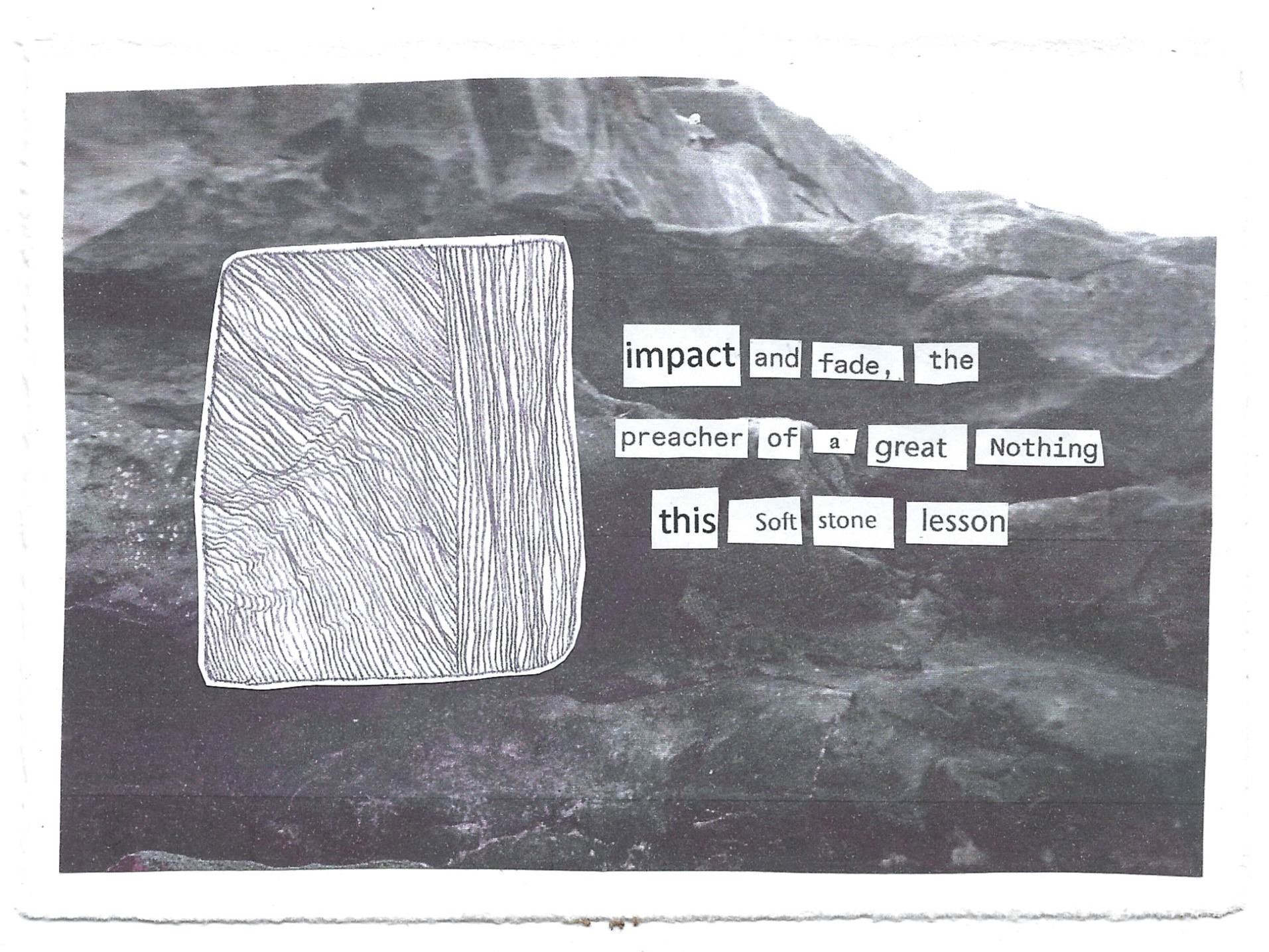
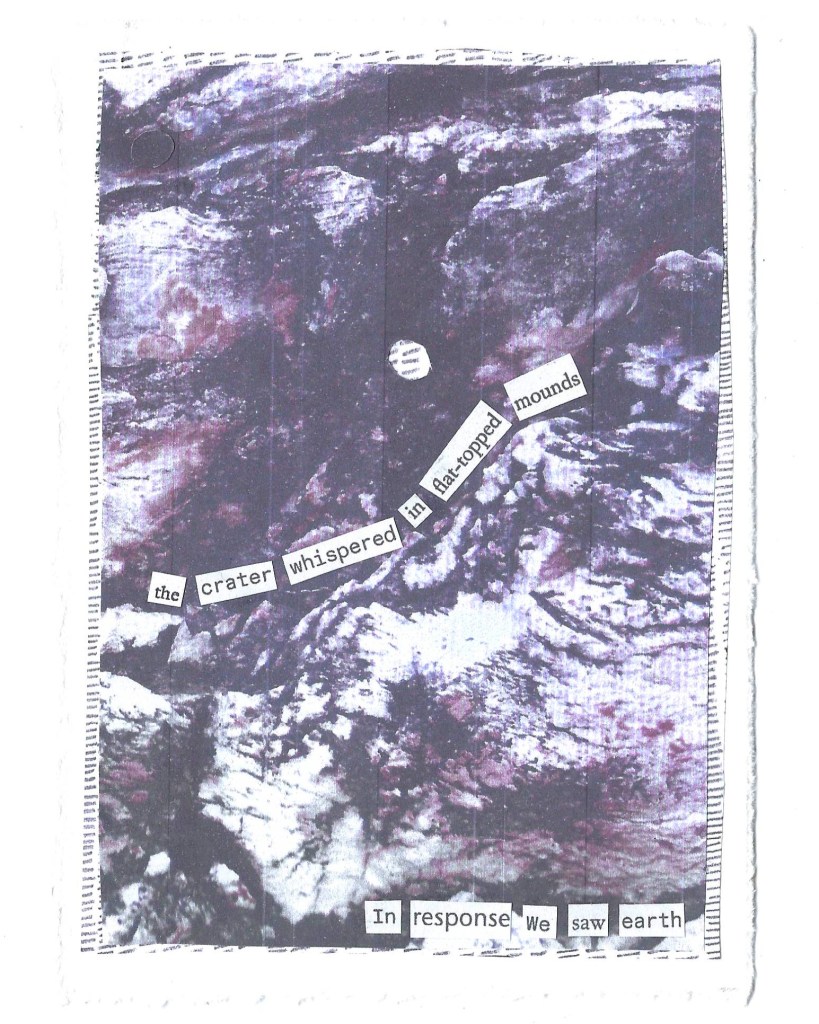
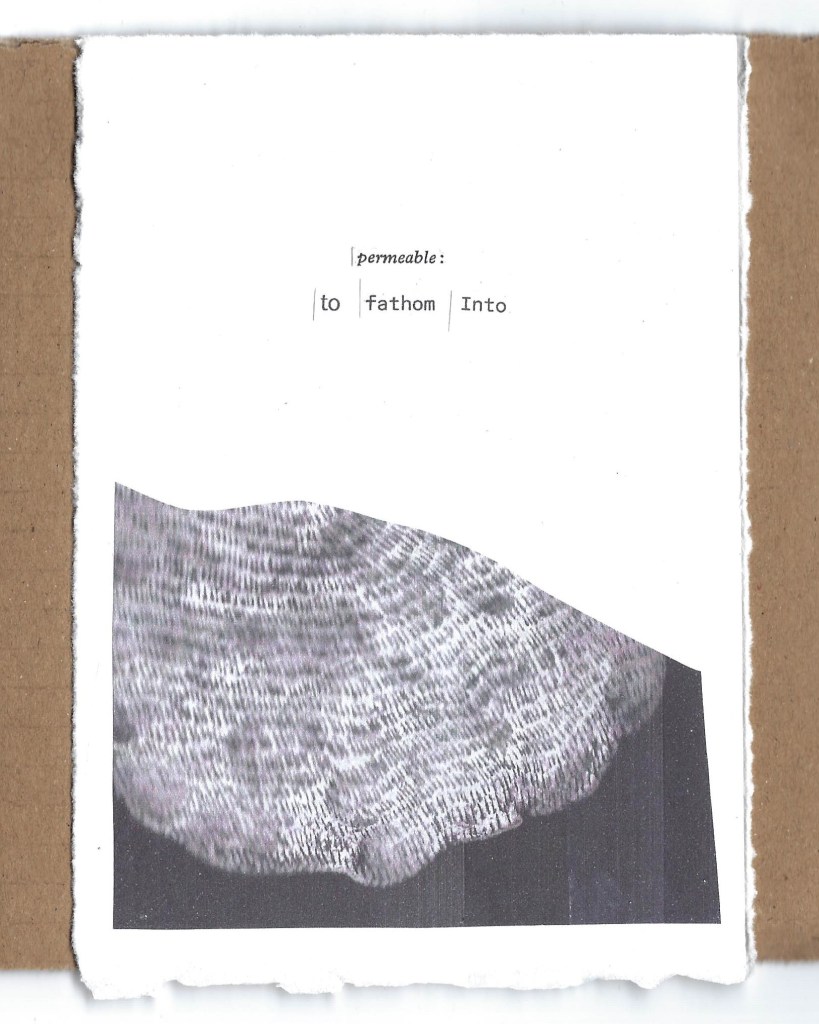
My immediate inclination is to get down absolutely everything I’ve thought over the past one and a half years but I think I’m going to have to resist that tendency and just start with where I am today. Today I am in the studio. I have recently started working on some small collages. Initially these were based on the idea of ‘rocks that do things’ but they have moved towards a slightly broader exploration of language through the introduction of cut-up text. I think this sums up well the two strands of my thinking/research of late, so I will try to talk a little about each one (although most likely will get very distracted talking about the first, meaning the second will be either non-existent or half-heartedly short).
To start with, Rocks that do things. This project (if we can call it that) is one of the many one-liners that has been kicking around in my phone notes/journal for a while, destined to a life of solitary confinement until the impetus to make it into something strikes me like a lightning bolt (lightning is an apt simile probability-wise). Luckily for RTDT, an external impetus came along in the form of the new visual art festival Flamm. As part of some mentoring I was doing with Flamm, I was asked if I would like to present anything at the festival. Realising an exhibition wasn’t an option (due to a variety of space and time related factors), I began exploring ways in which I could create something light-touch in response to artworks already due to be at the festival. Heather Phillipson’s Dream Land was RTDT’s call to arms.
It is at this point where I, for the first time, need to begin navigating the world of presenting research outside of a university context. If I knew this text would be handed in to be assessed, I would ensure to write up my notes on Heather Phillipson, showing that I have indeed done my due diligence in researching her work. And I would like to assure you (or me?) – I have. Whether I have written evidence of this is another matter (i.e. it appears I do not have written evidence of this). What I can tell you, having now seen the work, is that it is a surreal evocation of the nonhuman/more-than-human (note to self: research the difference between these terms) in all its weirdness. Archival footage from BBC nature documentaries is assembled to tell the story of a dust-mite that falls through a portal in a vacuum cleaner into a trippy, hallucinatory world of creatures creaturing. Even though their work differs in tone, I felt an immediate comparison between Phillipson’s work and that of Elizabeth Price – I believe both work is made through a process of gathering and re-assembling ‘found’ footage into new narratives. The main difference is, as far as I know, Price uses this method for the text used in her pieces, as well as the visuals, whereas Phillipson seems to have written the spoken narrative for Dream Land herself (heavily featuring ~Dave!~ – curious to know why).
Dream Land speaks to many of the ideas/themes that have been percolating in my mind, and perhaps in my work, since graduating. Primarily, the weird. I came across a phrase in Merlin Sheldrake’s Entangled Life that I have been clinging to as a touch-stone for all things weird and nonhuman: ‘speculating at dawn’. I unhelpfully don’t have the book to hand currently, but from what I remember Sheldrake was talking about scientific conventions and mindsets; often in science everything is controlled, held to account, put on the straight and narrow, numerically observed, charted, and other language to this effect – in other words, science is conducted ‘in fine weather at noon’. Sheldrake, instead, proposes that we/science should ‘speculate at dawn’ – observe things in the strange purple half-light of the early hours, as things are alien and the wrong colour and might be dancing. The nonhuman does not conform to human waking hours, so by appreciating that our view of the nonhuman is built on things observed through this narrow lens, we open space to imagine what else might go on outside the focus of our binoculars. (I feel I should add that I appreciate there will be science that is conducted at night – these statements lean towards metaphor).
A constant background searching in my own life, as I imagine in many other lives, is a search for purpose. In art, particularly, it can be easy to feel it is a self-indulgent pastime, not saving lives or advancing the knowledge of humanity in any way. This may be an entirely separate discussion (on which I have a lot to say but am trying desperately to stay on some kind of track here), but in a strange way being alive in a time of ecological crisis gives us an easy answer in this search for purpose; the future of all life on this planet is threatened, so what better a mission than to try to save it? I feel it is therefore impossible, at least personally, to make art that is not in some way responding to the climate crisis.
It is hard to make ‘good’ art about the climate crisis. It is also hard to know art’s purpose in the face of such an overwhelming challenge that feels more suited to the realms of science and politics (again, there is much to be said on the division of knowledge into disciplines like this but now might not be the time if I am ever to get to a point). With all this being said, I have a growing interest in the field of environmental humanities. I feel I should preface this by saying I am by no means a scholar or academic; I do not know many of the theories within this field, nor the important texts or individuals that are commonly referenced. My interest lies primarily in the field’s emotive intentions. To my understanding, the environmental humanities explore the ways in which we humans think and feel about the nonhuman. Where science shows us statistically how our actions are impacting the nonhuman, the environmental humanities explores how our (‘our’ applying differently to every human) attitudes towards the nonhuman have led us to this situation. Any psychologist will tell you (and you may have to ask them because I am not one) that people don’t just change what they’re doing because they’ve been told to – there’s a complex emotional process of registering that change needs to happen before sustainable (to the individual rather than in a planetary sense) changes can be made.
This, then, is where I see my practice situating itself, and is the driving force behind Rocks that do things. Initially I designed RTDT to get people to look more attentively at, and think more deeply about, the nonhuman and the abiotic. In particular, and this relates closely to my previous things body of work, I wanted to get people to think about nonhuman/abiotic agencies, breaking away from the notion that the world around us is inert and unagentic, there to be moved and used at human will. However, I soon came to realise there was a discrepancy between the answers people, myself included, were volunteering and the answers I really meant. Many answers were of the nature of ‘millstone: it makes flour’. While this is true, if we are to really drill down into this, it is not the stone that makes the flour but the human turning the stone. This somewhat undermines the point of the exercise, giving the agency back to the human rather than assigning it to the stone. What the millstone is actually doing in this instance is being heavy. It is the weight of the stone that allows it to make flour, along with perhaps the coarseness of its surface. So if we are thinking about rocks that do things, the things this rock is doing is being heavy and being coarse.
This is where we make the leap from my Rocks that do things collages (which are more illustrative depictions of rock that do things), to my text collages. I realised that in order to truly explore rocks that do things, we must first investigate, and perhaps change, the language we use to describe them. We don’t tend to talk about, and therefore think about, something that is heavy as actively being heavy. It is not perceived as agentic to be coarse (in a surface-texture way rather than being brusque to someone). This is where we brush up against another academic field, which again I can’t claim to know much about beyond its basic premise: ecolinguistics. My understanding of this field is, to be fair, pretty well summed up in the word itself; linguistics is the study of language, its formations, and, crucially, how it can structure our thinking – ecolinguistics, then, is this within the context of ‘eco’.
Merlin Sheldrake and Robert Macfarlane (amongst others, I’m sure) have both written about languages which are structured very differently to English – in which, for example, there is a word that means ‘to be a bay’. (I again don’t have the books to hand to name the language but at a guess I would say Potawatomi?). Using more agentic, perhaps even more empathetic, language to describe the nonhuman would likely bring with it a change in mindset; a bay would shift from being just a cold, lifeless thing over there to a thing you can be. This is what I am exploring in my work currently.
There is an interesting dilemma that I’ve found comes with this current exploration; how didactic should the work be? I think I have a tendency, as someone slightly scientifically-minded, to propose a hypothesis and then test and teach this through my work. (I think again this goes back to my eternal searching for purpose in my work). While I don’t think (or at least I don’t yet understand why) making didactic work is ‘bad’, if my work is purely created to educate the viewer on an idea or theory I have had, why don’t I just make a poster? Or better yet, write a text (hello!)? I find this middle ground of work that ‘explores’ without necessarily coming to a scientific ‘conclusion’ difficult. However, I think the emotive nature of the subjects I’ve touched on in my environmental humanities and ecolinguistic ramblings is precisely why art is needed; if humanity, beyond just the select few in academic circles, are to truly engage with these ideas they need a space to explore them. My hope is that thinking about something tangible and playful such as rocks that do things encourages an increased attentiveness to the nonhuman. This may, of course, not happen but at least we’ll have had a good time along the way, which is still of huge importance.
Other notes for future ramblings:
- Why is the weird important? Opening up space for new ideas to be formed, new attentions to be paid
- Landmarks, Robert Macfarlane – how language can and should reflect the infinite variety in this world. Potential exercise to be had here in noticing and naming things.
- The noticeable tendency in my work currently towards making interactive exercises. Workshops as part of practice
Rocks that do things:


Text collages (as yet untitled – they might still become Rocks that do things):





 Anna Harris