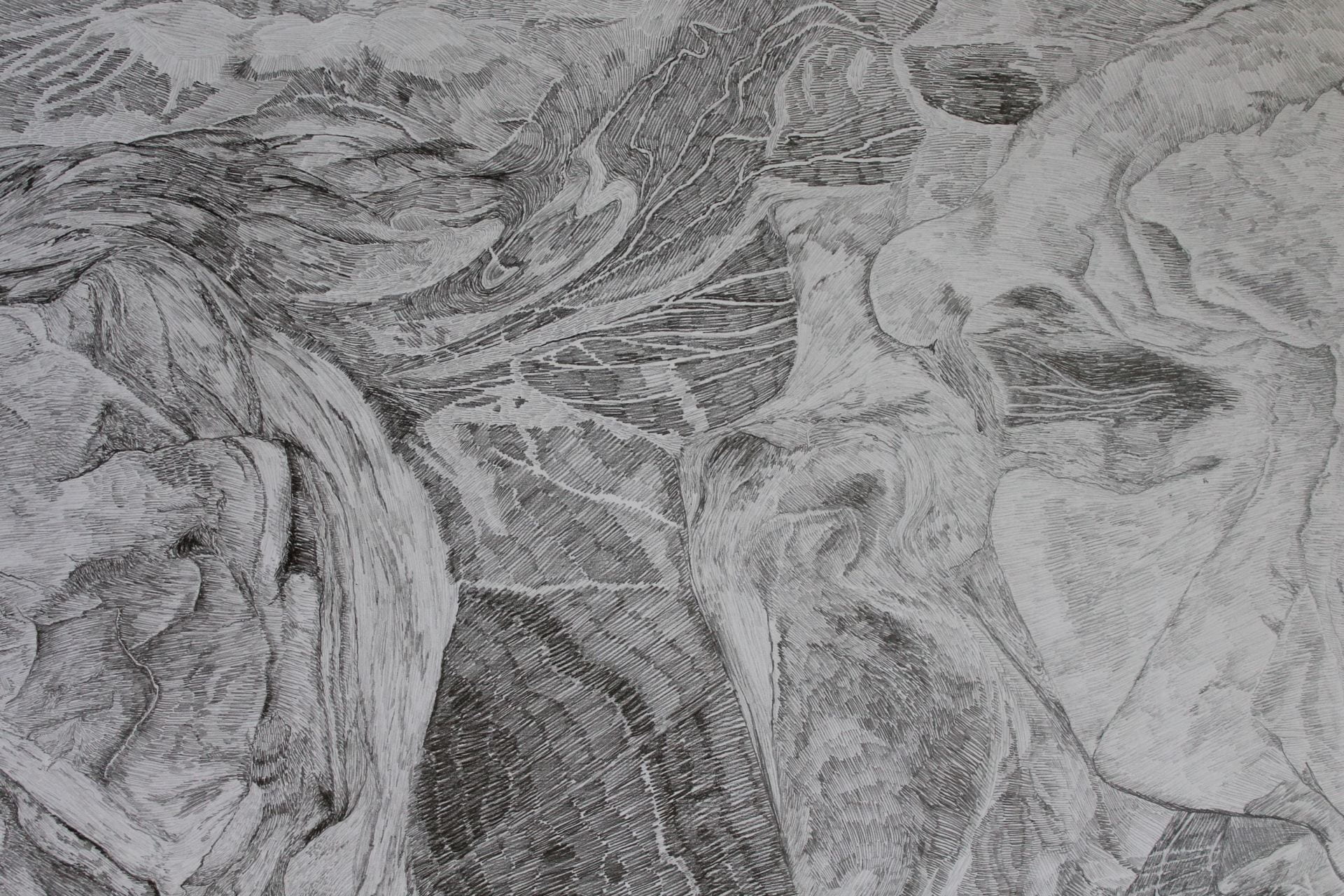
Considering free fall in relation to my work:
- association with height/looking down
- aerial perspectives (like we’ve been looking at through Steryl’s writing)
- I’ve been interested in aerial perspectives/maps (particularly on ‘landscapes’ but also the interaction with the man-made/growth) before
- was also looking at rocks and how to draw a viewer in/become ‘immersed’ in a small object
- rock landscapes
- looking down/falling down or even into
- rapid zooming in/details becoming larger and more exaggerated
- disorientating
- links to Bronwen’s piece/the text on getting lost
- I want people to get lost and wander through my drawings and therefore probe the surface of the rock – want to explore and delve further
- drawing people in to an uncontrollable/unknowable extent
Old work illustrating these ideas:


Quick photographic experiments playing around with the idea of miniature landscapes and free fall:


Feedback received in the session:
- registers of mark-making draws in the viewer in the rock landscape drawings
- it’s a pluralistic/complex surface
- ideas of territories and mapping
- look at historical associations of mapping – framing and categorising (see quote below)

- an ‘exploded microcosm‘ – playing with scale
- an act of fictionalising – creates moorlands and fields
- consider why the piece is black and white?
- artist Lygia Clark – work squeezing a plastic bag so a pebble rises and falls, a metaphor for breath, bringing tenderness/scrutiny and care – https://interartive.org/2012/09/the-therapeutic-art-of-lygia-clark/
- human knowledge falling away
- the book ‘Vibrant Matter’ by Jane Bennet may be of interest
- also Vija Celmins’ work, particularly the water drawings – the idea of enlarging, not just about reproducing a photo but about getting closer to the object
- ‘Writing Perceptions’ by Nicholas Chare: “In his essay ‘Art as Technique’, Victor Shkilovsky argues that art provides the remedy to habit in that in that it can make the familiar appear strange. He contends that “art exists that one may recover the sensation of life; it exists to make the stone stony. The purpose of art is to impart the sensation of things as they are perceived and not as they are known.” …writing about art can become artful… Can fulfil the purpose Shkilovsky ascribes to the work of art. Artful art history can make the familiar object of study strange, make the stone stony, so as to bring it back to perception. […]The materiality of things can only be returned to them through a writing that encourages deceleration, an extension of the length of perception, an attention to detail, even if this entails coming close to inertia.” (giving the inert object a voice, experiencing time with the stones)

 Anna Harris