Starting a new year of uni presents an opportunity for me to have somewhat of a fresh start. Lockdown and summer have put my art on pause, waiting to begin again but just never quite finding the right moment. I don’t want to entirely discard or move on from the work of the past year, but I do want to ensure that my work excites me and doesn’t start to stagnate after a prolonged period of studying similar ideas.
Many artists and thinkers use walking as a tool in their thinking process, as a way to get out of the house and refresh the mind. Feeling a slight lack of inspiration, away from my studio and spending the days sat in the same place for lectures, seminars and all things uni, I forced myself to go out exploring. I think it was important to me that I went somewhere I’d not been before, to give my eyes a chance to run through new landscapes and my mind a chance to wonder what was around the next corner.
There is a certain space given to the mind while walking: it wonders as the body wanders. I’ve long thought I need a way of recording the path it takes as usually any move to capture a fleeting thought shatters the web where it grew and what is written down appears odd and lifeless without its roots. If I could in some way record a stream of consciousness, perhaps through written word (but not on a phone – this always seems particularly lifeless) or even through recorded voice, this could be begin to solve the problem.
For this particular walk, as is my usual routine, it was only documented through photography. There was no pre-planned aim to this walk – I did not set out to find and photograph a particular landscape or object – if anything the main aim was to allow my mind some space to roam. However, a certain element of what I was thinking and drawn to must be captured through these photos so I thought it important to document them and give them some attention after the walk was completed.
While I was tempted to leave them in chronological order, as a kind of timeline or map of the journey, I have instead chosen to categorize/sort them to some extent. Looking back at the photos I noticed several themes running through the images which I have tried to highlight by gathering them into vague groups. The captions on each group of images should explain further what I felt I was drawn to with each one.
A solo person and a solo sailing boat amongst a vast landscape – reminiscent of Romantic landscapes, particularly Casper David Friedrich’s compositions. Not explicitly similar to any work I’ve done before – perhaps the human presence within the vastness of the landscape ties in with human instant in relation to deep time?
A different look at human presence within the landscape, also the presence of the artist/image maker in the image – a link to Velasquez’s Meninas (on my mind as featured in a recent lecture regarding the use of perspective and the positioning of the viewer in another body/position in space).
Peering through trees – I feel this links with the path series below – looking through/having something obscured and out of sight heightens a sense of intrigue? I looked at this a little last year with the study of exterior and interior but perhaps didn’t realise what I was doing so explicitly at the time so this could be good to harness in my sculpture work going forwards.
As mentioned above there is something intriguing about a path leading off into the unknown – I am aware these images could be considered a little cliche but I felt this realisation that this suggestion of the unknown/the invitation to explore further was important and something that I hope to use to my advantage going forwards.
Although we will come to a lot more rock pictures further down, I felt this particular formation was worthy of its own series – it shows such clear, distinct layers, and is made from two sections at such odds to one another that it felt particularly striking and significant. Looking at it I could not help but marvel at the geological undercurrents which clearly caused this to be created, and how explicitly you can see the varying layers and the sediments which fell so many years ago to form them.
This group is simply a collection of features in the landscape that intrigued me – there’s some unusually dark patches of grass, some rocks flung/found far up on a headland and some neat lines running through a field. The way a landscape holds clues to its own past has long since intrigued me and I suppose my previous intense study of rocks is a manifestation of this interest – there is a possibility here of branching this out to wider/other areas of interest.
This group shows rocks and water and the interaction between the two. Although rock comes with the association with deep time, water, too, has been around for deep timescales yet this is not it’s primary association. This is something I think could be intriguing to look at further, particularly exploring the difference in their materiality – the idea of flow would be a good starting point for this.
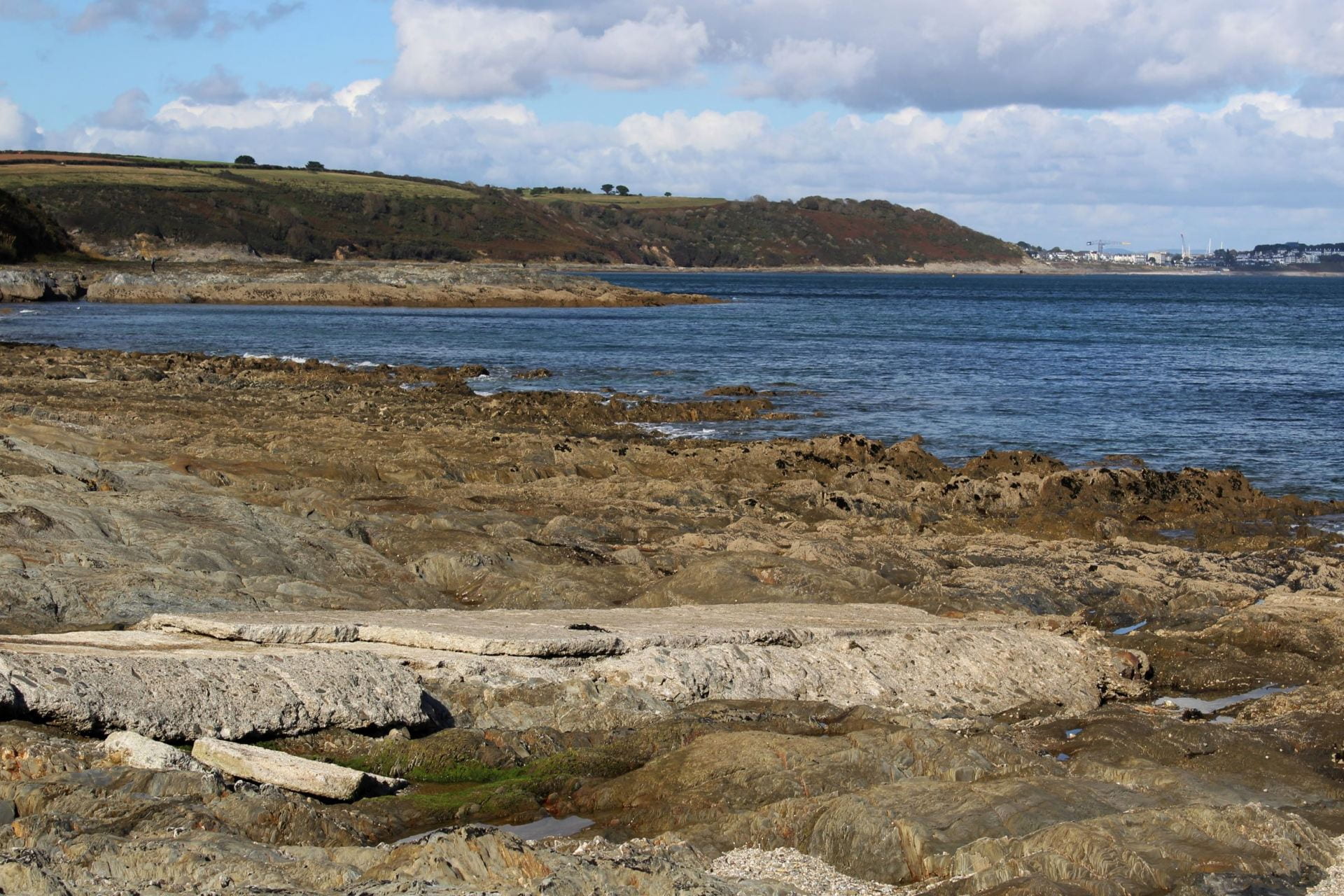
These images are rock more widely in the landscape, rather than close-ups or directly interacting with water. I’m less sure what these could be used for but as images they capture a certain structural quality of rock – the bones of the earth becoming exposed at the edge of the land before it falls away to the sea.
Rock close-ups – their patterns (particularly flow-like patterns) and their miniature landscapes – I’d like to use these to create more ‘rock landscape’ drawings, playing with scale. There’s also a few of a recently shattered stone which contains potential for some kind of stone carving/even performative piece – there’s something intrinsically exciting about revealing a new face of stone for the first time in thousands or millions of years.
Miscellaneous – compositions that for some reason grabbed my eye but don’t fit with other themes at the moment – I could have left these out but thought in the interest of openness to keep them – they could spark something in the future?


 Anna Harris