Below is a record of the works on show at both the Tremenheere Sculpture Gardens and the associated Tremenheere Gallery’s ‘New Landscape Paintings’ exhibition.

Richard Cook, By The Riverside 
Gareth Edwards, First Light 
Andrew Hardwick, Moor, Cloud, Shower 
Marie-Claire Hamon, Breathe 
Andrew Hardwick, Tor, Wind, Red Flag and Prohibited Zone 
Gareth Edwards, British Sea Light Series 
Richard Cook, My Aspens Dear 
Gareth Edwards, Arcadia 
Anthony Garratt, Oudeberg Veranda 
Marie-Claire Hamon, The Forager 
Andrew Hardwick, Dark Sea, Big Clouds 
Anthony Garratt, Sequoia 
Gareth Edwards, Searchin’ 
Gareth Edwards, Fallen From Heaven 
Gareth Edwards, Opening Credits 
Michael Porter, Death of Nature 
Michael Porter, Death of Nature (detail) 
Michael Porter, Death of Nature (detail)
For now my focus is not on the paintings, although I do think there is much to be unpicked here at a later date if and when it becomes more relevant to my work. There is an interesting sense of immersion in some of the paintings which is something I have looked at a little, and the link between material and landscape is also loosely explored: both ideas I could come back to at some point.

Sheila Williams, Winter Heliotrope 
Samuel Bassett, Lost Karensa 
Caroline Winn, Lunch on the Grass (after Manet) 
Kishio Suga, Untitled 
Richard Long, Tremenheere Line 
Sheila Williams and Patrick Cousins, Like It or Lump It 
Tim Shaw, Minotaur 
Kishio Suga, Untitled 
Matt Chivers, Hybrid 
Vong Phaophanit, Field of Rods 
Tom Leaper, Lieutenant Silver 

Ken Gill, Skhizma 
Tony Lattimer, Companion 
Richard Woods, Holiday Home 

Richard Marsh, Untitled 
Suzanne North, Living Rock 
Michael Johnson, Wall of Taps 
Peter Randall-Page, Slip of the Lip 
David Nash, Black Mound 
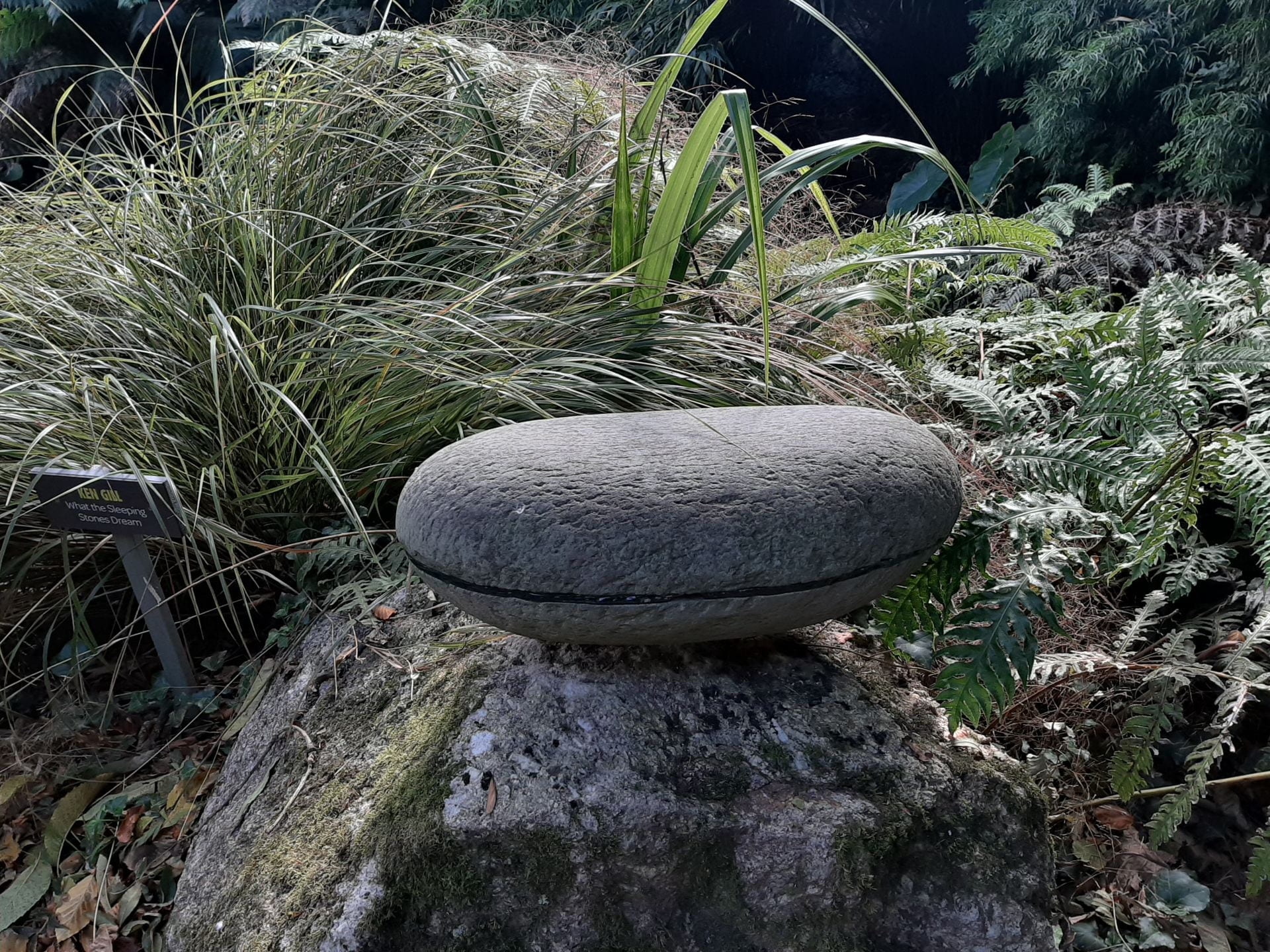
Ken Gill, What the Sleeping Stones Dream
Further research on the artists/sculptures that particularly stood out to me:
Peter Randall-Page
Artist website, including these videos:
- ‘the study of natural phenomena and its subjective impact on our emotions’
- ‘underlying principles determining growth and the forms it produces’
- ‘geometry is the theme on which nature plays her infinite variations, and can be seen as a kind of pattern book on which the most complex and sophisticated structures are based’
- a primitive mode of communication – making something and showing it to someone
- combining a random element (e.g. the shape of a boulder – used as both the material and the muse) and a structural/geometric element (taking a line for a walk? or applying a pattern)
- ‘play in the no man’s land between order and chaos’
- ‘in order to play one needs a playground and a set of rules’
- rules often taken from nature
- idea of shells/carapaces
- sequence – in order to have variation you need sequence/comparisons
- spontaneous pattern formation combined with natural variation = infinite variety
- what makes us react more to some than others?
- improvisation on a theme
- ‘the way in which pattern and surface implies internal dynamics to a stone’
- ‘pure geometry only exists in our imagination’ – always ‘imperfections’
- explores themes and patterns that underpin the natural world from the macro to the micro
- applying geometric patterns to randomly formed objects – slows the eye down, explores the increments of the form
Mat Chivers
- life as we know it is entirely carbon-based – as a result he creates many of his pieces from carbon, interchanging between right and left hand to explore and utilise all aspects of the brain/consciousness
- ‘we have always shaped the world with our hands as and a result it has shaped us back’
- for the first time we’re considering how consciousness may no longer be carbon based with the arrival of AI
- questions of authorship/individuality/sentience
- ‘what is it about being human that we value?’
- bringing emotion into data
- idea of cloud and stone being opposite – playing with ideas of ephemerality – also breath carved in stone (?) (link to Giuseppe Penone here – his breath sculptures are inwards however)
Ken Gill
http://kengill.co.uk/index.php/homepage
- fissure in the rock – represents a unique moment in time when a rock cracks – a unique combination of forces and pressures
- Skhizma (crack/separation) aims to recreate that force/put some light into the rock/make room for another dimension, highlighting a moment in time
- titles of his other works: Deep Time Latent, Accounting for Stones, What the Sleeping Stones Dream, Mineral Shadows, The Phantom Stone Circle
- unfortunately I can’t find much information on Gill’s work but by the names of the pieces alone it is clear that his work explores similar themes to mine, at the very least through the exploration of stone
David Nash
- “With wood sculpture one tends to see ‘wood’, a warm familiar material, before reading the form: wood first, form second. Charring radically changes this experience. The surface is transformed from a vegetable to a mineral – carbon – and one sees the form before the material.”
- Wooden Boulder – an ‘ongoing sculpture’ describing an object moving through the world – an association to object-related storytelling that I could use here? Or I could release my own fake rocks into the world?
- a new meaning to time-based work
- ‘an engagement not only with the elements, but also with the dimensions – space and time’
- ‘I was looking for a way of working in which the material would lead me, rather than my dominating it.’
- After all, what they are doing is taking a bit of material stuff – stone, metal, wood – and changing it so that it is interestingly different. ‘Sculptures need to be animated in some way,’ Nash feels. ‘They have to go outside the normal time you are in yourself; in some way they have to have something a bit extra about them as an object, to make them. Balance is one of the things that may do that, making something appear to be off-balance.’
- a concern for the four elements: earth, air, fire, water
- his works shape living trees – can I shape ‘living’ rock?!
The presentation of the sculptures within the natural surroundings of the park is also something to be noticed; art behaves very differently when placed in a dynamic environment like this rather than in the sterile ‘white cube’ space. This is something I’d like to explore further with my own work; how I present it and how it can interact with, or even be situated in, a certain location or environment.

 Anna Harris