Thinking about the idea of grief and mourning in relation to the theme Dust and Debris bring a broken object, piece of debris (or some dust) to this week’s research group session that you would be happy to talk about.
- I’m not a particularly sentimental person in that I don’t hoard/collect my own stuff but I do gather more anonymous items that provoke the imagination – objects that look curious, that appear to have traveled or have lived a life – objects that ‘tell tales of time‘ (from the Dream Narratives of Debris reading)
- E.g. old bottle, the objects in my studio space
- Alternately, considering my practice and looking at rock, sand is the most literal dust in those terms – an idea of a timescale/lifespan is provoked – here are ‘rocks’ further down the line – what once seemed immovable has been reduced to ‘dust’
- Link to a sand-timer, time trickling away and accumulating at the bottom (careful of cliché)
Why do we hold onto broken objects and collect debris with no significant material value?
- The stories they suggest, the narratives they create – they ‘tell tales of time’
- No direct reference to loss, grief or mourning in my work but a sense of time passing, particularly deep time scales in comparison to the human instant
Think about and discuss what you leave out of your practice, the fragments, the scraps the waste.
- The debris in my studio – never know what to do with it, how to bring out what is already there – could do a descriptive writing piece, like that in the text – even just exhibiting it, placing it in focus
- Old remains of casts – this idea of absence/negatives/voids
Above are the brief notes I made in preparation for the seminar, roughly answering each of the questions and making an outline for what I was to talk about. I decided to bring three options to the group to allow a discussion about which would be the best object to choose. As mentioned above, I chose to bring some sand as a literal ‘dust’ in terms of rock, a kind of geological dust. It has a certain specificity to it; it is a literal, elemental makeup of a particular area of space at a particular time. In the seminar we discussed how different beaches would result in different qualities of sand, and also an equivalence with deep time and of looking back in time that was contained within the grains.


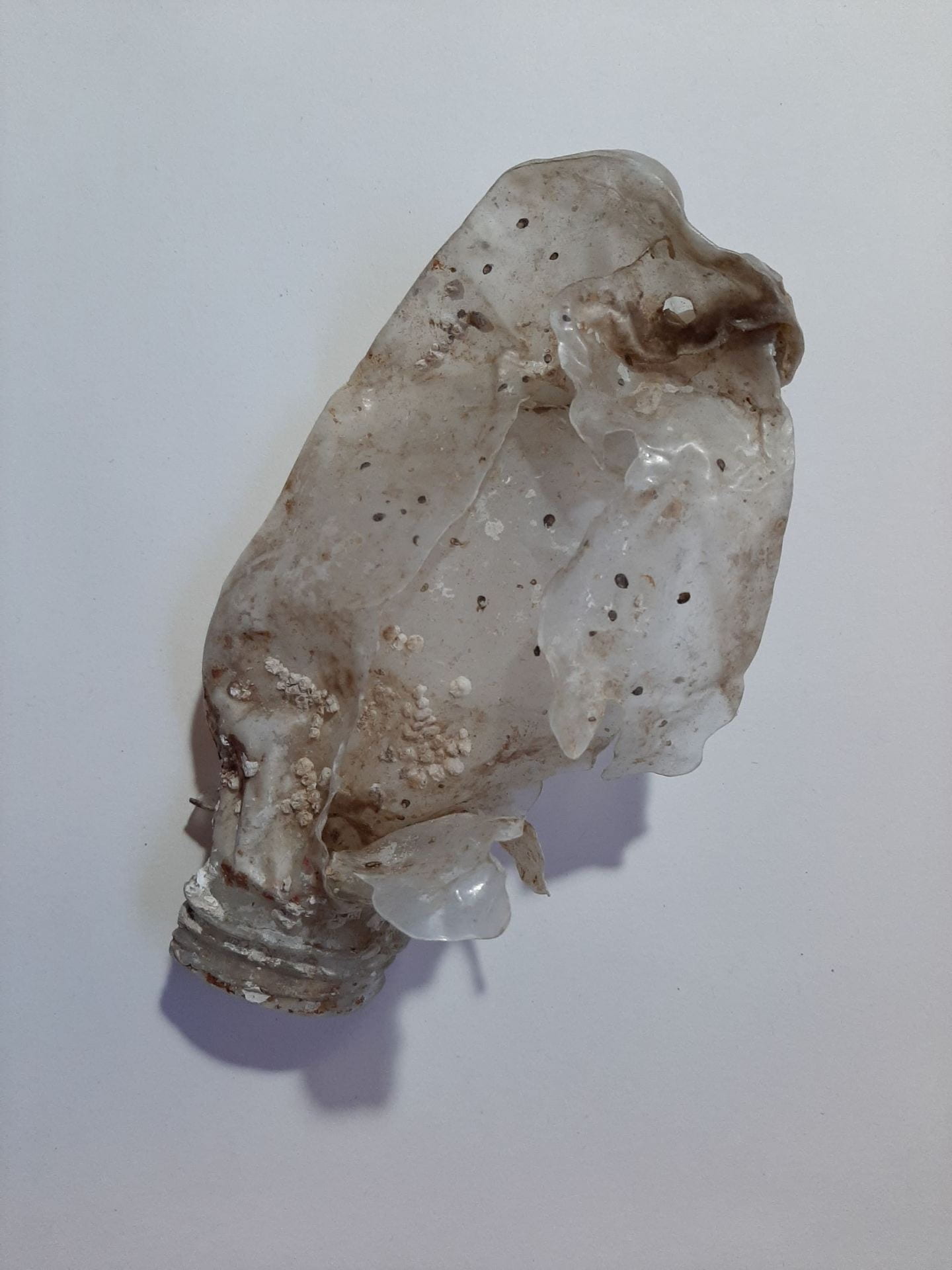
The other two objects were both chosen from the debris that accumulates in my studio. I have many scavenged objects that are curious to me and yet I have not yet found a use for, so remain piling up on my table waiting for a time, such as this, where they may become useful. The object I selected was an old, mangled plastic bottle found on the beach, in itself the very definition of ‘debris’. I was drawn to its obvious marks of age and of a story; it is hugely weathered, covered in barnacles and heavily mangled so must have encountered some intense force and been travelling for some time. In the seminar we spoke about the idea of a new geological era of plastic that the bottle represents and selected it as the object we would be using for the group’s selection (the result of which can be found here).

studio debris 
studio debris 
My last selection, also from the debris on my studio table, was an old mold from casting a rock. I’d kept it out of a similar unidentified intrigue into the object, but technically speaking it is debris – an off-cast from the casting process. However, when considering the loss, grief and mourning that was outlined in the brief and their relation to my own work, I found the idea of a loss, an absence or a void an intriguing link to the mold, and to some other work I have been creating recently. The mold outlines something that is no longer there, a kind of negative space or inverting of matter.

mold 
other recent work around idea of void/absence 
other recent work around idea of void/absence

 Anna Harris