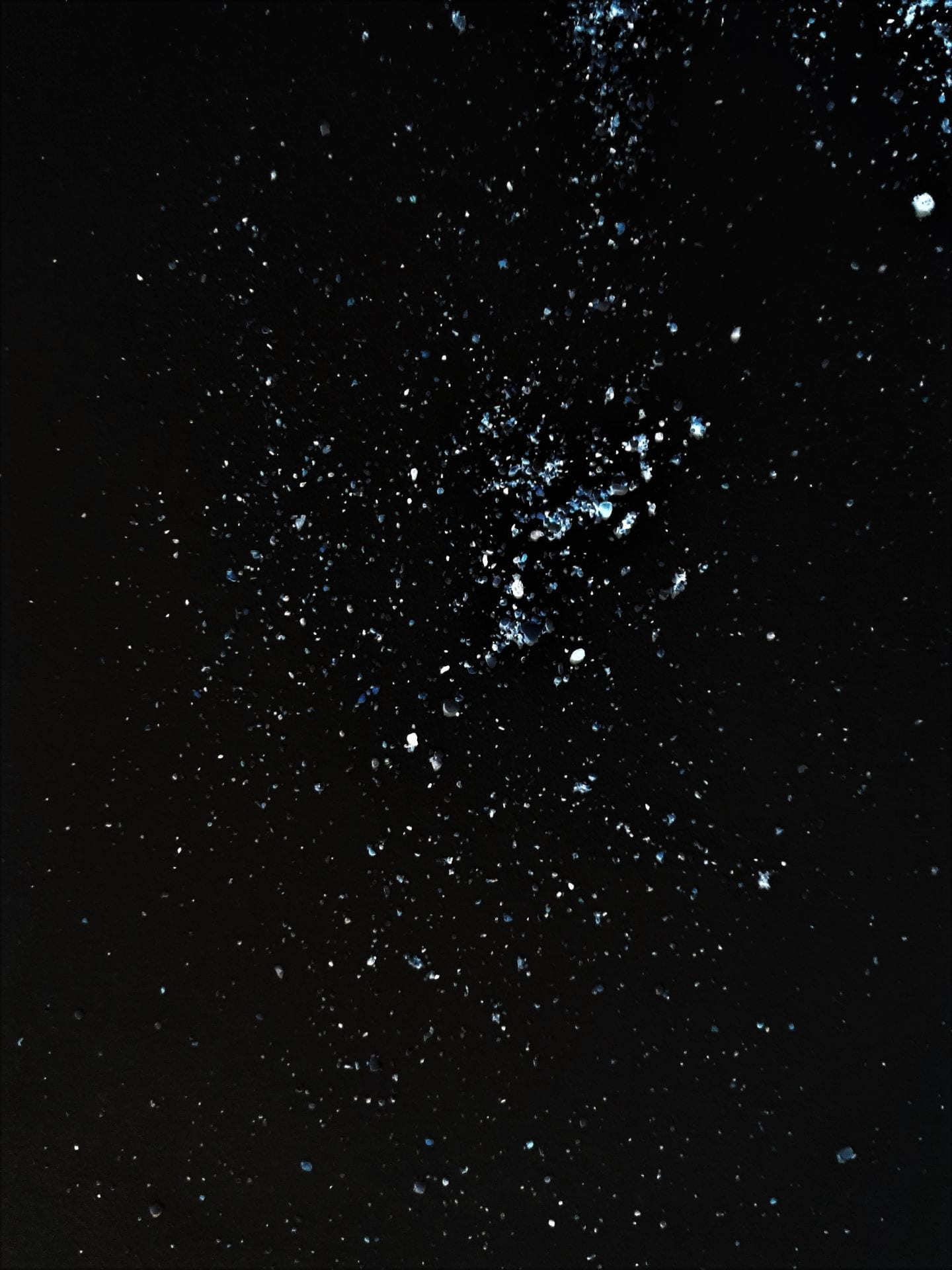
These images were made, almost by chance, through the photographing and inverting of scattered sand grains in preparation for the week 8 dust and debris seminar. I was playing around with how best to photograph the sand and, as I have just been studying Vija Celmins for the Mediascape essay, perhaps drew the link between these photos and some of Celmins’ later work (see below).


This then led me to invert the images, almost tracing Celmins’ career progression back through the years, from her later reversed galaxies to the originals where she began:


As it so happened, as we were talking about sand, an equivalence was drawn between looking at sand grains, bearing witness to past processes that have shaped what we’re seeing, and looking at stars – there’s a similar sense of looking back in time. This came up from looking at the normal images (not inverted) and I can’t help but feel the inversion plays on this idea, bringing forward the illusion of constellations, and therefore back in time.
As well as Celmins’ work I also feel this links to Cornelia Parker’s work and Haegue Yang’s current exhibition at Tate St Ives. Parker’s piece Neither From Nor Towards is almost a gathering of large-scale sand grains, a collection/accumulation of pieces that have been subject to tidal forces and currents and have traveled and been worn down in much the same way as sand. There are similar ideas of time and process wrapped up in this piece and my sand grain galaxies, as well as potentially materials with associated stories.

In relation to Yang’s exhibition I developed one of the pieces a little further and wrote an accompanying statement to be submitted for display at the Tate Collective Producer’s show in response to specifically Yang’s Non-Linear and Non-Periodic Dynamics:

When writing my accompanying statement I made a quick list of the similarities and links I could see between her work and my own piece:
- Cornish sand – link to Yang’s use of place (personal link of collecting on a walk but not sure if this links/whether to include?)
- Sand is created as a result of natural entropy/natural chaotic processes
- Scattered in a random arrangement (links of playful/movement to Yang’s work)
- The inverting gives it a cosmic feel – flips it back round from micro scale to macro – what is our place amongst the chaos?
- Use your imagination – find your place amongst the chaos – they could be dust particles floating through the air?
- The power/magnitude/vastness of the universe
- Everything is a continual process – this holds ideas of the ongoing movement of the universe
- Sand as geological dust
- An element of looking back in time, into deep time (perhaps not relevant here with link to chaos?)
- The material/elemental makeup of the universe
- Yang looks at meteorological effects – the interaction between small scale and large scale
- Unpredictability of nature
- Her chaos wall contains waves and rocks – mine is an indirect reference to this – sand implies a history of rocks+waves
- Her lacquer pieces are a literal record of climate and environment, just as these pieces of sand are records of a Cornish beach and deep time processes
In the interests of keeping the statement succinct I chose not to spell out every link but instead emphasise the most important ones. The resulting statement reads as follows:
My response to Haegue Yang’s Non-Linear and Non-Periodic Dynamics is an inverted image of sand grains that have been collected from local Cornish beaches. Sand is a material remain of hundreds of thousands of years of natural chaotic processes, of waves violently smashing against rocks – imagery that Yang has used throughout the wall. The inversion of colour creates an image that is ambiguous in scale, referring to Yang’s interest in the butterfly effect (the idea that miniscule changes in one location can lead to unpredictable, large-scale effects elsewhere). This ambiguity creates a confusion, or even connection, between the macro and the micro, and leads us to question where on this scale we see ourselves; where do we place ourselves among the chaos?


 Anna Harris