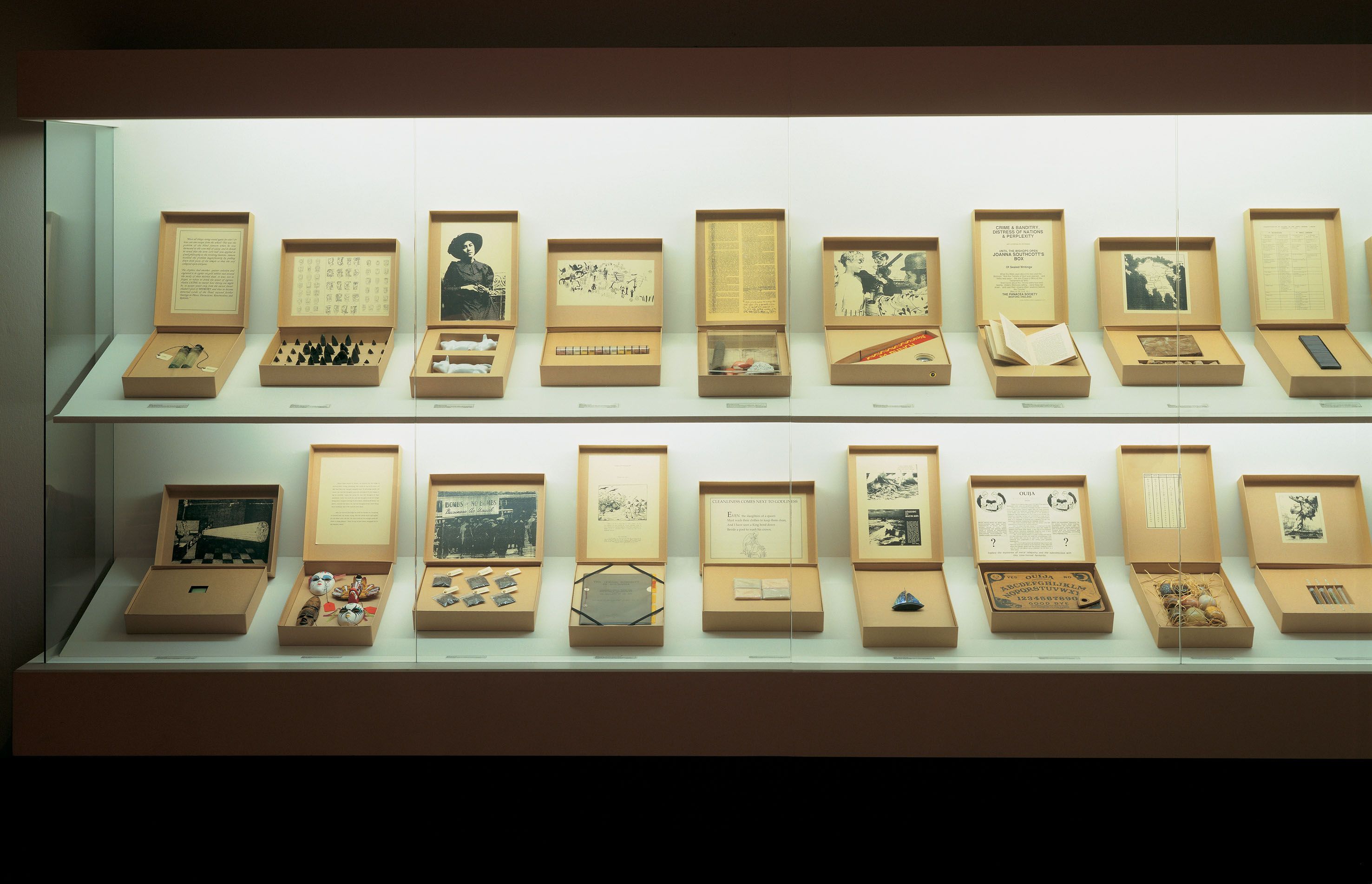
- ‘Each box is numbered and labelled in subversive imitation of ethnographic and museological conventions of description and display, commenting on rather than describing their contents, complicating their meaning and often trumping expectations.’
- Could do a very similar thing with my collections – try exercise such as posing the question ‘what story do these items tell when put together?’, ‘if this was all that was found to tell the story of humanity what might be deduced?’ etc
- This artwork goes some way to answering the question of what to do with found objects that you don’t know how to build on/add to yourself – also links to mark dion’s thames dig (**need to look at this**)
- The piece seems to intertwine hiller’s own life, work and belongings with that of freud’s – an interesting way of doing things, especially when compared with my own work – I don’t tend to see myself as much of the narrative when I collect items but ultimately I am the deciding factor on what is collected and what isn’t, and this should be acknowledged
- Susan Hiller: ‘Freud’s impressive collection of art and artefacts can be seen as an archive of the version of civilisation’s heritage he was claiming; my collection is more like an index to some of the sites of conflict and disruption that complicate any such notion of heritage. My collection offers some indigenous symbols and references that position me – and maybe you – as outsiders who don’t understand things that make perfect sense to others.’
- ‘The artist’s book After the Freud Museum experiments with the format of the book as ‘a place where an artist works’’
- ‘Hiller’s eccentric deployment of the superficial formalities of the archive provide the means for rethinking the organisation and transmission of knowledge and memory. In this sense, Hiller’s work displays affinities with French contemporary artist Christian Boltanski’s collections of data and material traces that simultaneously reveal and obfuscate their contents.’
- ‘Reviewing it in the Guardian in 2000, critic Jonathan Jones remarked upon the artist’s background as a research student in anthropology and her persistent attention to ‘the unconscious of our culture, the margins of the collective psyche’’ – I like the link of the unconscious as the retaining traces, this links to the analogy of the psychic pad traces as the unconscious – the material remnants, all but forgotten, but remaining and telling tales in doing so – also links to Rebecca Solnit quote of ‘material objects witness everything and say nothing’
- ‘Hiller’s collection, with its functional specimen boxes and its array of shards and fragments summons a potent psychoanalytic metaphor: the plumbing of the human mind as an act of archaeology, an excavation of the unconscious where nothing is lost and everything is conceivably waiting to be disinterred’
- (definition of art by Eric Fernie as ‘a branch of philosophy practiced with materials and with objects’)
- ‘More rebellious than what art historian Eric Fernie has termed ‘a branch of philosophy practised with materials and objects’,24 the definition of art implicit in From the Freud Museum highlights, questions and upsets the tacit assumptions of the academic settings from which Hiller consciously retreated. Rather than an artist informed by anthropology, she is a cultural producer who chose art over academic practice, for reasons that are elaborately and repeatedly articulated in her artworks and her words.’
Labels of all fifty boxes here: https://www.tate.org.uk/research/publications/in-focus/from-the-freud-museum-susan-hiller/from-the-freud-museum/fifty-box-labels

 Anna Harris